


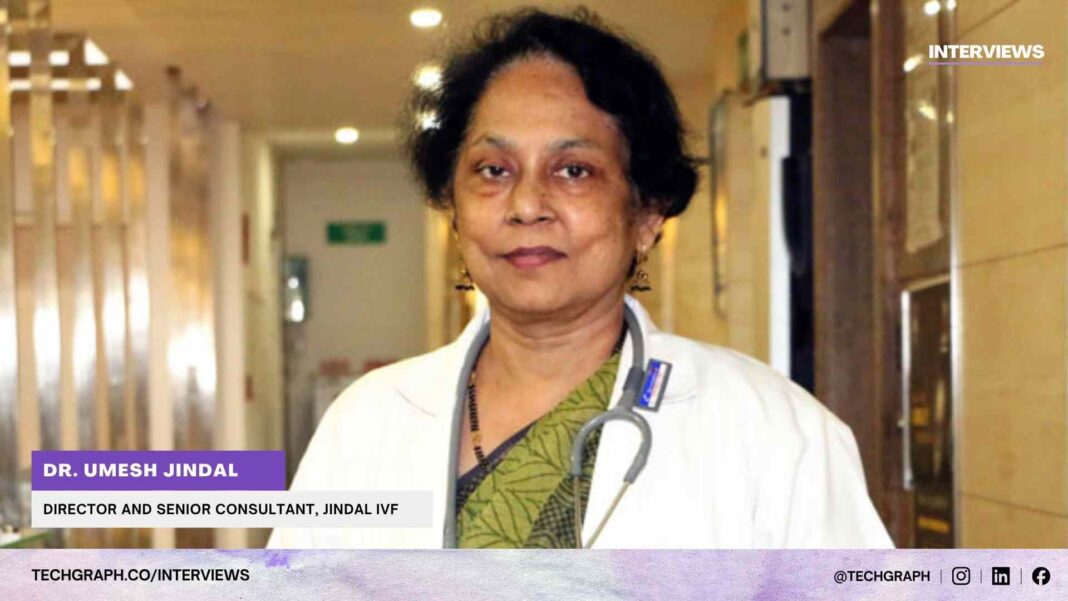
Speaking with TechGraph, Dr. Umesh Jindal, Director and Senior Consultant at Jindal IVF, discussed how genetics and precision diagnostics are shifting IVF from focusing only on conception to prioritising healthier outcomes, as tools such as PGT-M, PGT-SR, and PGT-HLA enable earlier detection of chromosomal abnormalities and hereditary disorders, helping clinics deliver safer and more consistent results for families seeking informed fertility care in India.
She also spoke about Jindal IVF’s approach to integrating emerging technologies by combining ethical counselling, transparent communication of success rates, and strict compliance with evolving ART guidelines to ensure that AI-assisted embryo assessment and personalised stimulation protocols strengthen patient trust while supporting more efficient, patient-centric fertility care.

Read the interview in detail:
TechGraph: Jindal IVF has been at the forefront of assisted reproductive technologies for over three decades. How has the integration of medical genetics transformed infertility treatment compared to the early years of IVF in India?
Dr. Umesh Jindal: Over the years, genetics has completely reshaped how we look at infertility. Earlier, IVF was mainly about achieving pregnancy, but today it is about ensuring that pregnancy leads to a healthy baby. With advances like preimplantation genetic testing, we can now identify chromosomal abnormalities or hereditary disorders before conception.
At our centre, we use tools such as PGT-M, PGT-HLA, and PGT-SR to help couples who may carry genetic conditions like thalassemia, cystic fibrosis, and chromosomal structural rearrangements conceive safely. It has made treatment far more personalised and precise, improving success rates and giving families greater reassurance.
We are able to answer the question, “Is my baby going to be normal?”. What I find most meaningful is how genetics has brought depth and direction to reproductive medicine. It allows us to move beyond just treatment towards prevention and healthier outcomes, making every journey not only about conception but also about the quality and safety of life that follows.
TechGraph: With rapid advances in preimplantation genetic testing and screening, what ethical considerations do you find most pressing when guiding couples through these decisions?
Dr. Umesh Jindal: At Jindal IVF, we prioritise guiding couples through preimplantation genetic testing with a focus on empathy and clarity. We ensure they understand the medical benefits, limitations, and emotional implications of every choice without feeling directed in any way. Protecting sensitive genetic information and maintaining privacy is non-negotiable, and we strictly avoid any selection beyond medical necessity. Cultural and societal pressures are carefully acknowledged, helping couples make decisions that align with their values.
Accessibility and affordability are also key considerations, so that advanced testing does not become a barrier. Bringing together embryologists, geneticists, and counsellors provides a balanced, multidisciplinary perspective. Our aim is to empower couples with knowledge, ethical guidance, and emotional support, enabling them to navigate complex decisions confidently and responsibly while keeping patient wellbeing at the heart of every conversation.
TechGraph: The regulatory environment around ART in India has been evolving. How have these changes shaped clinical practices at centers like Jindal IVF, and what further reforms would you like to see to support both innovation and patient safety?
Dr. Umesh Jindal: The evolution of India’s regulatory landscape for ART has significantly influenced clinical practices. at centers like ours. The introduction of the Assisted Reproductive Technology (Regulation) Act, 2021, has established a structured framework mandating clinic registration, ethical conduct, and adherence to standardized protocols. This has led to improved transparency, accountability, and patient trust.
However, challenges persist, such as high registration fees and the need for more robust enforcement mechanisms. To further enhance the sector, we advocate for the establishment of a national ART registry for data collection, mandatory continuous medical education for fertility specialists, and uniform guidelines for consent and embryo handling.
Additionally, integrating ART into public health insurance schemes could make treatments more accessible to underserved populations. These reforms would not only bolster patient safety but also foster innovation and ethical practices across the industry.
TechGraph: As global guidelines for reproductive genetics continue to develop, how does Jindal IVF ensure that its program remains aligned with international best practices while addressing the unique realities of patients in India?
Dr. Umesh Jindal: At Jindal IVF, we continuously align our reproductive genetics program with international standards while tailoring care to the unique medical, social, and cultural context of patients in India.
Our protocols incorporate globally recognised techniques such as PGT-HLA, PGT-SR, and advanced embryo screening, ensuring scientific rigor and safety. At the same time, we adapt counselling, cost structures, and treatment plans to reflect local realities, including family dynamics, societal expectations, and accessibility constraints. Ongoing training and collaboration with international experts, along with active participation in global fertility forums, allow our team to stay updated on emerging guidelines and innovations.
What sets us apart is integrating these standards into patient-centric workflows, ensuring every decision is ethically sound, culturally sensitive, and medically precise, so that families receive world-class reproductive care without compromising relevance or compassion for the local context.
TechGraph: Conversations about transparency in fertility treatments are gaining momentum, particularly around success rates and emerging technologies. What are the steps Jindal IVF is taking to build trust with patients and the wider public?
Dr. Umesh Jindal: Building trust with patients and the public begins with complete transparency around success rates, treatment protocols, and costs, ensuring there are no hidden charges or unrealistic promises. Each couple is provided personalised counselling that clearly explains medical options, expected outcomes, and the reasoning behind every step, helping them make informed decisions with confidence.
Our NABH ICMR and ISAR- accredited lab reinforces quality and safety, while community engagement and awareness initiatives help address misconceptions and social stigma around fertility treatments. Open communication, ethical practice, and consistent clinical outcomes create lasting relationships with patients and referring doctors.
Clear information regarding embryo status in the lab is a very important aspect of transparency, which we always follow. Combining scientific rigor with empathy allows families to feel supported throughout their journey, making assisted reproductive care not only accessible but also a trusted and empowering path to parenthood.
TechGraph: With more individuals opting for fertility preservation and delayed parenthood, how has the role of genetics evolved in managing long-term reproductive health and family planning?
Dr. Umesh Jindal: Genetics has become central to long-term reproductive health as more individuals choose fertility preservation and delay parenthood. It allows us to assess ovarian reserve, screen for hereditary conditions, and offer preimplantation genetic testing to reduce the risk of passing on genetic disorders.
This proactive approach helps couples make informed decisions about when and how to conceive, aligning biological readiness with personal and professional timelines. At our centre, integrating genetics into fertility planning ensures that egg or sperm freezing is not just about preserving gametes but also about preserving health and optimising outcomes for future pregnancies.
Couples gain clarity on potential risks, treatment options, and expected success rates, which reduces emotional and financial stress. Genetics has shifted reproductive care from reactive interventions to a forward-looking, precision-driven strategy, empowering families to plan parenthood confidently while safeguarding the health of the next generation.
TechGraph: Looking ahead, which developments in reproductive genetics and IVF excite you most, and how do you see them reshaping how families are built in the next decade?
Dr. Umesh Jindal: The most exciting developments lie in the convergence of advanced genetic screening, AI-driven embryo assessment, and personalised IVF protocols. Techniques like preimplantation genetic testing are becoming more precise, allowing us to prevent hereditary conditions and improve implantation success.
AI-assisted embryo selection enhances decision-making, reducing the number of cycles needed and making the process less emotionally and financially taxing. Coupled with fertility preservation and tailored stimulation protocols, these advancements enable families to plan parenthood on their own terms, whether delaying pregnancy for personal reasons or navigating complex medical scenarios.
Over the next decade, I see these technologies making reproductive care more predictive, efficient, and patient-centric. Families will benefit from safer, higher success journeys with informed choices at every step, transforming IVF from a reactive treatment into a proactive tool for building healthy, empowered families while minimising uncertainty and stress along the way.