


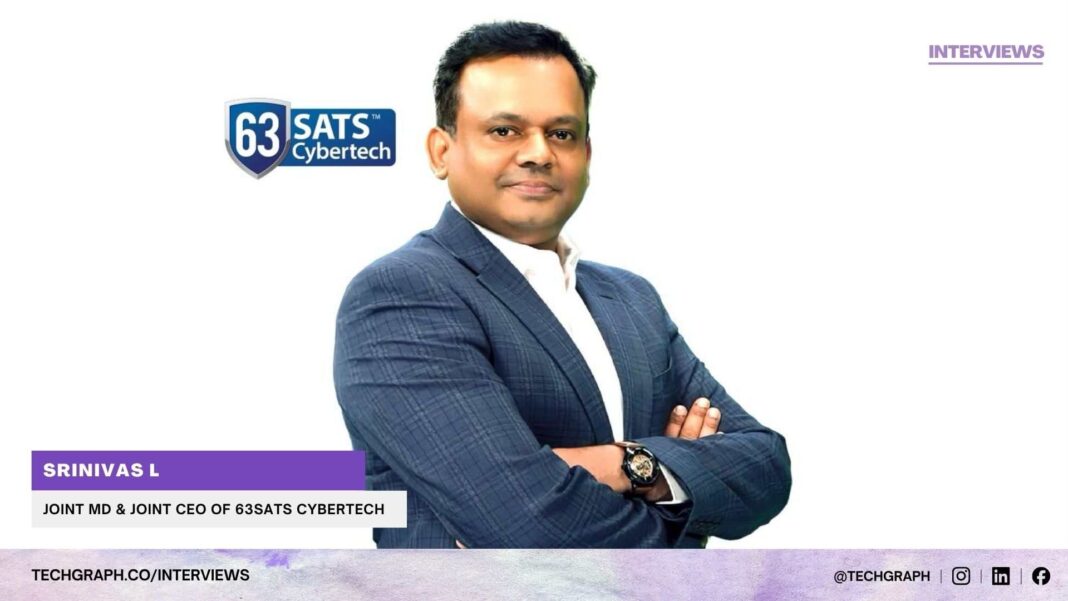
In an interaction with TechGraph, Srinivas L, Joint Managing Director and Joint CEO of 63SATS Cybertech, outlined how the surge in digital payments, online commerce, and mobile-first financial activity has exposed everyday users to increasingly sophisticated online scams and AI fraud, and how the company’s CYBX platform is delivering accessible, India-built protection that raises awareness and safeguards personal data across rapidly expanding digital ecosystems.
Srinivas also spoke about how CYBX’s AI-led defense model blends predictive analytics and user behavior insights with continuous human oversight to help users defend against AI-driven scams, regional attack patterns, and privacy breaches without disrupting the ease and convenience of everyday smartphone use.

Read the interview in detail:
TechGraph: Cybersecurity has traditionally focused on enterprises and governments, but the everyday internet user is now facing the same risks, from phishing to fraud. Do you believe this marks the beginning of a new era where consumer cybersecurity will stand as a full-fledged sector in its own right?
Srinivas L: I believe that consumer cybersecurity has always been a sector that needs to be classified as essential or even critical. While enterprises and governments have been at the forefront of cyber threats, everyday mobile and internet users have been equally exposed to threats in their daily lives. Studies suggest that post-pandemic, the digital adoption for making payments online, internet banking, and investment applications has exponentially increased. People started relying more on online and e-commerce platforms for shopping and even grocery purchasing. This rise in digital finance eventually led to more scams, breaches, and frauds.
From phishing attacks to OTP scams to call leaks, users have been exposed to rapidly changing and behavior-targeted scams. As per the 2024 data published by DATALeads, India took a loss of INR 22,842 crores to cybercriminals in 2024. The Indian Cybercrime Coordination Centre also predicts that in 2025 India will witness the loss of INR 1.2 Lakh Crore to cybercrime. The Mobile, IoT, and OT Threat Report published by Zscaler ThreatLabz suggests that India has been the leading target of mobile malware attacks. These aren’t just numbers but a stark reality where baits have been placed to trap mobile users.
Consumer cybersecurity is no longer to be overlooked; it is emerging as a sector of immense importance. It has the growth potential to create a cyber-aware India and help protect individuals’ digital lives.
TechGraph: The digital threat landscape looks very different from one region to another. Some countries deal with a flood of spam calls and harmful links, while others face a higher risk of phishing or identity theft. How can a consumer-focused app like CYBX by 63SATS Cybertech adapt to these local differences while also building a unified global identity?
Srinivas L: As mentioned above, India led the target for mobile malware attacks, but there have been studies that suggest that regions like Brazil and Africa have been more prone to threats related to spam calls. While some regions may be more prone to phishing attacks, others may see a surge in spam calls.
As per the Data Security Council of India (2025), Telangana recorded the highest number of cyberattacks in the country. Tamil Nadu ranked second, emerging as one of the most attacked states with high malware detections. What is scary here is that these cybercriminals have also been analyzing and strategizing attacks based on regional data. It is thus necessary to address this issue with a layered approach: a robust national foundation.
When we speak of a robust national foundation, CYBX mirrors the need for an India-built cybersecurity solution for India. Union IT Minister Ashwini Vaishnaw recently announced his switch to Zoho’s suite of productivity tools, urging citizens to embrace “Swadeshi” platforms and support India’s tech ecosystem, a move seen as a strong endorsement of the Aatmanirbhar Bharat mission, highlighting the importance of adopting locally trusted and secure digital solutions like CYBX.
CYBX ensures consistent protection with features that offer 360-degree solutions. Users throughout India receive the same trusted and seamless experiences, with defenses against scams that they are most likely to encounter in their digital lives.
TechGraph: Many people underestimate their risk until they have already experienced a scam or a breach. What, in your view, is the most effective way to close this gap and encourage individuals to see tools like CYBX as part of their daily digital routine rather than something they turn to only after a problem?
Srinivas L: When building CYBX, we knew that we would not be addressing consumer habits alone, but also the mindset. Most people believe that such scams will not happen to them. They hear about it on TV; they see it happening around them, but continue to think that it will never happen to them. Many of them tend to act after the scam or breach takes place. As per the Ministry of Home Affairs’ (MHA) report to the Rajya Sabha, the number of cybercrimes reported jumped over 401 percent, leading to cybercrime reports exceeding 22 lakhs in 2024.
CYBX is focused on seamless integration into the daily digital lives of Indian mobile users. We believe that protection must be convenient to a point that it should exist in the background of our digital lives, always alerting us to breaches. By creating awareness and making cybersecurity habitual, similar to our habit of wearing seatbelts while driving, people will see CYBX as an essential tool.
We are not here to overwhelm people but to help them understand the risks of identity theft, malware and phishing attacks, and insecure calling. Unfortunately, many only realize the consequences after falling victim to an attack. CYBX is here to be there for that one day to protect you against your mobile cybertheft losses! CYBX has introduced India’s first mobile cybersecurity insurance coverage of up to INR 10 Lakhs. The Ministry of Home Affairs (MHA) has estimated that in 2025, within the first 5 months, Indians have lost over INR 7000 Crore to online scams. That’s a huge number! CYBX’s insurance coverage is here to protect you against such loss of money with multiple insurance coverage options and features.
TechGraph: Scammers are now using artificial intelligence to design highly convincing frauds, from deepfake voices to AI-generated phishing attempts. How does CYBX prepare for this new wave of AI-driven threats, and do you see it eventually evolving into a more intelligent digital companion that can adapt in real time rather than relying only on fixed defenses?
Srinivas L: Artificial intelligence is on the rise. It has transformed our digital lives but is now also transforming threats and scams. According to the State of AI-Powered Cybercrime: Threat & Mitigation Report 2025, AI is behind about 82.6% of phishing emails, nearly eight out of 10 campaigns. It’s not just used for email text but also to generate realistic dashboards, typosquatting domains, and interactive phishing pages, making attacks convincing.
As much as individuals are benefiting from AI, scammers are too by using deepfake voices and bait phishing. CYBX is here to challenge these arising problems, providing solutions such as real-time threat detection and anticipating potential attacks on your devices. The entire aim for CYBX is to build a user model that learns from user patterns, analyzes risks, and protects users as a digital companion.
TechGraph: One of the recurring challenges with consumer security tools is finding the right balance. If they are too complex, people abandon them, but if they are too simple, the protection feels incomplete. How are you ensuring that CYBX finds this middle ground, delivering strong defense while still feeling effortless to use?
Srinivas L: As mentioned above, CYBX is not here to overwhelm users but to create a seamless experience. Users have to be able to understand and navigate around the features and tools we are providing. To us, usability and accessibility remain critical. We understand how security tools or complex interfaces may create discouragement and how completely simple tools can make security feel inadequate.
Thus, CYBX is created with the balance of a strong enterprise-grade defense with effortless interfaces. We have been testing, understanding, and applying appropriate changes to our interface after analyzing user habits and nudges. These users are not seeking a complete understanding of encryption or analytics, but the assurance that their devices are safe. This combination of powerful protection and ease of use is what sets CYBX apart.
TechGraph: Looking to the future, if consumer cybersecurity apps do become as common on smartphones as antivirus software once was on personal computers, what role do you see CYBX playing in setting that standard, and do you believe regulators will eventually treat these apps as part of essential digital infrastructure?
Srinivas L: Initially, antivirus software on personal computers wasn’t big, but eventually, people realized the importance of protecting their devices. People are more dependent, and their digital lives revolve around their mobile devices. From UPI payments to their social media, everything is logged, and all their data is on their mobile devices.
Users want their finances to stay secure. They need their identity and privacy protected. They expect confidentiality in communication and safety for their device data. Consumer cybersecurity apps thus become an essential tool on smartphones. We are thus looking at a foreseeable future where mobile cybersecurity is a staple. CYBX aims to set the benchmark, not just as a security tool, but as a digital companion.
Regulators have started and will increasingly recognize these apps as a part of digital infrastructure, and CYBX is positioned to lead this evolution. With time, CYBX is built to establish itself as the first go-to mobile cybersecurity app with 360-degree cyber protection and India’s first mobile cybersecurity insurance coverage.