


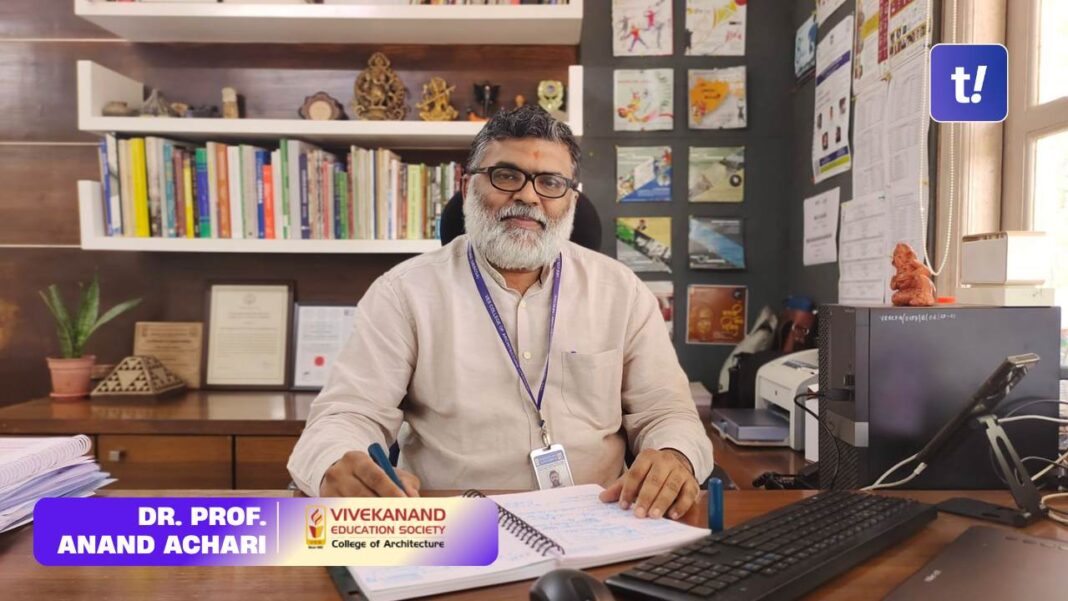
Speaking with TechGraph, Principal of VES College of Architecture (VESCOA), Dr. Prof. Anand Achari, discussed how architectural education is evolving with AI tools, simulation technologies, and parametric design while also strengthening studio culture to help students understand sustainability, human needs, and urban development.
He also spoke about how the institution ensures that students gain hands-on experience with materials and space, along with digital exposure, helping them build a more comprehensive understanding of architecture and its impact on people and cities.

Read the interviews in detail:
TechGraph: Over the past few years, technology has started playing a much deeper role in architecture education, from AI-supported design tools to simulation-based planning. How has this shift changed the way architecture is taught at VES College of Architecture, and what new skills are you encouraging students to develop today?
Dr. Prof. Anand Achari: Over the past few years, technology has become an integral part of architectural education. At VES College of Architecture, we have embraced AI-supported design tools, simulation software, and parametric modeling as part of our curriculum. These tools allow students to experiment, iterate, and visualize their ideas more effectively.
Beyond software proficiency, we are encouraging students to develop critical thinking, design analytics, and an understanding of how technology can enhance sustainability and human-centered design. The goal is to produce architects who are not only digitally competent but also capable of applying technology thoughtfully to real-world challenges.
TechGraph: Architecture studios have traditionally been spaces for sketches, discussions, and physical models. Today, however, students are also working with parametric tools and digital fabrication. How has the studio culture adapted to this change while still keeping the design process grounded?
Dr. Prof. Anand Achari: Our studios continue to be spaces of dialogue, sketching, and model-making, which remain central to the design process. What has changed is the way these traditional methods coexist with digital tools. Parametric design, 3D printing, and virtual simulations have been integrated to complement hand drawing and physical modeling.
The studio culture now fosters experimentation across mediums, ensuring that students develop a tactile understanding of materials and space, while also gaining fluency in digital tools that extend the possibilities of architectural expression.
TechGraph: Many young architects graduate with strong software skills but sometimes struggle to translate those tools into thoughtful architecture. How is VES College of Architecture bridging the gap between technological proficiency and a deeper understanding of space, context, and human use?
Dr. Prof. Anand Achari: We are conscious that strong software skills alone do not create good architecture. At VES, we emphasize the contextual and human aspects of design alongside technology.
Through case studies, site visits, and interdisciplinary projects, students are encouraged to analyze the social, cultural, and environmental context of their work. Technology is positioned as a means to amplify design thinking rather than replace it, enabling students to explore spatial relationships, user experience, and sustainability in a more nuanced way.
TechGraph: Cities today are dealing with complex challenges around sustainability, density, and infrastructure, and technology is becoming central to addressing many of these issues. How is VES College of Architecture shaping its curriculum so that architecture students can respond to these urban realities with both strong design thinking and technological understanding?
Dr. Prof. Anand Achari: Urban challenges today; density, sustainability, infrastructure pressures demand architects who can combine design sensitivity with technological insight. Our curriculum integrates smart city concepts, environmental modelling, and data-driven planning into design studios and theory courses.
Students learn to use technology to simulate energy use, optimize layouts, and visualize urban impacts, while retaining a focus on human-centered design. This prepares them to respond to contemporary urban realities with solutions that are both innovative and socially responsible.
TechGraph: Architects often worry that heavy dependence on software could reduce the importance of conceptual thinking and hand drawing, which have long been central to architectural training. How do you ensure that technology supports creativity rather than overshadowing it?
Dr. Prof. Anand Achari: Technology is a tool, not a substitute for creative thinking. We continue to stress the importance of conceptual clarity, hand drawing, and narrative design, using digital tools to expand, not constrain, imagination.
By alternating between analog and digital methods, students learn to critically assess when a software solution enhances a design and when a more intuitive, hands-on approach is necessary. This balance ensures technology serves creativity, rather than overshadowing it.
TechGraph: Architectural practice today involves working closely with engineers, planners, environmental experts, and technology specialists. How are you encouraging students to think beyond traditional boundaries and prepare for this kind of interdisciplinary collaboration?
Dr. Prof. Anand Achari: Modern architectural practice is inherently collaborative. To prepare students for this, we include projects that involve interaction with engineers, planners, environmental experts, and technology specialists.
Workshops, joint studios, and cross-disciplinary research projects help students appreciate diverse perspectives and develop communication skills essential for collaboration. The objective is to nurture architects who can think beyond traditional boundaries and contribute meaningfully in integrated project teams.
TechGraph: Lastly, you have been closely involved in architectural education and have seen the discipline evolve over the years. When you look at the students graduating from VES College of Architecture today, what changes stand out most in the way they think about design, technology, and the future of cities?
Dr. Prof. Anand Achari: What stands out in our current graduates is their ability to think simultaneously about design, technology, and societal impact. They are more adept at integrating computational tools with environmental and human-centered considerations, and they approach urban challenges with a holistic mindset.
Compared to previous generations, they are more versatile, agile, and conscious of the future of cities, equipped to design not just buildings, but resilient, responsive, and inclusive urban environments.