


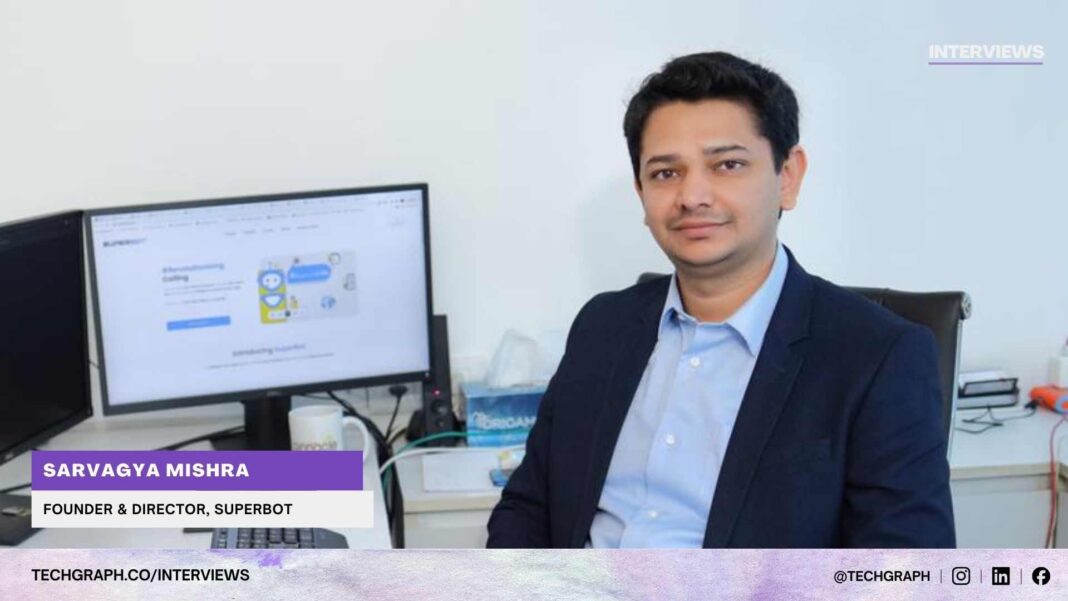
Speaking with TechGraph, Sarvagya Mishra, Founder and Director of Superbot, discussed how India’s shift toward voice-led engagement in Tier 2 and Tier 3 markets is exposing the limitations of traditional multilingual platforms that struggle with cost efficiency, dialect accuracy and cultural tone, and how Superbot’s in-house ASR and NLP engines along with a modular architecture are allowing the company to scale across regional languages without escalating operational expenses.
Mishra also explained how Superbot combines automated retraining loops with human-in-the-loop validation to adapt to vernacular cadence, informal phrasing, and cultural nuance, giving businesses the ability to deliver native-sounding conversations and build trust across regional markets.

Read the interview in detail:
TechGraph: Superbot has positioned itself as a conversational AI platform built for scale. But when the conversation shifts from English and Hindi to regional languages like Gujarati, Tamil, Telugu, Marathi, or Kannada, the economics become more challenging. How do you prevent costs from escalating while expanding into these large but diverse language markets?
Sarvagya Mishra: Expanding into regional languages is a strategic investment rather than a cost challenge for us because our architecture has been designed to scale efficiently across linguistic diversity. We have built our proprietary ASR and NLP engines in-house, which means we do not rely on expensive third-party APIs that often drive up operational costs.
Instead, our models are trained on rich, localized datasets that allow us to fine-tune recognition and response accuracy for each dialect with minimal incremental expense.
Moreover, our modular design enables the reuse of conversational frameworks across industries and languages, reducing development overhead. Automation-driven retraining loops combined with human-in-the-loop validation ensure language quality improves continuously without proportional cost increases.
The result is a scalable, cost-efficient multilingual system that grows smarter and more adaptive with every interaction, allowing us to deliver high-quality conversations even in economically sensitive or niche linguistic markets.
TechGraph: Superbot is working in markets where dialect and cadence often matter more than formal language. In practice, has the tougher challenge been refining your speech recognition models or handling the unpredictability of vernacular speech patterns?
Sarvagya Mishra: Indian languages and dialects present immense variability in cadence, intonation, and colloquialisms, which can shift even between neighboring regions, making vernacular speech patterns the greater challenge. While refining our ASR models is essential, capturing these nuanced variations in real time and accurately understanding intent requires continuous adaptation.
Our proprietary ASR and NLP engines are trained on extensive localized datasets and are fine-tuned regularly to accommodate emerging speech patterns, regional slang, and informal phrasing. Human-in-the-loop validation helps resolve edge cases, while automation-driven feedback loops ensure the system learns from every interaction.
This combined approach allows Superbot to maintain over 95 percent speech recognition accuracy, delivering seamless, empathetic, and contextually relevant conversations across diverse linguistic landscapes without compromising speed or user experience.
TechGraph: Many enterprises stop at two or three dominant languages because the return looks more straightforward. What kind of adoption signals has Superbot seen that justify deeper investment in smaller regional markets where the commercial case isn’t immediately obvious?
Sarvagya Mishra: What we have seen at Superbot is that engagement in regional languages drives real, measurable outcomes, with users responding far better when addressed in their native dialects, leading to higher lead conversions, lower drop-offs, and increased callback requests, especially in Tier 2 and Tier 3 cities.
Our analytics consistently show that vernacular interactions boost customer satisfaction and repeat engagement, reinforcing that localized communication builds trust and loyalty.
In many cases, support limited to just a few dominant languages signals technology that struggles to deliver consistent results across diverse dialects. Superbot’s proprietary ASR and NLP engines are designed to handle even long-tail languages effectively, enabling tangible ROI and strong adoption signals in markets where the commercial case may not seem obvious at first.
This capability validates our deeper investment in regional languages, demonstrating that scaling voice AI inclusively is not only socially responsible but also strategically and commercially advantageous.
TechGraph: Once the commitment is made, the rollout math gets tougher. How do you avoid a situation where every new language added feels like starting from scratch in terms of infrastructure and deployment cost?
Sarvagya Mishra: What makes Superbot’s approach resilient is the way we’ve built modularity into our core architecture. Instead of rebuilding infrastructure for every new language, we’ve created reusable conversational frameworks and scalable language models that allow us to layer new linguistic capabilities without multiplying cost or effort.
Our proprietary ASR and NLP engines are trained on diverse phonetic and grammatical datasets, which means each new language benefits from existing learnings and model optimizations.
We also automate large parts of the retraining and fine-tuning process through AI-driven feedback loops, drastically reducing manual intervention and time-to-deploy. This allows us to maintain consistency in performance and cost efficiency, even as we expand across long-tail languages.
Essentially, every new rollout strengthens the system as a whole rather than resetting it, ensuring that linguistic diversity becomes an asset in scaling rather than a burden on infrastructure.
TechGraph: Accuracy can be engineered, but cultural trust is harder to buy. How much of your spend and strategy is shaped by the need to sound native and reassuring in a caller’s own language, not just correct in syntax?
Sarvagya Mishra: A significant part of Superbot’s strategy and investment is dedicated to ensuring that conversations feel genuinely native, emotionally reassuring, and culturally aligned with the caller. While accuracy can be engineered, trust comes from sounding human, local, and contextually aware.
To achieve this, we rely on a strong people-first design approach. Our team of conversation designers, linguists, and regional language experts crafts scripts, conversational flows, tonality, and persona in a manner that reflects real speech patterns rather than basic translations.
In the current Gen AI environment, where LLM-driven systems naturally generate flexible and dynamic responses, we also add a structured engineering layer. Our prompt engineers, along with an in-house pre-processing data layer, shape the grammar, syntax, and structure of the responses so the bot consistently speaks in a clear, natural, and culturally aligned conversational style.
Human-in-the-loop validation and real-world feedback loops further fine-tune these interactions to make them sound natural and reassuring, especially in sensitive sectors such as healthcare, BFSI, and education.
Our DIY platform allows clients to adjust tone and phrasing for their specific audiences, giving them control over the cultural resonance of every interaction. This focus on authenticity drives engagement, increases response rates, and strengthens brand trust, proving that investing in native sounding and empathetic communication delivers significantly higher return on investment than accuracy alone.
TechGraph: Expanding across India means navigating a patchwork of state-level compliance and data regulations. How have these regulatory frictions shaped Superbot’s product roadmap and investment choices for regional language AI?
Sarvagya Mishra: We built Superbot to handle privacy and compliance from day one, making sure data is secure, and all standards like ISO 27001 are met. The system is designed to adapt easily to different state rules and industry requirements without slowing things down, which keeps managing local data and consent simple.
Expanding into new languages and regions flows naturally while staying compliant. Keeping client and user information safe builds trust and lets businesses run voice interactions confidently at any time.
For us, regulations aren’t just boxes to tick; they guide our growth and ensure Superbot scales across regions and languages practically and reliably.
TechGraph: Finally, as the sector matures, what in your view will separate platforms that truly achieve regional scale from those that stop at token pilots in a handful of languages? Is it capital, technology depth, or something more fundamental about customer adoption?
Sarvagya Mishra: What really separates platforms that achieve true regional scale from those that remain limited is how deeply they understand and serve the end user. Technology and capital matter, but they only get you so far.
The real differentiator is the ability to deliver conversations that feel native, empathetic, and contextually relevant across diverse dialects and cultural nuances. Platforms that stop at token pilots often struggle to make interactions genuinely engaging or consistent in smaller languages, which limits adoption.
Superbot invests in proprietary ASR and NLP models, human-in-the-loop learning, and real-world feedback loops to ensure accuracy, trust, and responsiveness.
Sustained adoption comes when users feel heard and understood, and businesses see measurable outcomes like higher engagement, conversions, and retention. Platforms that combine technological depth with an unwavering focus on customer experience are the ones that truly scale across India’s linguistic diversity.