


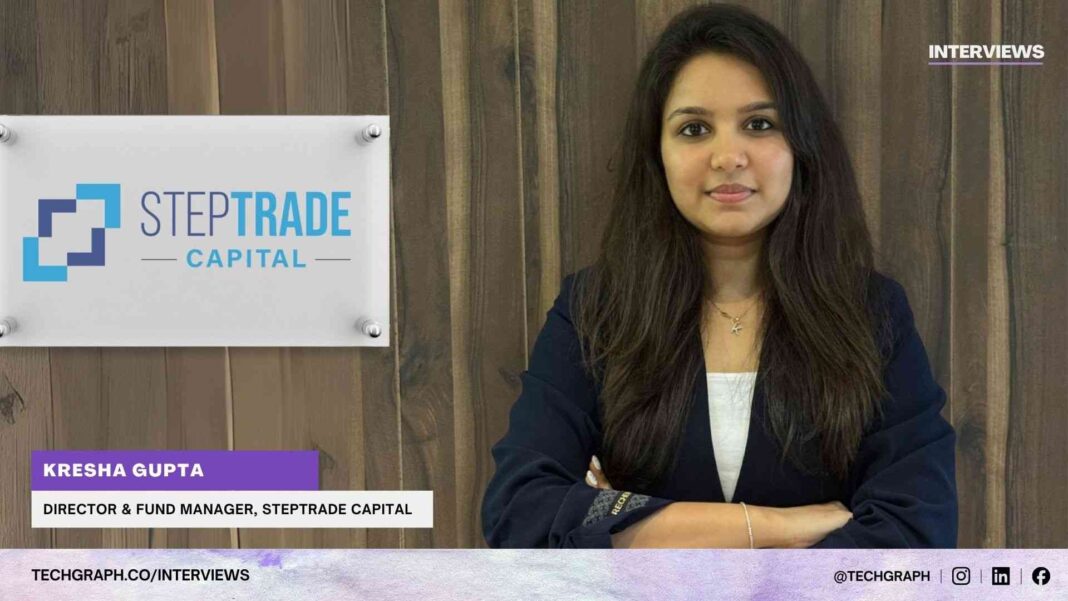
Speaking with TechGraph, Kresha Gupta, Director and Fund Manager at Steptrade Capital, discussed how the Indian and global investment landscape is increasingly favouring alternative investment structures over traditional mutual fund and PMS models, and how the company has built a multi-vehicle platform around AIFs, PMS, and an FME presence in GIFT City to address the need for flexible, high-conviction strategies for sophisticated investors.
Gupta also explained how Steptrade Capital uses the AIF structure to pursue deep research-led investing through concentrated positions, co-investments, and unlisted exposure while maintaining global accessibility through GIFT City, allowing both domestic and international investors to participate in India-focused opportunities through a clean and scalable investment framework.

Read the interview in detail:
TechGraph: Steptrade Capital has built three AIF funds along with a PMS license and an FME presence in GIFT City. What strategic gaps in the Indian and global investment landscape pushed you to build this structure instead of taking the more familiar PMS plus MF route that many firms follow?
Kresha Gupta: The main purpose we started with AIFs was that in today’s world, AIFs are growing tremendously and have become the most powerful vehicle for sophisticated investing.
Mutual funds cater primarily to retail investors and are massive in terms of AUM, while PMS follows a completely different style and cannot be compared with the flexibility and depth that an AIF structure provides.
AIFs cater to a niche class of investors who want boutique, sharp investment strategies, including unique, high conviction ideas, while also accessing pre IPO opportunities through co- investments, unlisted exposure, and structured deals. This structure gives us the freedom to build high alpha strategies.
AIFs give us the ability to conduct deep due diligence, engage directly with promoters, and take flexible position sizes without being restricted by benchmarks.
We added our FME presence in GIFT City for the same reason. It provides global credibility, tax efficiency, and a clean gateway for foreign capital without offshore complexity. International investors today actively want to tap into the opportunities offered by India-focused AIFs, and GIFT City enables that seamlessly.
TechGraph: Every fund house claims to be data-driven and research-led, yet very few consistently deliver returns above benchmark across market cycles. When you study your own performance history, which specific discipline or framework has actually shielded Steptrade during phases when broader market behaviour turned irrational?
Kresha Gupta: One factor that has always differentiated Steptrade from other fund houses is our active, continuous tracking discipline. For us, research is a daily responsibility. We maintain a deep, ongoing understanding of every portfolio company through:
Regular promoter and management calls.
Shareholding pattern tracking.
Detailed fundamental analysis.
Monitoring every corporate announcement, however small.
Understanding sector-level sentiment and momentum shifts.
I strongly believe that long-term investing does not mean buying a company and forgetting it for 2–3 years. Long-term compounding requires continuous validation. We track every variable that can impact a company’s ability to perform over the long term, like operational, financial, sectoral, behavioural, and regulatory.
This is exactly why, when markets turn irrational, or when sentiment for a specific industry weakens, we are able to make fast, informed decisions. Our early detection of risk factors and sentiment shifts has helped us protect capital during volatile phases while repositioning the portfolio ahead of the market.
TechGraph: Investors today are crowding into similar themes and asset classes, and this has led to steady alpha erosion. How does your team identify opportunities early enough to capture meaningful upside before the broader market rushes in?
Kresha Gupta: At Steptrade, our core philosophy has always been to identify opportunities where others aren’t even looking yet, which are small and micro-cap companies. This segment is the biggest gap in the investment landscape, and it offers outsized alpha when discovered early.
We do this through a structured framework that combines sector foresight and bottom-up research. We look for sectors that are showing early signs of global growth, have strong economic support, and reflect shifts in consumer behaviour or manufacturing trends. When these indicators align, we know the theme is becoming important.
Our research team then goes bottom up, identifying companies that are quietly performing, businesses that are delivering strong results, securing significant B2B orders, improving operations, and building quality client relationships.
We actively track management changes, order book momentum, supplier ecosystem trends, and capacity expansion plans. To strengthen this process, we stay closely connected to auditors, merchant bankers, and legal advisors who engage with these companies at every stage. These signals typically appear months before the numbers show up in quarterly results, allowing us to position ourselves before the wider market enters.
TechGraph: AIFs in India are evolving quickly with shifting investor profiles and rising institutional participation. How do you strike the balance between product innovation and unnecessary complexity, especially when HNI and UHNI investors want clarity and accountability rather than noise?
Kresha Gupta: Even though our internal research, structuring, and diligence processes are detailed and rigorous, the investor experience is intentionally kept uncomplicated. HNI and UHNI investors want clarity, not complexity. They want to know where their money is, why it is invested in a certain way, and how it is performing. That’s why we focus on clear communication, simple product architecture, and high accountability.
One of the ways we ensure this is through our dedicated investor tracking app (Industry first innovation), which provides real-time visibility into their investments, performance updates, documents, and reporting. It reinforces trust and makes investors feel that their capital is being monitored with complete responsibility. Our goal is to create products that are innovative in strategy but straightforward in presentation.
TechGraph: Global liquidity has turned unpredictable again with shifting interest rate expectations and uneven growth across regions. How have these conditions reshaped your asset allocation playbook for the next four quarters?
Kresha Gupta: Over the next four quarters, we are focusing more on businesses where earnings visibility is strong and predictable. Companies with stable cash flows, steady customer demand, and sustainable margins tend to outperform in volatile environments. Our fund doesn’t invest in cash-burning companies. Our exposure to overleveraged companies is less. We are increasing allocation to businesses with clean balance sheets and pricing power.
And obviously, when the market looks tough, there is no harm in maintaining a higher cash position. When you are managing a fund, caution is a responsibility. There are certain phases where holding cash actually protects returns and gives you the flexibility to deploy at far better valuations.
At a sector level, we continue to see strength in areas supported by long-term domestic and policy tailwinds like manufacturing, power and energy transition, and infrastructure.
TechGraph: With the rise of quant-driven products and algorithmic strategies, many investors are chasing speed rather than insight. Do you believe the next cycle of outperformance will favour human-led discretionary judgment supported by data or a more automated approach?
Kresha Gupta: Quant-driven products and algorithmic strategies are definitely growing, but it’s important to remember that there is a fundamental difference between trading and investing. Algorithmic models are excellent for capturing short-term price movements and technical patterns, and they do generate returns, but largely in a trading-oriented manner.
Long-term wealth is still created through human-led discretionary judgment supported by data. This is because quant systems struggle with factors that require context, intuition, and qualitative assessment, such as shifts in governance quality, management behaviour or intent, regulatory transitions, supply chain disruptions, informal industry dynamics, cultural disturbances, etc. Humans can read intent, credibility, and long-term vision, which no algorithm can quantify meaningfully.
TechGraph: Looking ahead, which themes will define wealth creation in India over the next three to five years across public markets, private equity, and alternatives, and how is Steptrade Capital preparing to lead that transition rather than respond to it once it arrives?
Kresha Gupta: Over the next three to five years, India’s wealth creation will be driven by a set of structural themes. The biggest opportunities will come from energy transition, climate tech, advanced manufacturing, infrastructure expansion, and strategic minerals like rare earths, which are tied to global shifts in EV adoption, clean energy, and high-tech demand.
Energy transition will create an entire ecosystem of opportunities, from renewables and storage to EV components, power efficiency technologies, and carbon reduction solutions.
Manufacturing is entering a multi-decade expansion driven by China plus one, domestic capex, and the formalization of supply chains. Infrastructure will remain at the centre of India’s growth story as the country scales logistics, mobility, data capacity, and urban development. And with global realignment in critical minerals, rare earths are becoming a multi-year strategic opportunity that will influence both public and private market investments.
At Steptrade, we’ve positioned ourselves to stay ahead of these shifts. Our AIF frameworks are built around identifying sectors early, before they turn into crowded trades. We prefer companies that are reinvesting for growth rather than relying on short-term market sentiment, and we stay disciplined on valuations even when a theme is trending. Our multi-vehicle structure gives us the flexibility to capture opportunities across public markets and private deals.