


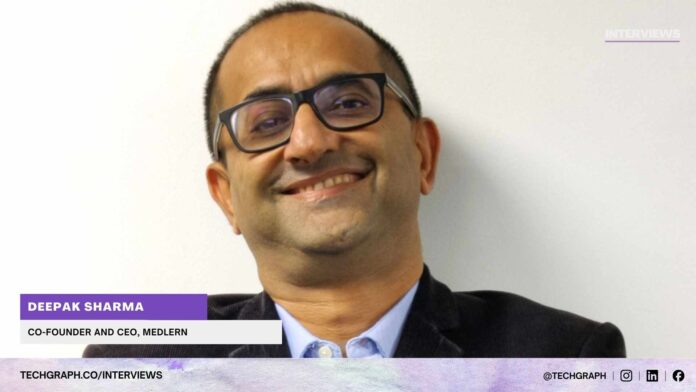

Speaking with TechGraph, Deepak Sharma, Co-founder and CEO of MedLern, discussed how traditional instructor-led medical training models have struggled to scale consistently across hospitals while maintaining objective skill assessment and patient safety outcomes, and how the platform is filling these gaps by introducing a digital hybrid resuscitation training framework that reduces dependency on human instructors without compromising training quality.
Sharma also discussed MedLern’s scenario-driven and sensor-enabled training approach that allows healthcare professionals to practice critical life support skills anytime while receiving precise, real-time feedback, helping hospitals standardise competency across staff, free up instructor bandwidth, and improve readiness for high-risk clinical situations through a structured and scalable learning system.
Read the interview in detail:
TechGraph: MedLern has introduced a digital hybrid resuscitation training that works without a human instructor into the Indian medical training segment. How does this address the gaps in the training ecosystem and address patient safety? How has this been received by the market?
Deepak Sharma: There are three big gaps in the traditional training approach: it is entirely dependent on a subjective assessment of hands-on skills, takes time and complicated logistics to schedule and complete, and can be very difficult to scale without compromising on the quality. Even the best human instructor simultaneously overseeing 20 or more learners has to split his attention and may not be able to pinpoint areas of improvement precisely and consistently, let alone consistently grade performance with just visual observations. Also, these workshops can take weeks to organise and up to 2 days to conduct.
HeartCode Complete is globally recognised as the gold standard in Life Support training that uses adaptive learning methodologies, state-of-the-art manikins with precision sensor-driven individualised feedback to guide learners in real time. With regular practice, which can be done 24X7 at the convenience of the learner, it can also deliver much better survival outcomes, due to a progressive increase in learner confidence and skills.
Hospitals need a consistent, high level of competency in cognitive and psychomotor skills, but the traditional model simply couldn’t reach all staff regularly. By creating a digital, scenario-driven pathway that mirrors real decision-making and enables frequent refreshers, HeartCode Complete delivers scale, frees learner time, and improves quality consistently – there is a very high bar for certification.
Leading experts have embraced the change and realized that freeing up highly trained instructors lets them from cognitive and psychomotor domains lets them focus on the human side of training– the affective domain. It’s definitely a win-win for all.
TechGraph: Hospitals and nursing institutes that have embraced digital training strategies are keen to validate their impact on measurable outcomes on the floor. How does MedLern help them track real productivity and skill application?
Deepak Sharma: MedLern integrates several tools to track the translation of training to impact – measuring knowledge outcomes, performance audits, and periodic feedback and refreshers. At MedLern, our innovations have been designed to engage first-time digital learners through gamified microlearning, interactive modules, scenario-based approaches, and OSCEs (Objective Structured Clinical Evaluations).
The app-based approach makes a training ready reckoner available at the point of care to reinforce situational learning and retention of knowledge. Pre and Post assessment capture the knowledge lift, feedback, and audit mechanisms measure the floor outcomes – in patient safety, patient experience, and compliance, not just efficiency. Our latest release also complements this with the capture of overall quality indicators at the process, unit, and org levels to complete the picture.
Where needed, our experts engage with the client team to design a goal-based approach for critical initiatives. This is already visible in the numerous real-world successes reduction of Hepatitis C infection rate to zero against an industry norm of 20% in dialysis centres, and successful implementations of NABH quality programs that have been published.
TechGraph: Healthcare administrators are often reluctant to increase learning hours because of staff shortages and mounting patient loads. Given this pressure, how did you build a framework that motivates professionals to take up continuous learning without it becoming a checkbox activity?
Deepak Sharma: We recognised that continuous learning would only work if it seamlessly fit into the realities of clinical life. So we built the system around short, mobile-first modules that clinicians can complete in micro-moments without disrupting patient care. Every module is scenario-based and directly relevant to real clinical challenges, making learning inherently purposeful.
We also enable linking of training milestones to career progression, competency frameworks, and recognition pathways, ensuring learners feel tangible professional benefit. Team-based learning, micro-challenges, and leader-led reinforcement turn learning into a culture-building activity instead of a checkbox requirement.
TechGraph: Compliance training is usually treated as a formality across the healthcare sector and often suffers from outdated content or insufficient assessment. What steps have you taken to ensure that compliance learning actually improves decision-making during high-risk situations rather than ticking regulatory requirements?
Deepak Sharma: We redesigned compliance learning to simulate real-world pressures rather than asking professionals to memorise policy text. Every compliance module presents situational scenarios that require judgment-based decisions aligned with clinical protocols. Assessments evaluate how learners navigate these situations, not how much policy they recall.
When incidents reveal systemic gaps, our platform enables targeted micro-learning campaigns to address the gaps. All compliance content is regularly refreshed by clinical SMEs to stay aligned with evolving guidelines and frontline challenges. This ensures compliance training becomes a meaningful patient safety tool instead of a regulatory ritual.
TechGraph: Digital platforms in healthcare usually struggle to stay current with treatment protocols and clinical best practices. How then does MedLern keep its learning content updated at the pace at which medical knowledge and clinical guidelines evolve?
Deepak Sharma: We stay ahead of clinical updates through three layers: strategic content partnerships with global leaders such as the American Heart Association, Laerdal, and others; a modular content architecture that allows quick updates to specific algorithms or decision elements; and a strong SME panel that validates and contextualises changes for Indian healthcare settings. Updates are published as and when relevant to learners.
This ensures healthcare professionals always have access to the latest evidence-based practices without waiting for periodic classroom refreshers. We are also in the process of testing advanced AI tools to streamline this.
TechGraph: With AI tools now entering clinical learning and training support many startups are promising personalised skill development for doctors and nurses. What role do you see AI playing in MedLern’s roadmap, and how do you keep the technology supportive without diluting the human aspect of clinical judgement?
Deepak Sharma: AI will enhance personalisation, insight generation, and adaptive training, but it will not replace human decision-making. In our roadmap, AI helps identify skill gaps, personalise learning sequences, and provide reflective feedback based on behavioural patterns. At a systems level, AI highlights competency deficits across teams or departments, allowing hospitals to intervene proactively.
However, all AI interventions are clinically audited, and final judgment always remains with the clinician. Our philosophy is clear: AI should support learning, accelerate insights, and strengthen clinical preparedness while keeping human expertise at the centre of every decision.
TechGraph: Hospitals that invest in talent and training usually expect quantifiable returns within a short period, yet developing clinical skills is a long-term exercise. How do you convince decision makers to see training and upskilling as a strategic advantage rather than an expense that does not reflect immediately on the balance sheet?
Deepak Sharma: Most hospital leaders understand that their ongoing investment in human resources is nearly 40-50% of their operating costs. In terms of improving care outcomes, safety, patient experience, and reputation protection, these investments are a lot more critical than infrastructure or marketing expenses. By digitising core administrative tasks relating to training and L&D, MedLern starts delivering to the bottom line on day 30 through reduced onboarding times, paperless compliance processes, and freed productivity.
Over time, improved clinical competence leads to fewer adverse events, better patient outcomes, lower staff turnover, and stronger accreditation readiness, all of which have measurable financial impact. By mapping training outcomes to tangible metrics like incident reduction, audit performance, and operational efficiency, we help leaders view skilling not as a discretionary expense but as an essential component of organisational resilience and patient safety.
TechGraph: Lastly, as healthcare delivery grows more tech-enabled and the expectations on clinical staff continue to rise, what is the next big gap in training that MedLern aims to solve, and how are you preparing the organisation for that next phase of growth?
Deepak Sharma: Training needs to keep in step with evolving changes in clinical, compliance, process, and operational knowledge to equip the hospital workforce. Significant digital and tech-adoption in the coming days will need innovative strategies to engage, motivate, and empower hospital employees to give their best to patient care.
We are evaluating a pipeline of innovations in clinical and behavioural learning that can be game changers – virtual simulation, AI assessments, collaborative and community learning models are on our radar, among others.