


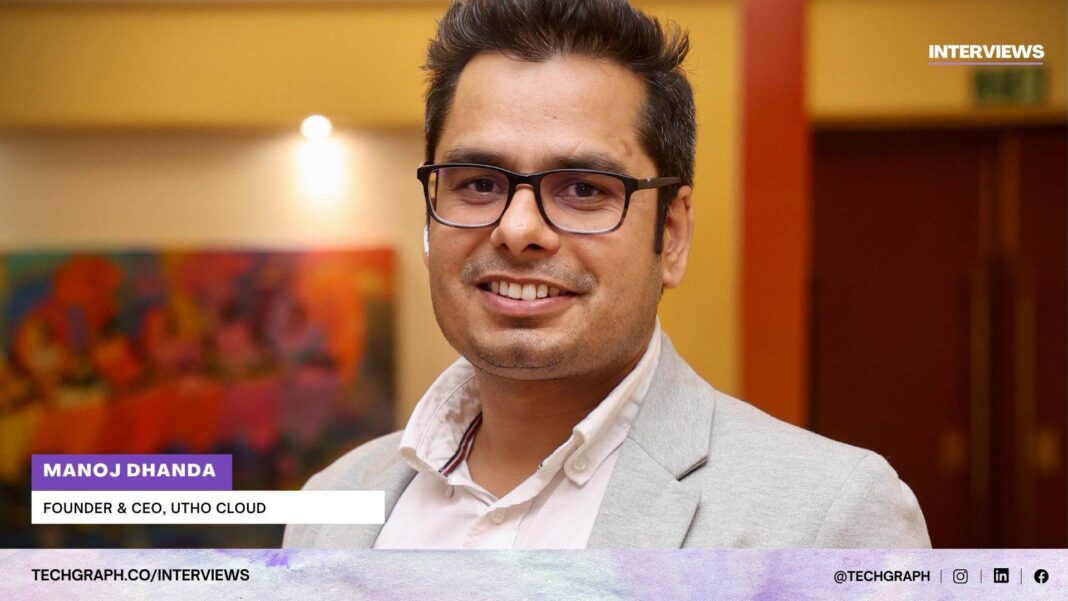
Speaking with TechGraph, Utho Cloud Founder and CEO Manoj Dhanda explained how the company is building an India-first cloud platform that meets compliance standards while keeping data within the country’s borders. He further highlighted the need for scalable infrastructure to support AI and data-heavy workloads and shared plans for new localized data centers that will bring users closer to fast, low-latency processing.
Read the complete interview:

TechGraph: The cloud market in India is often seen as dominated by global giants, yet Utho has positioned itself as a serious homegrown alternative. What specific gaps in the market do you believe Utho has been able to address better than international players?
Manoj Dhanda: Utho was established to fill key gaps that global hyperscalers tend to ignore in India. Even though global players provide strong services, they pose challenges in cloud expenses, data sovereignty, compliance, and privacy domains, where Indian institutions and companies are most vulnerable. Utho fills this gap by being entirely built on Indian ground, regulated by Indian laws, and keeping national data within the country’s borders.
Apart from compliance, our offerings are specifically designed for Indian businesses to suit their distinct requirements, providing cost-effectiveness, localized service, and infrastructure availability. By integrating world-class tech with knowledge of India’s regulatory and operational environment, the organization has established itself as an authentic, dependable, and indigenous alternative.
TechGraph: Many enterprises in India are still cautious about fully moving to the cloud due to concerns over compliance, data sovereignty, and cost predictability. How is Utho tackling these concerns to build stronger trust with businesses?
Manoj Dhanda: At Utho, we understand that businesses are slow to shift completely to the cloud because of complexity in compliance, issues of sovereignty, and unknown costs. To tackle this, we have developed an India-first cloud platform that strictly complies with local regulations and keeps data within the country’s borders. Our open-book pricing models remove surprise bills, providing businesses with more predictability and control.
Moreover, Utho’s infrastructure is performance- and security-centric, supported by responsive local care. Through the integration of compliance, sovereignty, cost savings, and reliability, we are supporting businesses to transition with confidence while building India’s safe and indigenous digital ecosystem.
TechGraph: With AI workloads, high-performance computing, and edge adoption on the rise, the demands on cloud infrastructure are changing rapidly. How is Utho reshaping its technology roadmap to keep pace with these shifts?
Manoj Dhanda: Utho is transforming its technology roadmap to address the increasing needs of AI workloads, high-performance computing, and edge adoption in a definitive India-first strategy. We are building scalable, high-speed infrastructure that provides the processing power needed for advanced AI and data-oriented applications. To enable edge adoption, we are adding localized data centers in various locations in India, closer to users for improved latency and performance.
Our roadmap also prioritizes interoperability, cost-effectiveness, and compliance to allow businesses to innovate without compromise. By positioning our platform on the future of AI and edge, Utho is establishing a cloud ecosystem that enables enterprises to remain ahead in an ever-changing digital world while protecting data sovereignty.
TechGraph: The government’s push toward digital public infrastructure has opened opportunities for cloud providers to play a deeper role. How does Utho view its participation in this national digital transformation journey?
Manoj Dhanda: We see the government’s effort towards digital public infrastructure as a turning point for India’s tech future, and Utho is completely in line with it. As a Bharat-first cloud, our goal is to enable safe, sovereign, and accessible solutions that empower the backbone of India’s digital ecosystem. By hosting data locally and under Indian regulations, we enable businesses, startups, and government agencies to innovate with boldness.
Utho’s responsibility is not just as a service provider but also as a partner in India’s digital revolution journey, aiding the emergence of AI, cloud adoption, and digital public goods that, in aggregate, help materialize the vision of a genuinely self-reliant, digitally sovereign India.
TechGraph: Cost optimization has become a major boardroom topic as enterprises try to balance innovation with efficiency. What is Utho doing differently to help customers avoid cloud sprawl while still scaling effectively?
Manoj Dhanda: At Utho, we understand that enterprises often struggle with cloud sprawl, where costs escalate without proportional business value. Our strategy is centered on clear, consistent pricing that’s much lower than on global platforms, as what can be ₹1,500 elsewhere can be just ₹250 with Utho. Apart from cost-effectiveness, we offer facilities for smart resource allocation, tracking, and scaling, so companies pay only for what they actually consume.
This avoids wastage and provides maximum ROI. By blending affordability with performance and local support, we enable businesses to innovate and scale in a sustainable manner, without compromising on efficiency. Utho’s India-first approach helps organizations attain growth and cost optimization in a balanced, future-focused manner.
TechGraph: Security in the cloud is often described as a shared responsibility, but enterprises sometimes see it as an area of confusion. How is Utho approaching cloud security in a way that makes it both simpler and more transparent for customers?
Manoj Dhanda: At Utho, we recognize that cloud security can feel complex, especially with the shared responsibility model. Our goal is to simplify this by providing complete clarity on which layers we secure and where customers retain control. We embed enterprise-level security into all levels of our infrastructure, such as encryption, firewalls, identity management, and compliance, so that customers are already starting from a solid foundation.
Outside of tools, we focus on transparency through explicit policies, simple-to-grasp dashboards, and forward-looking advice from our local security experts. This allows companies to fully understand exactly how their data is safeguarded and what they can do further. With cloud security and making it accessible, Utho builds trust while enabling enterprises to innovate confidently without security becoming a roadblock.
TechGraph: Looking ahead, the competitive edge for cloud providers may not just be about infrastructure but also the ecosystem they build around it. How is Utho thinking about partnerships, developer communities, and new-age startups as part of its long-term growth story?
Manoj Dhanda: Utho envisions the future of cloud leadership in fostering an environment where startups, developers, and partners can collaborate to innovate. We are proactively developing strategic alliances with technology vendors, system integrators, and government organizations to form integrated solutions that ease cloud adoption for Indian businesses.
Also, for the developer community, our Utho Innovators Hub and activities through Kubernetes meetups, hackathons, and open-source projects give them hands-on training, early access to new capabilities, and direct feedback into our product strategy. We will help developers become empowered with open APIs, comprehensive documentation, and prompt local support so they can develop and grow without restrictions.
For new-gen startups, our “Build on Utho” program provides cloud credits, migration support, and go-to-market guidance, so the founders can concentrate on growth while saving up to 60% of costs. By combining localized infrastructure with a vibrant partner and developer ecosystem, Utho is evolving from a pure infrastructure provider into a long-term growth platform that strengthens India’s digital-first future.