


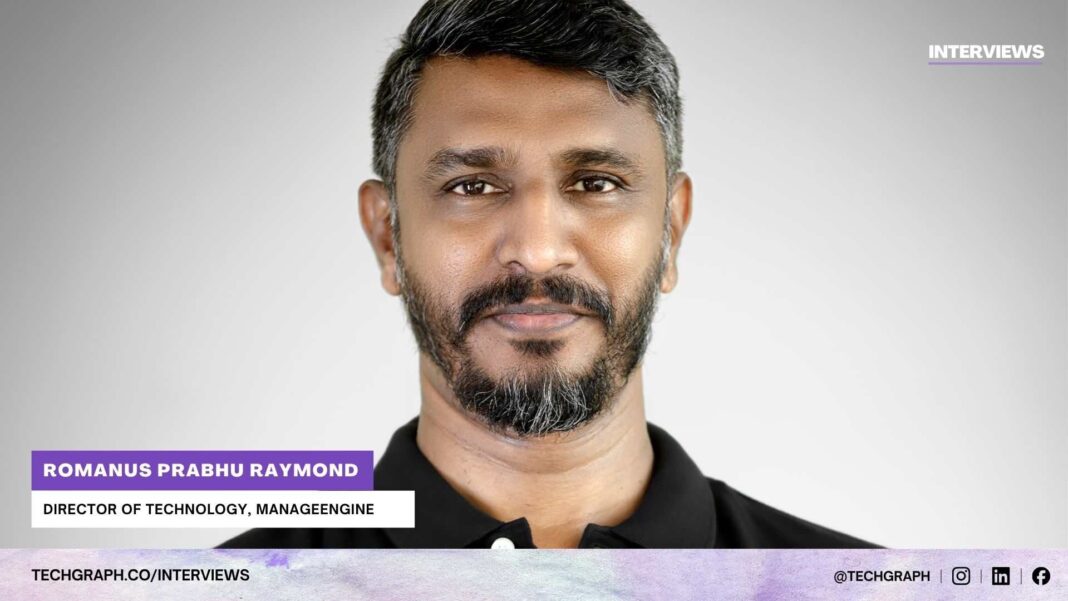
In an interaction with TechGraph, Romanus Prabhu Raymond, Director of Technology at ManageEngine (Zoho Corp.), outlined how the growing complexity of hybrid and multi-cloud infrastructures is compelling enterprises to rethink their IT architecture, and how the company’s design-first approach unifies user experience, data, and workflows across its product portfolio to deliver simplicity, interoperability, and scalability for modern enterprises.
He further spoke about ManageEngine’s suite, which combines continuous vulnerability detection, configuration management, and unified auditing to provide proactive defense and streamlined compliance, helping organizations maintain visibility and meet regulatory requirements without slowing down operations.

Read the interview in detail:
TechGraph: With ManageEngine offering one of the largest portfolios in IT management, how do you approach building a unified technology architecture that avoids silos and keeps the entire suite cohesive?
Romanus Prabhu Raymond: ManageEngine’s IT management suite covers endpoint management, identity & access, ITSM, monitoring, analytics, security, and more. With one of the industry’s broadest IT management portfolios, our goal is to deliver depth in each product while maintaining cross-suite cohesion. That cohesion begins with design—UI/UX consistency in dashboards, navigation, and reporting styles ensures admins do not feel like they are learning a new tool every time. A common data layer for identities, assets, logs, and audit trails further eliminates silos.
Architecturally, we follow an API-first model. Products are modular but plug seamlessly into each other and third-party ecosystems. Unified authentication, role-based access, SSO, and centralized policy enforcement simplify governance, while alerts and incidents feed into a central analytics and SIEM layer. This enables outcome-driven workflows—for instance, a ServiceDesk incident can trigger automated remediation via Endpoint Central or AD Manager Plus.
Most importantly, customer-centric cohesion drives our strategy. CIOs and boards expect outcomes, not product silos, and our customer success and product teams ensure frictionless unification and prioritize roadmaps accordingly. Out-of-the-box integrations across ITSM, endpoint, AD auditing, SIEM, and monitoring reduce integration overhead, while a centralized analytics engine delivers cross-product dashboards for IT, security, and compliance. Our ‘adopt-as-you-grow’ model lets customers start with one product and easily expand into adjacent modules without migration pain, keeping the architecture flexible, scalable, and future-ready.
TechGraph: As enterprises accelerate adoption of hybrid and multi-cloud setups, what do you see as the most pressing technical challenges for IT management, and how is ManageEngine addressing them?
Romanus Prabhu Raymond: As organizations embrace hybrid and multi-cloud setups, IT teams face pressing challenges around visibility, cost, security, compliance, and performance. Managing on-premises, private, and multiple public clouds often creates blind spots, making unified infrastructure oversight critical for efficient resource allocation and faster troubleshooting. Cost management is equally complex, with different providers offering varying pricing models, while fragmented security tools and regulatory differences make achieving a unified security posture difficult.
ManageEngine addresses these with a holistic approach. Solutions like OpManager, Site24x7, and Applications Manager deliver a single-pane-of-glass view across on-premises, AWS, Azure, and Google Cloud, ensuring consistent monitoring and control. Our cloud cost management tools provide granular insights into resource utilization, enabling optimization and cost savings. Built on an API-first model with native integrations for major cloud platforms, our products ensure seamless data collection, workflow automation, and scalability—helping enterprises gain clarity, control, and measurable outcomes from their hybrid and multi-cloud strategies.
TechGraph: With cybersecurity becoming a boardroom concern, how are you embedding security and compliance into your IT management products rather than treating them as add-ons?
Romanus Prabhu Raymond: For us, security and compliance are embedded into our IT management products from the ground up—not treated as afterthoughts or add-ons. Our core strategy is to merge IT operations and security operations so enterprises can manage and protect their environments seamlessly. Tools like Endpoint Central and Vulnerability Manager Plus go beyond endpoint management to serve as foundational security platforms, enabling continuous vulnerability detection, patch management, enforcement of security configurations, and control over application usage.
On the monitoring side, solutions like ADAudit Plus and Log360 collect and correlate security events across the IT landscape, giving teams a holistic view of risks and incidents. Compliance is equally built in, wherein our products include pre-built, out-of-the-box reports aligned with major regulatory standards, so IT teams no longer have to compile audit data manually. Instead, compliance becomes an integrated, automated process rather than a reactive, manual effort.
TechGraph: There is a lot of talk about AI in IT operations, but from a technology leader’s standpoint, where are you actually seeing measurable impact today, and which AI-driven use cases do you believe will reshape IT management in the near future?
Romanus Prabhu Raymond: We are already seeing measurable impact from AI in IT operations, particularly in anomaly detection and predictive analytics. ManageEngine’s monitoring tools leverage machine learning to analyze vast volumes of operational data, identify the true root cause of issues, and filter out noise from insignificant alerts. This helps IT teams focus on critical problems and significantly reduce mean time to resolution (MTTR). Predictive analytics is another area delivering results. By analyzing historical data, AI models can anticipate resource bottlenecks or hardware failures, enabling proactive maintenance and preventing downtime.
Looking ahead, AI will drive near-autonomous IT operations. AI-driven systems will not only detect and diagnose issues but also self-remediate without waiting for human intervention, whether for restarting a service or reallocating resources. Beyond IT efficiency, AI will also reshape security. Models will evolve from anomaly detection to advanced threat prediction, analyzing global intelligence and behavioral patterns to anticipate the next wave of attacks. This creates a proactive, self-adapting layer of defense, fundamentally transforming how enterprises manage and secure their IT environments.
TechGraph: Many enterprises struggle with balancing innovation with cost control in IT. How does ManageEngine position its suite to deliver both operational efficiency and long-term value?
Romanus Prabhu Raymond: Enterprises often face the challenge of driving innovation while keeping costs under control, and that is exactly where ManageEngine’s suite delivers value. Our tightly integrated platform helps customers consolidate multiple IT needs that would otherwise require separate point solutions from different vendors. This consolidation not only reduces licensing and maintenance costs but also eliminates integration headaches.
At the same time, our modular approach gives enterprises flexibility. They can start with a solution for a specific need and seamlessly expand as requirements evolve, without overspending on unnecessary features. Across the suite, products are designed to automate repetitive, manual tasks such as patch management, user provisioning, and configuration changes. By freeing IT teams from these time-consuming activities, we enable them to focus on innovation and strategic projects that create long-term business value.
TechGraph: Looking ahead, what emerging technologies or trends do you believe will disrupt IT management in the next five years, and how are you preparing your roadmap around that?
Romanus Prabhu Raymond: We see several emerging technologies that could significantly disrupt IT management over the next five years. Edge computing is one. As more processing shifts closer to where data is generated, IT management will need to evolve from a centralized model to a decentralized one. This will bring new challenges in managing, securing, and monitoring thousands of remote devices, and we are preparing by building lighter-weight agents and decentralized management capabilities that can operate effectively at the edge.
Another major disruptor is quantum computing. While still nascent, it has the potential to break modern encryption algorithms, rendering current security approaches obsolete. We are closely tracking developments in post-quantum cryptography (PQC) to ensure our frameworks and products are adaptable to this future.
Also, Generative AI is a trend we believe will fundamentally reshape IT management. Beyond basic automation, it can power more advanced conversational interfaces for help desks and even generate complex scripts and workflows on demand. Our roadmap is geared toward embedding these capabilities to help IT teams operate more efficiently and focus on higher-value initiatives.