


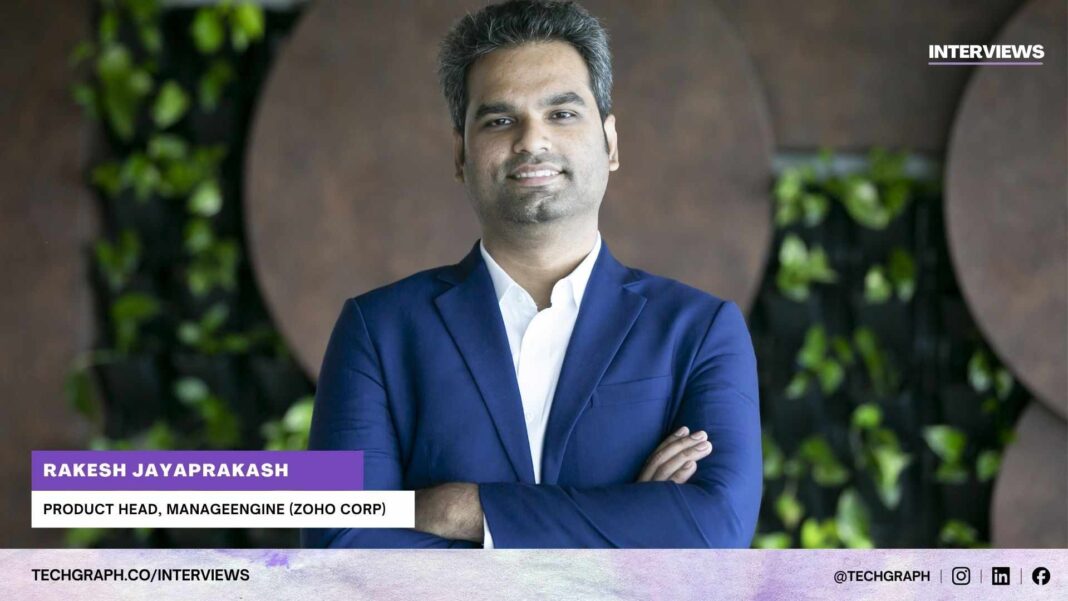
Speaking with TechGraph, Rakesh Jayaprakash, Product Head and Chief Analytics Evangelist at ManageEngine (Zoho Corp), discussed the rapid shift to hybrid and multi-cloud environments that is transforming enterprise IT management, and explained how ManageEngine’s integrated ecosystem is enabling organizations to simplify operations, innovate with confidence, and keep infrastructure seamless and adaptable across complex digital environments.
He also spoke about integrating advanced analytics and AI capabilities across ManageEngine’s suite through innovations like Zia and the company’s custom-built Zia LLM, designed to deliver real-time intelligence that helps organizations make faster, data-backed decisions across their entire IT landscape.

Read the interview in detail:
TechGraph: ManageEngine offers one of the broadest IT management suites in the market. How do you balance the need to constantly innovate across such a wide product portfolio without overwhelming customers with too many choices?
Rakesh Jayaprakash: At ManageEngine, innovation is in our DNA, and it is fueled by customer needs. We are an R&D-driven organization, with the majority of our investments directed toward engineering and only about 20% toward marketing. This ensures that every new capability we introduce is purposeful, helping IT teams run operations more efficiently rather than overwhelming them with options.
Our strength lies in offering a tightly integrated ecosystem of tools, where each product excels in its domain. Many of our solutions are regularly featured in Gartner’s Magic Quadrants, reflecting our ability to innovate while maintaining depth. At the same time, we work closely with customers to tailor solutions by combining the right products for their specific requirements. They have the flexibility to handpick tools themselves or do so with our guidance, and as their needs evolve, they can seamlessly adopt new products without disruption, thanks to our integrated architecture.
This modular, customer-centric approach empowers enterprises to scale at their own pace. It gives them the freedom of choice without locking them into an all-or-nothing suite, ensuring innovation translates into real, long-term value.
TechGraph: With enterprises adopting hybrid and multi-cloud environments at a rapid pace, where do you see the biggest gaps in IT management today, and how is ManageEngine positioning itself to address those challenges?
Rakesh Jayaprakash: In hybrid and multi-cloud environments, the biggest gap we see is enterprises relying on a patchwork of tools from different vendors, loosely connected through integrations. These often fall short—data sharing fails, automation breaks, and workflows become fragmented. It’s not enough to align IT operations under a common framework; the tools themselves must work seamlessly to ensure uninterrupted outcomes.
That’s where ManageEngine stands out. Our products are built to integrate by design, unified through common configuration models and shared architecture. This makes both implementation and ongoing management far simpler for IT teams. For example, the CMDB in ServiceDesk Plus is automatically populated by OpManager during a network scale, eliminating manual entry and saving hours of effort. This is just one of many integrations across our suite.
By offering a tightly integrated platform with consistent features across both cloud and on-premises deployments, ManageEngine fills a critical gap in today’s fragmented IT software landscape. It makes us especially well-suited for hybrid and multi-cloud setups, where flexibility, interoperability, and efficiency are key.
TechGraph: As the IT landscape is shifting from reactive support to proactive and predictive management. What role do analytics and AI play in reshaping the way your products deliver value to enterprises?
Rakesh Jayaprakash: It’s high time IT teams move beyond constant firefighting and adopt a proactive, planned approach to operations. Analytics is a key enabler of this shift, offering a strategic, bird’s-eye view of IT environments. By uncovering alarm and incident patterns, it helps teams step back and assess operations holistically rather than reacting to isolated alerts. This is particularly critical in NOC environments, where reacting in silos often causes broader trends and root causes to be overlooked.
For example, a recurring spike in incident volume at certain times might reveal a backup failure linked to disk space issues, something that could easily go unnoticed if each alert were handled in isolation. When combined with AI, analytics become even more powerful by not just identifying patterns but reasoning through them to uncover true root causes. This empowers IT teams with deeper insights, faster resolutions, and smarter decisions, ultimately saving time, effort, and cost for the enterprise.
TechGraph: Data privacy regulations are multiplying across regions, and compliance is becoming more fragmented and expensive. How do you build flexibility into your products so global enterprises can stay compliant without slowing down operations?
Rakesh Jayaprakash: With our products used in over 190 countries, we build flexibility into our platforms so enterprises can configure the guardrails needed to meet diverse regional and industry-specific data privacy regulations. While the details of each regulation vary, the underlying principle is consistent—protecting corporate and personal data. That shared foundation allows us to design capabilities that support compliance globally while preparing customers for future regulatory changes.
Our global presence also gives us early visibility into emerging compliance trends, helping us anticipate and adapt to requirements before they spread to other regions. And for widely adopted frameworks like GDPR, we go a step further by offering out-of-the-box capabilities tailored to those regulations, significantly reducing the effort for customers to stay compliant. This approach ensures enterprises can meet regulatory demands without slowing down operations.
TechGraph: Many IT leaders are under pressure to cut costs while still driving innovation. What role do your analytics and IT management tools play in helping organizations make smarter decisions with fewer resources?
Rakesh Jayaprakash: IT leaders today are under immense pressure to balance cost control with innovation, and this is where our analytics and IT management tools play a critical role. Analytics has evolved from being a visibility layer to becoming a true decision intelligence engine. By aggregating data across IT systems, our platform serves as a central hub for running simulations and what-if scenarios, enabling leaders to visualize outcomes before committing to a decision.
This data-driven approach boosts agility, reduces trial-and-error in production, and minimizes costly rollbacks. For example, analytics can simulate staffing models by weighing workload against productivity—helping organizations identify the optimal team size that maximizes efficiency while still enabling innovation.
TechGraph: With generative AI becoming mainstream, what practical applications do you see for it in IT management that go beyond hype, and how are you preparing your customers to adopt it responsibly?
Rakesh Jayaprakash: At ManageEngine, we view generative AI as a facilitator—enhancing IT operations by working alongside proven IT management frameworks, not replacing them. AI brings powerful capabilities like intelligent reasoning, human-like contextual understanding, and access to vast, evolving knowledge, but it is not a silver bullet for every challenge, nor should it be treated as one.
Our philosophy is to leverage AI where it creates real value, such as replacing rigid workflows with dynamic reasoning, while continuing to rely on established frameworks for areas like forecasting or sentiment analysis, where traditional methods already deliver reliability and efficiency. This balance improves outcomes while optimizing cost and resource consumption.
We’ve been embedding AI into our tools long before the current wave of hype. Features like Zia, our intelligent assistant, already enable conversational queries and workflow automation across products. Building on this foundation, we are now rolling out our own custom-built Zia LLM, which has begun powering our IT management suite. By introducing AI features incrementally and responsibly, we ensure customers can adopt them with confidence and see tangible benefits.
TechGraph: Given the global footprint of your users, how do you balance the push for advanced features with the need for simplicity and adaptability in markets where IT maturity levels may vary widely?
Rakesh Jayaprakash: From the very beginning of our two-decade journey, simplicity has been central to our product philosophy. We design our tools so customers can implement and customize them without relying on expensive consultants because advanced features should never come at the cost of complexity. Our engineering and product teams are fully aligned around this principle, ensuring we deliver powerful capabilities while keeping the experience intuitive.
At the same time, we recognize that IT maturity has evolved dramatically, with IT shifting from a support function to a strategic business driver. Organizations are adopting advanced capabilities faster than ever before, and our portfolio reflects this evolution.
To meet customers where they are, we offer tiered editions of our products — enabling enterprises to start small and scale as their needs and maturity grow. Each tier introduces advanced features at the right stage, ensuring customers are not overwhelmed upfront but have a clear, confident growth path.