


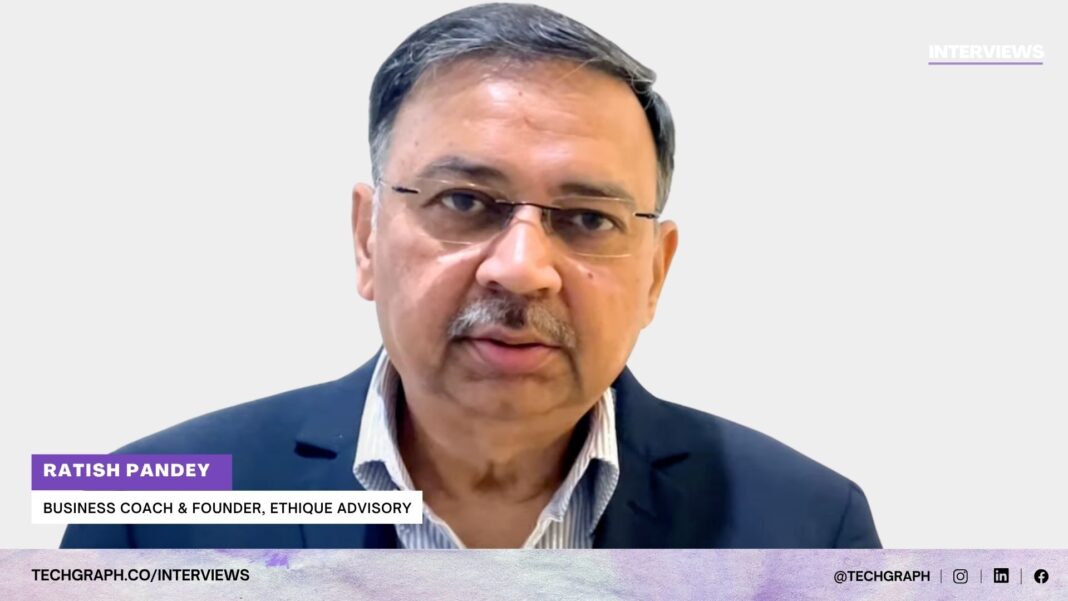
In a conversation with TechGraph, Ratish Pandey, Business Coach and Founder of Ethique Advisory, highlighted the recurring challenges faced by Indian CXOs, from over-reliance on intuition to resistance to delegation. He explained how Ethique Advisory tackles these issues through structured frameworks, measurable outcomes, and the ActionCOACH methodology, ensuring that coaching delivers tangible value for businesses navigating both legacy pressures and modern demands.
Read the interview in detail:

TechGraph: The business coaching and advisory industry has grown rapidly in recent years, but it is also becoming crowded with self-proclaimed coaches. How do you see the role of credibility and accountability shaping the future of this sector?
Ratish Pandey: The coaching space has expanded rapidly, but sheer numbers do not guarantee quality. In fact, credibility and accountability will define the future of this industry. At Ethique Advisory, in partnership with ActionCOACH, we believe coaching cannot be about buzzwords or motivational talk-it has to be about evidence-based frameworks, measurable outcomes, and ethical practice.
Clients are becoming more discerning; they want to see tangible results tied to their KPIs. This healthy scrutiny will raise the bar, ensuring only those who consistently deliver accountable value remain relevant. With three decades of proven ActionCOACH methodology behind us, we bring structure and global best practices that make business coaching a serious, results-driven discipline.
TechGraph: Indian businesses often juggle family ownership, traditional hierarchies, and the pressures of rapid digital change. How does Ethique Advisory shape its coaching to respond to these uniquely Indian challenges?
Ratish Pandey: India’s business ecosystem is at the crossroads of tradition and transformation. Family ownership and hierarchical structures battle the demands of digital agility. At Ethique Advisory, we believe every business carries its own story, especially family-run enterprises where tradition runs deep. Our role is to respect that heritage while helping leaders embrace modern ways of working. For example, we often guide families through succession planning so that the next generation can step in with clarity and confidence.
At the same time, we help put in place professional systems that make growth sustainable. Over the years, we’ve seen legacy businesses not just strengthen their foundations but also branch into new-age ventures — all without losing the cultural DNA that makes them unique. In many ways, we become the bridge: preserving what matters, while preparing leaders to thrive in a market that refuses to stand still.
TechGraph: Many Indian companies still treat leadership coaching as a quick fix, and some even hesitate to invest in structured programs because they see it as a discretionary cost. How has Ethique Advisory shifted that perception and proven tangible value creation?
Ratish Pandey: One of the first conversations we have with clients is to reposition coaching – not as a cost, but as an investment with measurable ROI. At Ethique Advisory, we directly link coaching outcomes to business metrics, including profitability, productivity, employee engagement, and leadership pipeline strength.
When clients see coaching tied to results, the perception changes. Several of our clients began with skepticism but now consider coaching central to their strategic planning because they have experienced reduced inefficiencies, improved decision-making, and accelerated growth. The key is making coaching outcomes visible and tangible.
TechGraph: There is often a debate on whether business coaching should focus more on strategic results or on personal transformation of leaders. How do you strike the right balance when working with executives?
Ratish Pandey: The truth is, it cannot be an either/or choice. Strategy without leadership growth doesn’t sustain, and personal transformation without alignment to business goals feels incomplete. At Ethique Advisory, we recognise that a business can only grow as much as its leader does. That’s why our coaching doesn’t stop at strategy.
Yes, we help leaders sharpen their business thinking, but we also focus on the person behind the role — building self-awareness, resilience, and stronger communication. When both sides grow together, the results last. Our focus is never on short-term performance uplift, but on creating growth that’s steady, sustainable, and truly holistic.
Technology is reshaping every industry, and coaching is no exception. With the rise of AI-driven platforms and virtual tools across India, how is Ethique Advisory balancing technology adoption while preserving the human depth that executive coaching requires?
Ratish Pandey: We see technology as an enabler, not a replacement. We use digital tools, AI-driven assessments, and virtual platforms for efficiency, better reach, and data insights. But the essence of coaching rests in trust, empathy, and dialogue that human interaction brings. The intent is to improve efficiency and deliverables by using technology to handle the logistics and data, while our coaches can focus on the human engagement that drives transformation. We also encourage clients to embrace AI tools, but we’ve found that the most powerful breakthroughs still come from meaningful questions and reflective conversations between coach and leader.
TechGraph: When your team works with Indian CXOs and senior leaders, what recurring blind spots or cultural patterns do you observe, and how does Ethique Advisory help them address those challenges without triggering resistance?
Ratish Pandey: Two recurring blind spots stand out. First, an over-reliance on intuition and legacy practices, often at the cost of data-driven decision-making.
Second, not wanting to delegate. A fact deeply tied to cultural notions of retaining control. We address these by introducing structured frameworks and showing small, quick wins to build confidence. For example, when leaders experience the efficiency gains from effective delegation, they begin to trust their teams more. Our role is to make change non-threatening by aligning new practices with the leader’s identity and organizational values. This way, adoption becomes natural rather than forced.