


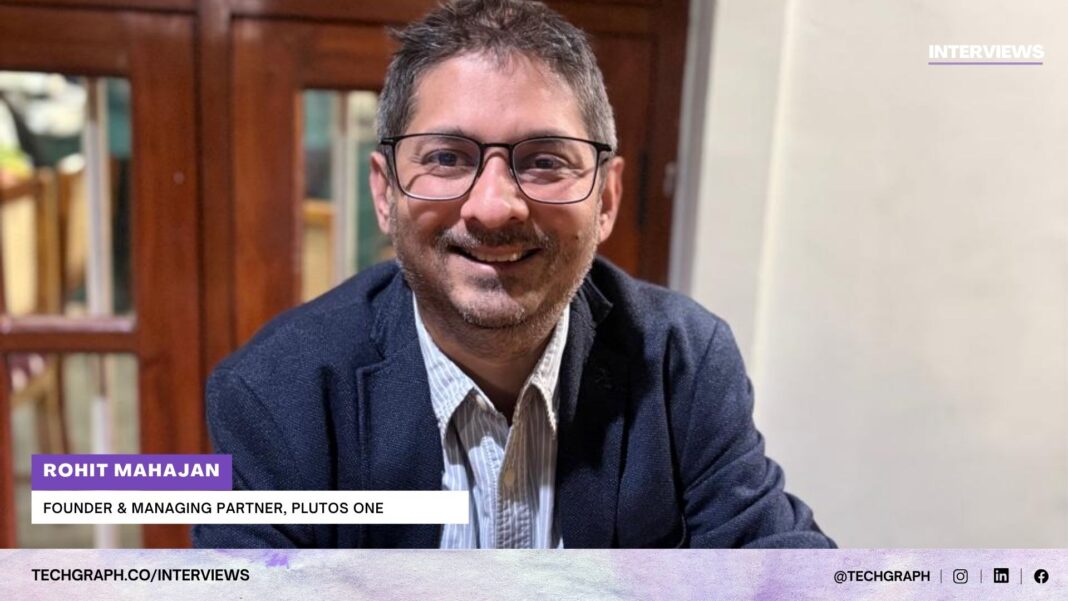
Speaking with TechGraph, Rohit Mahajan, Founder and Managing Partner of Plutos ONE, outlined how the company is taking the Bharat Bill Payment System (BBPS) deeper into semi-urban and rural markets through assisted payment models built around village-level entrepreneurs and local partners to create easier access to digital payments and help close the gap between urban and rural participation in formal finance
Mahajan further discussed how plutosONE uses GenAI-based onboarding and reconciliation tools to help banks and billers streamline backend processes, accelerate integrations, and strengthen trust in digital payments, particularly across education and municipal services.

Read in detail:
TechGraph: BBPS was meant to be the backbone of recurring payments, yet many categories like education fees and municipal services still haven’t scaled up on it. Why do you think these gaps persist despite the rails being in place? and how is plutos ONE shaping its role to bridge the gaps that still prevent universal adoption?
Rohit Mahajan: BBPS today has more than 22,000 billers, and transaction volumes are projected to grow from ₹1.2 lakh crore to over ₹3 lakh crore by 2026. Yet, gaps remain—education and municipal services being prime examples. India has over 4.5 lakh education institutions, but onboarding has been slow, largely due to old technologies and servicing-led business models that resist change.
The new CCF 1 rule has simplified education biller onboarding, and we expect new categories to be announced at GFF. Municipal services, meanwhile, are moving faster as they accelerate digitalization, and at Plutos ONE we are ensuring these billers go live in the shortest possible time. With our GenAI-powered Biller Onboarding solution, we’ve cut integration timelines from 4–5 months to just two weeks. Our goal is to add 20,000+ new billers by December 2026, driving BBPS adoption across both education and municipal categories.
TechGraph: The promise of BBPS was universality, but years later, many billers and categories remain outside it. What does that tell us about the way digital infrastructure is being built in India, and what needs to shift to fix it?
Rohit Mahajan: In only eight years, BBPS has had great success with exponential growth in the numbers. The launch of the new categories during GFF will increase BBPS’s scale of universality. NBBL continues to innovate and is focused on developing an inclusive digital bill payment ecosystem, however the next evolution should have emphasis on biller onboarding solutions quicker, extending collaboration of TSPs, while solving the last mile adoption challenge; so no consumer or biller left behind.
TechGraph: In tier II and tier III cities, people still rely on cash counters or local agents to pay their bills even when digital options are available. Do you see this as an issue of trust or habit, and how can an infrastructure player like plutos ONE help change that equation?
Rohit Mahajan: It’s a combination of trust and habit. Currently, the top 10 private apps account for 80% of online bill payments, but we know the next significant opportunity will come from bank apps and assisted models. We are closely working with our partner Common Service Centers (CSCs) to support assisted bill payments.
Our technology is enabling VLEs (Village Level Entrepreneurs) to facilitate payments across 20+ categories, and in the coming months, we will be launching a complete multilingual software suite to enhance access to these solutions. The next wave of adoption for bill payments is coming from assisted models and enabling transactions offline, specifically enabling the digital transaction experience for users who are not wholly comfortable using self-service applications.
TechGraph: Banks have a central role in expanding bill payments, but their priorities don’t always align with the speed at which the ecosystem is moving. How do you see their role evolving, and what does it take to keep them engaged in scaling this category?
Rohit Mahajan: Banks are a key pillar of the BBPS ecosystem and we must collaborate with them and agree on priorities. In the past, biller onboarding used to be a long and cumbersome process, but we’ve solved this pain point with our onboarding solutions. Our focus is to build the confidence of our banks and billers and we have the technology, service elements, advanced dashboards, reconciliation process and real time engagement to pull it all together as a TSP to build this confidence. This will drive adoption if we can keep banks engaged and the end-users supported as they adopt a more digitized experience.
TechGraph: For a consumer, paying a bill is supposed to be one of the simplest financial tasks. Yet the backend remains layered with integrations, reconciliations, and settlement challenges. Why has the industry struggled to simplify something so basic, and how do you intend to break that cycle?
Rohit Mahajan: Bill payments look simple for the consumer, but the backend has long been weighed down by fragmented integrations, delayed reconciliations, and unclear regulatory roles. With RBI now defining the role of TSPs and NBBL supported strongly by banks, the industry is finally moving toward structure and scale. At Plutos ONE, we’ve streamlined merchant and agent onboarding with bank and NBBL support, expanded our offline biller technology, and are seeing double-digit growth in transactions.
More importantly, we’re breaking the cycle of complexity with our real-time transaction dashboard and GenAI-powered reconciliation and settlement solutions, giving banks and billers full visibility and automation. The goal is clear—make bill payments not just simple for consumers, but frictionless for the institutions that power them.
TechGraph: With UPI becoming the default for everyday payments, there is growing debate on whether bill payments will remain a distinct category. Do you believe consumers even need to see bill payments as a separate experience, or is the real value in making it seamlessly invisible?
Rohit Mahajan: UPI is just a mode of payment—it doesn’t matter how you pay, what matters is making bill payments seamless, reliable, and ubiquitous across multiple channels, whether or not consumers realize they are engaging with BBPS. The real shift is towards making bill payments purposeful and integrated into everyday financial behavior. The ecosystem will expand as more billers are onboarded at scale and assisted models drive inclusion in rural India, ensuring payments become simple, invisible, and inclusive.
TechGraph: The surge in digital adoption has brought rising cyber risks, especially in areas involving payments, banking, and card data where even a single breach can erode trust. How do you see plutosONE’s role in strengthening fraud resilience in this space, and what kind of safeguards should the industry adopt as standard practice?
Rohit Mahajan: For plutos ONE, security is always a consideration. We are ISO 27001 compliant, continuously running tests and rebuilding our payment infrastructure with partners like Google and Uber. The NPCI is updating the security framework that the entire ecosystem uses regularly and we make sure that we are in transition relative to those guidelines. Regular audits, proactive fraud monitoring, and consumer education will be key measures in enhancing trust for our consumers, especially as digital usage continues to increase.
TechGraph: Looking ahead, what does success for Bharat’s bill payment infrastructure look like in the next five years, and what is the role you envision for plutosONE in shaping that journey?
Rohit Mahajan: BBPS has transitioned to Bharat Connect, and the next five years will focus on scale, innovation and deeper penetration. IBMB is planned for launch during GFF, and Bharat Connect B2B is expected to be a large growth engine by 2026. plutos ONE is already the number 2 player in the ecosystem by volume; we want to be TSP #1 with 100+ banks onboarded in the next year. Our strong focus to onboard billers, enable assisted models, and simplify tech will drive our participation predicting the future of Bharat’s bill payment infrastructure.