



The solar and clean energy sector has welcomed Union Budget 2026–27 for its focus on strengthening domestic manufacturing and energy security, particularly through customs duty exemptions for batteries, energy storage systems, critical mineral processing, and solar glass inputs. Industry leaders said the sharp rise in funding for PM Surya Ghar and KUSUM to ₹27,000 crore, along with support for advanced manufacturing and hi-tech tooling, is expected to improve demand visibility for domestic manufacturers, lower input costs, and accelerate rooftop and distributed solar adoption across urban and rural India.
Experts, however, noted that delays in fund flow, uneven state-level implementation, and continued dependence on NBFC-led consumer financing could affect adoption, particularly among residential customers and smaller developers.

Read detailed reactions from solar industry leaders below
Dr. Chetan Shah, Chairman & Managing Director, Solex Energy Limited
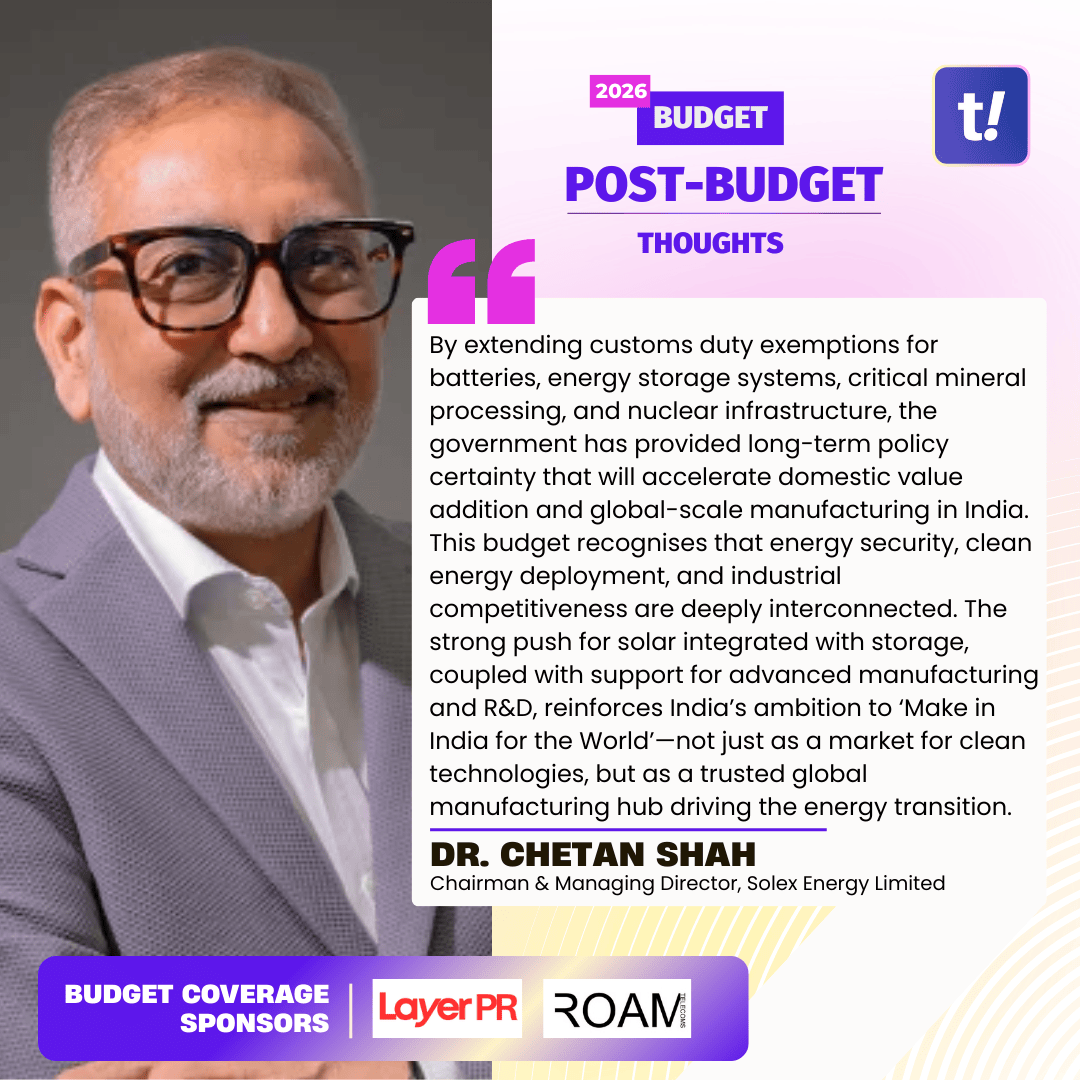
The Union Budget 2026–27 clearly positions manufacturing at the heart of India’s energy transition. By extending customs duty exemptions for batteries, energy storage systems, critical mineral processing, and nuclear infrastructure, the government has provided long-term policy certainty that will accelerate domestic value addition and global-scale manufacturing in India.
This budget recognises that energy security, clean energy deployment, and industrial competitiveness are deeply interconnected. The strong push for solar integrated with storage, coupled with support for advanced manufacturing and R&D, reinforces India’s ambition to ‘Make in India for the World’—not just as a market for clean technologies, but as a trusted global manufacturing hub driving the energy transition.
Vinay Rustagi, CBO, Premier Energies
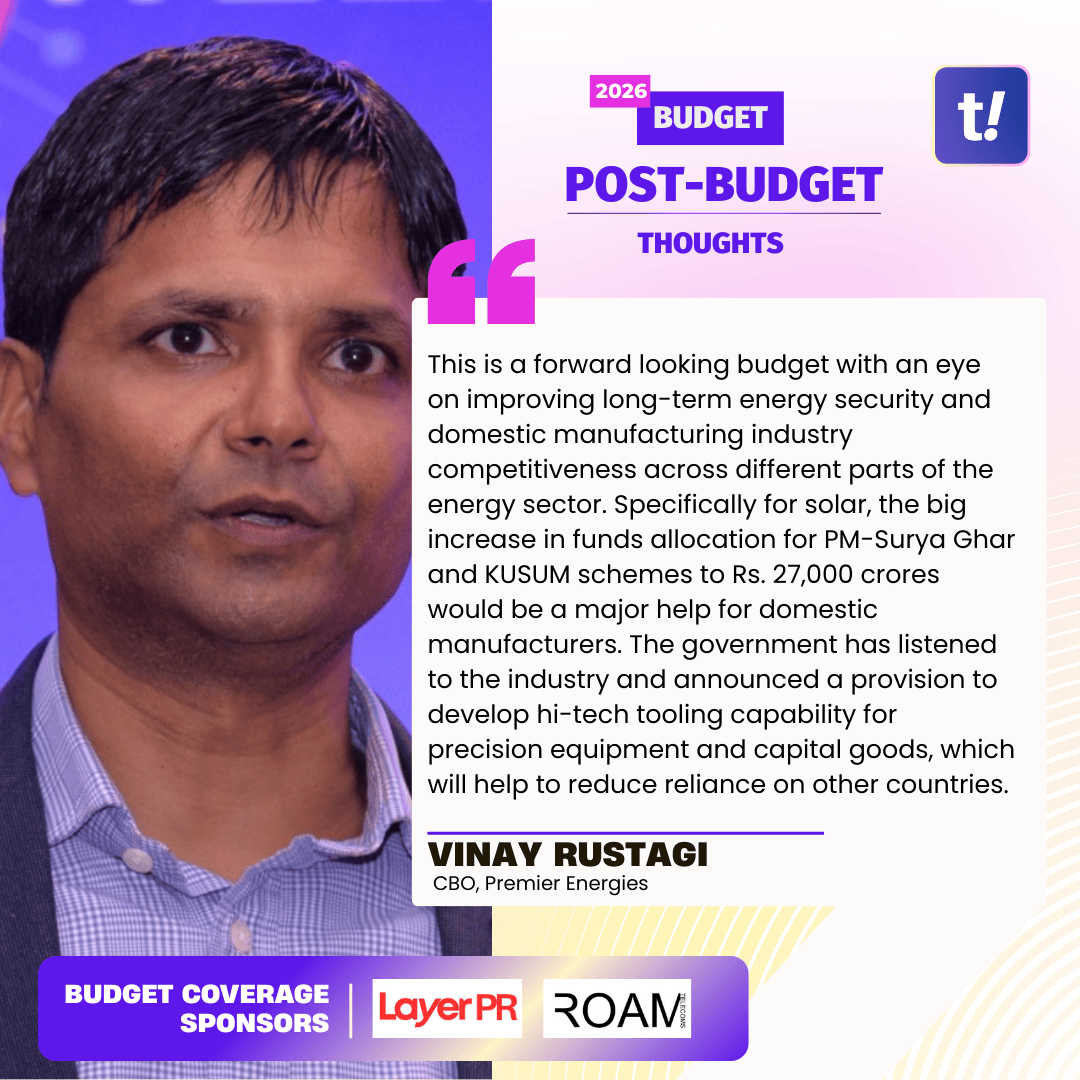
This is a forward-looking budget with an eye on improving long-term energy security and domestic manufacturing industry competitiveness across various parts of the energy sector. Specifically for solar, the big increase in funds allocation for PM-Surya Ghar and KUSUM schemes to Rs. 27,000 crores would be a major help for domestic manufacturers.
The government has listened to the industry and announced a provision to develop high-tech tooling capability for precision equipment and capital goods, which will help to reduce reliance on other countries. Import duty waivers on equipment used for battery storage manufacturing and critical mineral processing are expected to reduce the cost of domestically manufactured products. Other significant measures include substantial financial support for developing new technologies like carbon capture and nuclear.
Saurabh Marda, Co-Founder & Managing Director, Freyr Energy

The restructuring of REC and PFC is a welcome step that could strengthen financing for solar projects. These institutions play a critical role in enabling consumer solar adoption—many of our residential customers access loans through NBFCs and banks that ultimately source capital from REC and PFC. Improved operational efficiency and lending capacity at these institutions should translate to better access and terms for consumer solar financing.
The customs duty exemption on solar glass manufacturing inputs, along with the continued support for Battery Energy Storage Systems, reinforces the government’s commitment to building a robust domestic clean energy ecosystem. Combined with the PM Surya Ghar program’s momentum—now serving 2.5 lakh households—we’re seeing strong tailwinds for distributed solar adoption in India.
At Freyr Energy, we’re focused on leveraging these policy supports to make solar more accessible and affordable for the millions of Indian households ready to make the switch to clean energy.