



The Union Budget 2025, presented by Finance Minister Nirmala Sitharaman on Saturday, has drawn various reactions from investors and the startup community. The ₹10,000 crore Fund of Funds (FoF) announced in the budget has been welcomed by many as a significant step in strengthening early-stage funding.
Some view this as a sign of the government’s continued support for startups, reinforcing the role of Alternative Investment Funds (AIFs) in mobilizing capital.

The announcement to double the credit guarantee for startups from ₹10 crore to ₹20 crore has also received positive responses, with industry voices highlighting its potential to improve access to debt capital and reduce equity dilution. While these measures address long-standing demands, some investors remain cautious about their implementation, calling for clarity on fund disbursement and regulatory processes.
Read the budget reactions in detail:
Padmaja Ruparel, Co-founder, IAN Group

With over 1.5 lakh startups approved by DPIIT and the government’s renewed focus on innovation, India’s startup ecosystem is all set to expand further. The Budget 2025 announcement of an additional ₹10,000 crore Fund of Funds is revolutionary and reaffirms the government’s continued support for startups.
The Fund, which builds on the FFS scheme launched in 2016 will reduce reliance on foreign investments with essential capital up to the seed, growth stage. This would be in compliance with the Startup India action plan and will bring about a lot of domestic funding and innovation along with making India a global leader in deeptech and entrepreneurship.
Bhaskar Majumdar, Managing Partner, Unicorn India Ventures

Given that deeptech is being seen as an area for growth at the national level, with a China +1 macro and the creation of the PLI/DLI schemes of the government, this is a great step. The Government has created this FoF for deeptech to enable funds to invest in deeptech and back highly innovative startups that can put India in a competitive global AI race.
Hand in hand, in continuation of the R&D fund of last year, the Government has enhanced the same for enterprises to enable technology innovation. This shows that the Govt realizes that future innovation is the heart of economic growth as the global wars are fought around AI and Semiconductors.
Mayuresh Raut, Managing Partner, Seafund

The increase in credit guarantee for startups from Rs 10 crore to Rs 20 crore is a much-needed demand that has been finally accepted. This will not only enable startups to have access to debt capital it will also help them scale faster with less equity dilution.
Hence, it will lead to a virtuous cycle of higher top line, less equity dilution, better valuation, and better fundraising. As the budget commenced, the FM highlighted that they would like to see 70% of women’s participation in economy building. Thus, the addition to the credit guarantee will ensure a timely boost, as more women entrepreneurs are needed for our ecosystem.
With regards to the earlier 3 Centers of Excellence, this along with Krishi Dhan Dhanya program will bring the best of AI practices to the agri-tech startups ecosystem and breed further innovation. Our view is that this requires large patient capital, but aligns us with the renaissance and renewed interest in nuclear energy that is happening all over the world, led by the US. Definitely opens the sector to private investors. Push for data centres consuming huge powers will need nuclear power which will further fuel our AI aspirations.
Bruce Keith, Co-founder & CEO, InvestorAi

While the Budget started with a big bang quite literally, the Honourable Finance Minister has announced a string of boosters for the Indian startup sector. The extensions to the loan programs make sense in the context of micro-enterprises.
However, the crucial fund of funds of Rs 10,000 crore will play a key role in boosting domestic capital in the startup sector. The announcement on the deep tech fund, while details are awaited, should be viewed through the DeepSeek lens of what can be done with relatively small amounts of capital when provided to agile and creative teams. We expect the VC ecosystem to bring velocity and momentum into funding these enterprises.
I was especially delighted to hear about enhancing the “spirit of curiosity and innovation with IIT expansions of capacity and centers of excellence for AI education – talent availability is a necessary part of continuing our growth.
Sridhar Parthasarathy, Co-Founder & General Partner, Bluehill VC

The government’s announcement of another Fund of Funds (FoF) worth ₹10,000 crore in the budget shows a strong commitment to cultivating an entrepreneurial ecosystem and acknowledgment of the role of Alternative Investment Funds (AIFs) in channeling these resources effectively.
While equity funding through AIFs is essential, there is an urgent need for debt financing for startups. The introduction of a credit guarantee will help startups achieve a balanced mix of equity and debt funding, making their growth more sustainable.
Additionally, the plan for a new Deep Tech Fund of Funds is a crucial step towards advancing deep-tech innovation in India. This signals a clear intent from the govt to position India strongly in the global AI race, which is much much-needed boost for deep tech startups especially in AI and space tech.
Ankur Mittal, Co-founder, Inflection Point Ventures

Our ask was a better credit platform and framework for startups and to that extent, this is a welcome step. This will allow them to grow and build sustainable businesses and not be dependent on just equity infusion to grow.
Their capacity to attract follow-on growth capital will be further strengthened by the additional cash, which will also help them make important investments in operations, personnel, and technology. This action boosts job creation, accelerates startup growth, and creates long-term value in the ecosystem by resolving financial limitations.
Pramod Gummaraj, Founder and CEO, Aprecomm

The government’s renewed commitment to fostering innovation through the additional ₹10,000 crore Fund of Funds for Startups is a significant boost for the entrepreneurial ecosystem. Such measures not only ease capital constraints but also foster an ecosystem where disruptive deep tech can thrive.
The Bharat Net Scheme’s focus on providing broadband connectivity to all government secondary schools is commendable, as it lays the foundation for a digitally inclusive society. Enhanced connectivity will bridge the digital divide and open avenues for tech-driven education. Furthermore, by increasing investment and turnover limits for MSMEs, the government empowers these enterprises to scale and innovate, reinforcing their role as pivotal contributors to the economy.
Sirish Korada, Managing Director & CEO, BINDZ

The Union Budget 2025-26 underscores the government’s unwavering commitment to fostering entrepreneurship and innovation. The establishment of a ₹10,000 crore corpus under the Startup India initiative, coupled with a ₹91,000 crore alternative investment fund and an expanded ₹10,000 crore Fund of Funds (FoF), is a decisive move to accelerate startup growth.
Additionally, enhancing credit guarantee cover for startups will significantly improve access to capital, fostering a more robust and dynamic entrepreneurial ecosystem. These measures will not only attract investment but also drive job creation and contribute meaningfully to India’s economic growth trajectory.
Pratip Mazumdar, Partner at Inflexor Ventures
A ₹10,000 crore infusion into a new Fund of Funds announced by Finance Minister Sitharaman alongside tailored schemes for female entrepreneurs & first-time entrepreneurs from underrepresented communities, is exactly the kind of bold step India needs to fuel the next wave of disruptive startups.
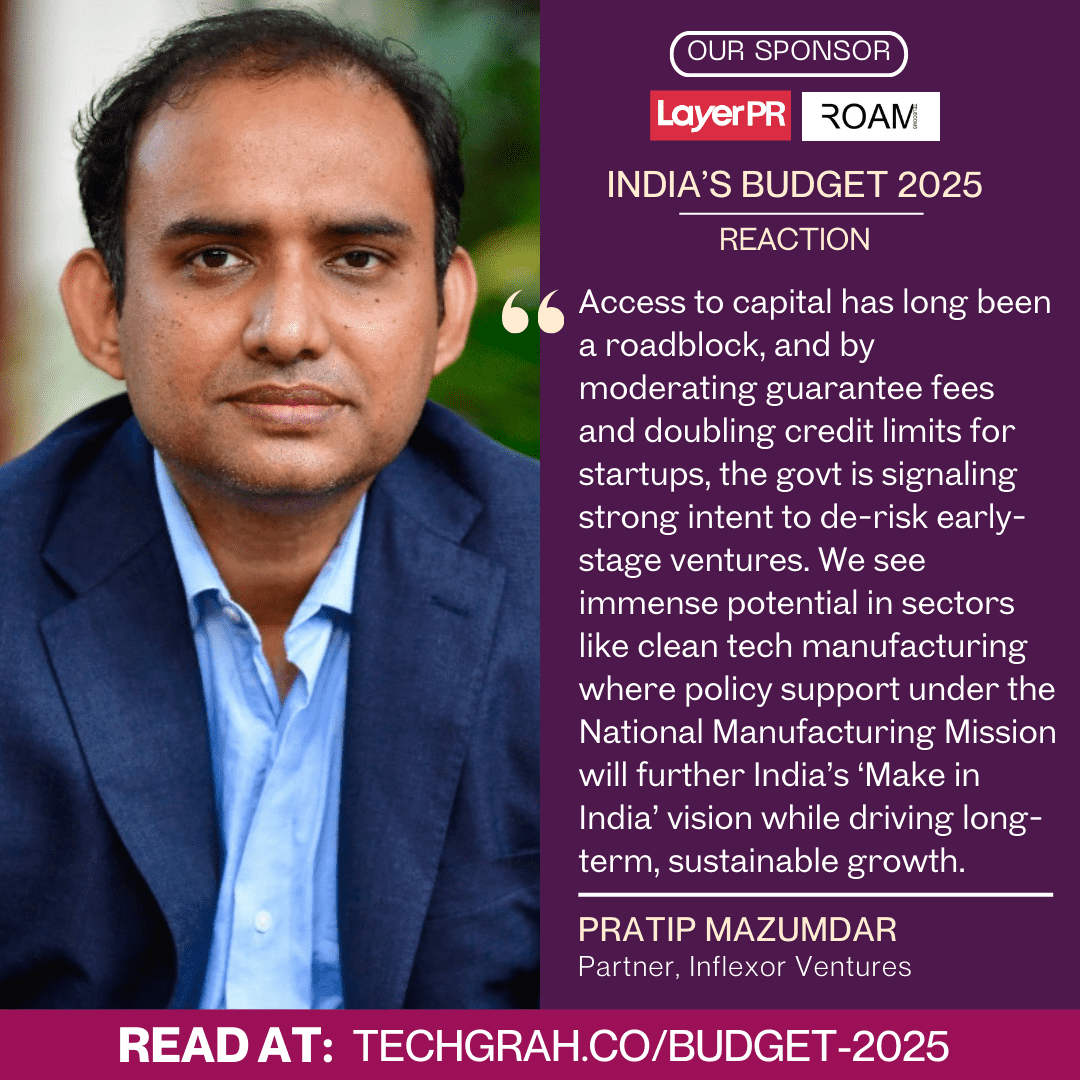
Access to capital has long been a roadblock, and by moderating guarantee fees and doubling credit limits for startups, the government is signaling strong intent to de-risk early-stage ventures. We see immense potential in sectors like clean tech manufacturing where policy support under the National Manufacturing Mission will further India’s ‘Make in India’ vision while driving long-term, sustainable growth.
Manish Aggarwal, CEO & Founder, FINQY

The Union Budget 2025-26 brings a welcome boost for India’s startup ecosystem, particularly in improving access to credit and fostering growth. The increase in the credit guarantee cover for startups to ₹20 crore, with a moderated guarantee fee, will significantly enhance funding opportunities for emerging businesses in critical sectors.
The announcement of establishing a new Fund of Funds underscores the government’s commitment to nurturing innovation and scaling high-potential ventures. Extending tax benefits under Section 80-IAC for startups incorporated until 2030 is another encouraging step, providing much-needed financial relief and incentivizing entrepreneurship.
I believe these measures will help strengthen the foundation for a self-reliant and globally competitive startup ecosystem in India. The increased emphasis on Fintech solutions to enable Startups & MSMEs to access financial services will further facilitate the ease of doing business in the country.
Yash Kela, Founder, Singularity Ventures

The Union Budget 2025-26 reinforces India’s commitment to startups, deeptech, and sustainable innovation. The ₹10,000 crore Fund of Funds for Startups and the proposed Deeptech Fund will provide vital financial backing, while 10,000 research fellowships at IITs and IISc will strengthen the design first, product + service export ecosystem we want to build in the country.
The focus on clean tech manufacturing—spanning solar PV cells, EV batteries, electrolyzers, and wind turbines—positions India as a global leader in climate-friendly industrial growth.
Additionally, the ₹2 crore funding scheme for first-time women entrepreneurs is a significant step toward fostering inclusive business leadership. At Singularity, we believe these bold initiatives that will accelerate startup growth, drive deeptech breakthroughs, and propel India toward global innovation leadership.
Harsh Jayesh Ruparel, Co-Founder & CEO, Commbitz

The abolition of the ‘angel tax’ is a progressive step towards boosting the Indian start-up ecosystem. The removal will facilitate more investment and foster innovation within the start-up community. The additional ₹10,000 crore contribution announced by the honorable Finance Minister presents a dynamic opportunity for startups to accelerate their growth.
Furthermore, with enhanced financial support from the government, startups will now be able to access much-needed capital to scale operations, develop innovative products, and explore new markets. This funding injection not only provides direct financial benefits but also encourages investor confidence, leading to increased private funding opportunities.
It is equally important to note that startups can also leverage these funds to invest in research and development, enabling them to adopt advanced technologies and stay competitive in dynamic markets.
Moreover, the increased funding will also make it easier for startups to venture into emerging sectors, driving innovation and contributing to the country’s technological advancements. We are positive that this financial boost will set the stage for the start-up sector to achieve sustained growth, enhancing their market presence and overall impact.”
Girish Shivani, Executive Director and Fund Manager, YourNest Venture Capital

The ₹10,000 crore Fund of Funds is a big step forward for India’s startup scene. Besides increasing support for early-stage businesses, it also indicates how confident the government is in the Indian startup ecosystem’s capacity for expansion.
At YourNest, we believe that access to capital is key to fostering innovation, and this fund will give Indian business owners more opportunities to expand globally. We are excited to see how this program accelerates the expansion of startups, especially in deeptech and innovation-driven industries.
Ravi Mittal, Founder and CEO, QuackQuack

The Union Budget 2025-2026 takes a strong step toward strengthening India’s startup ecosystem with an additional ₹10,000 crore Fund of Funds. Access to capital remains one of the biggest obstacles for emerging businesses, and this fresh infusion of funds will provide critical support for startups to innovate, expand, and create jobs.
Additionally, the new scheme for first-time women, SC, and ST entrepreneurs is a commendable move toward fostering inclusivity and diversity in the entrepreneurial landscape.
At QuackQuack, we understand the challenges of building something from the ground up, and we believe such initiatives will empower more founders to take bold steps toward their dreams. This is a positive push toward making India a global hub for innovation and entrepreneurship.
Ankit Kedia, Founder and Lead Investor, Capital-A.

The Union Budget 2025 sends a strong signal to India’s startup ecosystem. Extending tax benefits until 2030 and raising the credit guarantee to ₹20 crore will ease access to capital, a critical need for early-stage founders.
The ₹10,000 crore Fund of Funds is a step in the right direction, but what really stands out is the proposed Deep Tech Fund of Funds—recognizing that frontier innovation in AI, manufacturing, energy transition, semiconductors, and cybersecurity needs patient capital.
Beyond tech, it’s encouraging to see clean tech and manufacturing startups getting policy tailwinds. The National Manufacturing Mission and incentives for EV batteries, solar PV, and advanced industrial components could create strong domestic champions in these spaces.
However, the gap remains in structured growth capital for mid-to-late-stage startups—these companies need clearer regulatory pathways for global expansion and capital beyond early-stage grants. If India is to compete globally, we need to bridge that funding gap and create a more seamless scale-up environment.
Sakshi Shah, Founder, GoodLives

The Union Budget 2025-2026 demonstrates a strong commitment to nurturing India’s startup ecosystem. The additional ₹10,000 crore Fund of Funds is a crucial step in addressing the funding challenges that many startups face, helping them scale and sustain growth.
What stands out even more is the dedicated support for first-time women and underrepresented entrepreneurs. Building a business requires not just capital but also confidence, and this initiative will encourage more diverse voices to enter the entrepreneurial space.
At GoodLives, we believe in holistic growth both personal and professional and this move will empower many to take the leap into entrepreneurship with greater assurance. It’s heartening to see such inclusive steps being taken to fuel innovation and progress in India.