




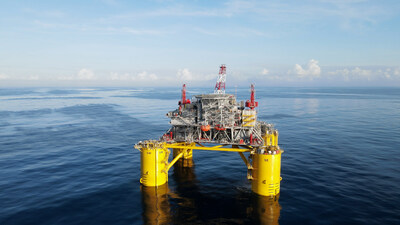
“Vito is an excellent example of how we are approaching our projects to meet the energy demands of today and tomorrow, while remaining resilient as we work toward achieving net zero emissions by 2050,” said Zoe Yujnovich, Shell’s Upstream Director, adding, “Building on more than 40 years of deep-water expertise, projects like Vito enable us to generate greater value from the GoM, where our production has amongst the lowest greenhouse gas intensity in the world for producing oil.”
The Vito development is owned by Shell Offshore Inc. (63.11% operator) and Equinor (36.89%). In 2015, the original host design was rescoped and simplified, resulting in a reduction of approximately 80% in CO2 emissions over the lifetime of the facility as well as a cost reduction of more than 70% from the original host concept.
Vito also serves as the design standard for our Whale project that will feature a 99% replication of the Vito hull and 80% of Vito’s topsides.
Shell’s Powering Progress strategy to thrive through the energy transition includes increasing investment in lower-carbon energy solutions, while continuing to pursue the most energy-efficient and highest-return Upstream investments.
Notes to editors
- Originally discovered in 2009, the Vito field spans four Outer Continental Shelf (OCS) blocks in the Mississippi Canyon and is located at a depth of more than 4,000 feet (1,220 metres) of water. The host is located approximately 150 miles (241 kilometres) southeast of New Orleans and 10 miles (16 kilometres) south of the Shell-operated Mars TLP.
- Shell announced a final investment decision (FID) on the Vito project in April 2018.
- Vito is a four-column semi-submersible host facility with eight subsea wells (31,000 feet or 9,400 metres) with deep (18,000 feet or 5,500 metres) in-well, gas lift, and associated subsea flowlines and equipment.
- Vito will produce into Shell Midstream’s Mars Pipeline system.
- The Vito field includes leases subject to the Gulf of Mexico Energy Security Act of 2006, which share lease revenues with Gulf producing states and the Land & Water Conservation Fund for coastal restoration projects.
- Current estimated recoverable resource volume of the Vito development is 290 million boe. The estimate of resources volumes is currently classified as 2p and 2c under the Society of Petroleum Engineers’ Resource Classification System.
- The estimated peak production and current estimated recoverable resources presented above are 100% total gross figures.
- Vito is Shell’s 13th deep-water host in the Gulf of Mexico.
- Shell reached an FID on Whale in 2021 and is currently scheduled to begin production in 2024.
- The reference to our US Gulf of Mexico production being among the lowest GHG intensity in the world is a comparison among other IOGP oil-and gas-producing members.
- Shell is the leading operator in the US Gulf of Mexico for oil and gas production.
- In addition to operations in Brazil and the US Gulf of Mexico, Shell’s deep-water portfolio includes our Argentina Shales organization and frontier exploration opportunities in Mexico, Suriname, Sao Tome & Principe, Argentina and Namibia.
Cautionary note
The companies in which Shell plc directly and indirectly owns investments are separate legal entities. In this announcement, “Shell”, “Shell Group” and “Group” are sometimes used for convenience where references are made to Shell plc and its subsidiaries in general. Likewise, the words “we”, “us” and “our” are also used to refer to Shell plc and its subsidiaries in general or to those who work for them. These terms are also used where no useful purpose is served by identifying the particular entity or entities. ”Subsidiaries”, “Shell subsidiaries” and “Shell companies” as used in this announcement refer to entities over which Shell plc either directly or indirectly has control. Entities and unincorporated arrangements over which Shell has joint control are generally referred to as “joint ventures” and “joint operations”, respectively. “Joint ventures” and “joint operations” are collectively referred to as “joint arrangements”. Entities over which Shell has significant influence but neither control nor joint control are referred to as “associates”. The term “Shell interest” is used for convenience to indicate the direct and/or indirect ownership interest held by Shell in an entity or unincorporated joint arrangement, after exclusion of all third-party interest.
Forward-Looking Statements
This announcement contains forward-looking statements (within the meaning of the U.S. Private Securities Litigation Reform Act of 1995) concerning the financial condition, results of operations and businesses of Shell. All statements other than statements of historical fact are, or may be deemed to be, forward-looking statements. Forward-looking statements are statements of future expectations that are based on management’s current expectations and assumptions and involve known and unknown risks and uncertainties that could cause actual results, performance or events to differ materially from those expressed or implied in these statements. Forward-looking statements include, among other things, statements concerning the potential exposure of Shell to market risks and statements expressing management’s expectations, beliefs, estimates, forecasts, projections and assumptions. These forward-looking statements are identified by their use of terms and phrases such as “aim”, “ambition”, ”anticipate”, ”believe”, ”could”, ”estimate”, ”expect”, ”goals”, ”intend”, ”may”, “milestones”, ”objectives”, ”outlook”, ”plan”, ”probably”, ”project”, ”risks”, “schedule”, ”seek”, ”should”, ”target”, ”will” and similar terms and phrases. There are a number of factors that could affect the future operations of Shell and could cause those results to differ materially from those expressed in the forward-looking statements included in this announcement, including (without limitation): (a) price fluctuations in crude oil and natural gas; (b) changes in demand for Shell’s products; (c) currency fluctuations; (d) drilling and production results; (e) reserves estimates; (f) loss of market share and industry competition; (g) environmental and physical risks; (h) risks associated with the identification of suitable potential acquisition properties and targets, and successful negotiation and completion of such transactions; (i) the risk of doing business in developing countries and countries subject to international sanctions; (j) legislative, judicial, fiscal and regulatory developments including regulatory measures addressing climate change; (k) economic and financial market conditions in various countries and regions; (l) political risks, including the risks of expropriation and renegotiation of the terms of contracts with governmental entities, delays or advancements in the approval of projects and delays in the reimbursement for shared costs; (m) risks associated with the impact of pandemics, such as the COVID-19 (coronavirus) outbreak; and (n) changes in trading conditions. No assurance is provided that future dividend payments will match or exceed previous dividend payments. All forward-looking statements contained in this announcement are expressly qualified in their entirety by the cautionary statements contained or referred to in this section. Readers should not place undue reliance on forward-looking statements. Additional risk factors that may affect future results are contained in Shell plc’s Form 20-F for the year ended December 31, 2021 (available at www.shell.com/investor and www.sec.gov). These risk factors also expressly qualify all forward-looking statements contained in this announcement and should be considered by the reader. Each forward-looking statement speaks only as of the date of this announcement, February 16, 2023. Neither Shell plc nor any of its subsidiaries undertake any obligation to publicly update or revise any forward-looking statement as a result of new information, future events or other information. In light of these risks, results could differ materially from those stated, implied or inferred from the forward-looking statements contained in this announcement.
Shell’s net carbon footprint
Also, in this announcement we may refer to Shell’s “Net Carbon Footprint” or “Net Carbon Intensity”, which include Shell’s carbon emissions from the production of our energy products, our suppliers’ carbon emissions in supplying energy for that production and our customers’ carbon emissions associated with their use of the energy products we sell. Shell only controls its own emissions. The use of the term Shell’s “Net Carbon Footprint” or “Net Carbon Intensity” are for convenience only and not intended to suggest these emissions are those of Shell plc or its subsidiaries.
Shell’s net-Zero Emissions Target
Shell’s operating plan, outlook and budgets are forecasted for a ten-year period and are updated every year. They reflect the current economic environment and what we can reasonably expect to see over the next ten years. Accordingly, they reflect our Scope 1, Scope 2 and Net Carbon Footprint (NCF) targets over the next ten years. However, Shell’s operating plans cannot reflect our 2050 net-zero emissions target and 2035 NCF target, as these targets are currently outside our planning period. In the future, as society moves towards net-zero emissions, we expect Shell’s operating plans to reflect this movement. However, if society is not net zero in 2050, as of today, there would be significant risk that Shell may not meet this target.
Forward Looking Non-GAAP measures
This announcement may contain certain forward-looking non-GAAP measures such as cash capital expenditure and divestments. We are unable to provide a reconciliation of these forward-looking Non-GAAP measures to the most comparable GAAP financial measures because certain information needed to reconcile those Non-GAAP measures to the most comparable GAAP financial measures is dependent on future events some of which are outside the control of Shell, such as oil and gas prices, interest rates and exchange rates. Moreover, estimating such GAAP measures with the required precision necessary to provide a meaningful reconciliation is extremely difficult and could not be accomplished without unreasonable effort. Non-GAAP measures in respect of future periods which cannot be reconciled to the most comparable GAAP financial measure are calculated in a manner which is consistent with the accounting policies applied in Shell plc’s consolidated financial statements.
The contents of websites referred to in this announcement do not form part of this announcement.
We may have used certain terms, such as resources, in this announcement that the United States Securities and Exchange Commission (SEC) strictly prohibits us from including in our filings with the SEC. Investors are urged to consider closely the disclosure in our Form 20-F, File No 1-32575, available on the SEC website www.sec.gov.
Photo – https://techgraph.co/wp-content/uploads/2023/02/Shell_s_newest_platform_in_the_US_Gulf_of_Mexico___Vito.jpg
Logo – https://techgraph.co/wp-content/uploads/2023/02/Shell_Logo.jpg
View original content:https://www.prnewswire.co.uk/news-releases/shell-starts-production-at-vito-in-us-gulf-of-mexico-301748369.html