


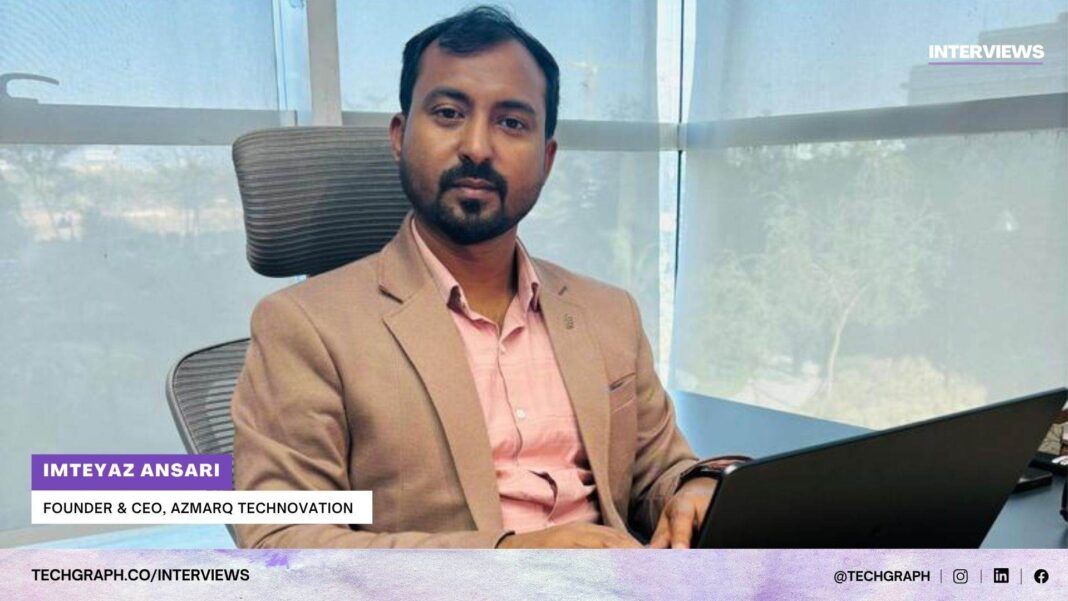
Speaking with TechGraph, Imteyaz Ansari, Founder and CEO of Azmarq Technovation, discussed how Indian CPaaS providers hold a competitive advantage through their understanding of local regulations, linguistic diversity, and regional communication preferences that shape enterprise messaging strategies.
He also spoke about how Azmarq is leveraging its Baynix.ai platform to combine this local expertise with scalable cloud infrastructure and strong compliance frameworks, enabling the company’s expansion into regions such as MENA while creating a secure-by-design platform that strengthens data governance and builds long-term enterprise trust in large-scale digital communication.

Read the interview in detail:
TechGraph: As enterprises increasingly adopt omni-channel strategies, where do you see the biggest gaps today in how businesses manage conversations across WhatsApp, RCS, SMS, and other channels, and how is Azmarq addressing those challenges?
Imteyaz Ansari: Many businesses still manage channels like WhatsApp, SMS, and RCS in isolation, without a unified communication strategy. This fragmented approach often leads to fragmented customer experiences, message duplication, loss of contextual continuity, and missed engagement opportunities. For instance, a transaction may begin on SMS before shifting to WhatsApp, losing valuable conversation history or personalization in the process, resulting in inefficiencies that ultimately devalue customer engagement.
Azmarq solves these issues with its integrated Omni-Platform, presented under Baynix.ai, which brings channel management onto one easy-to-use dashboard. Our platform takes advantage of AI-based message routing, smart fallback mechanisms in case of a failure of a primary channel, and detailed cross-channel analytics to offer complete visibility. This solution ensures flawlessly continuous behavior across channels, saves user context, enforces compliance regulations, and presents a consistent brand experience across the customer journey. The result is a massive cut in message redundancy, better targeting of the audience, and less convoluted operational processes, assisting businesses in communicating more effectively and efficiently with their customers.
TechGraph: Many organizations see AI as a buzzword in customer engagement, but the real test is in execution. From your perspective, what does meaningful AI adoption in business messaging look like, and how can companies move beyond just chatbots to achieve real value?
Imteyaz Ansari: Effective AI implementation goes well beyond surface-level automation like chatbots and scripted replies. It involves infusing sophisticated machine learning and predictive models across the entire messaging stack. This involves optimizing channel priority, sequencing messages strategically, building comprehensive behavioral profiles, and adjusting the timing of message delivery to maximize impact.
We are one step ahead at Azmarq by embedding AI directly into our flow builders. This creates adaptive message flows that adjust in real-time according to user feedback, device used, or channel. Our prediction engines determine delivery success and engagement probability in real time so that businesses can anticipate failures beforehand, for instance, falling back to an alternative channel if a WhatsApp message is not delivered. The outcome is a value-driven effect on critical measures: increased conversion, fewer customer drop-offs, and better overall satisfaction. This method is centered on important business results, not a higher volume of messages or even increased open rates.
TechGraph: India’s CPaaS and SaaS ecosystem is scaling rapidly and becoming globally competitive. In the CPaaS space specifically, what unique advantages or hurdles do Indian players face when compared to global incumbents?
Imteyaz Ansari: Indian CPaaS players have a major advantage with a native understanding of the local market. They have experience with local regulatory requirements, including conformity to TRAI rules and DLT regulations, as well as knowledge about regional consumer behavior patterns and cost sensitivities. They are familiar with vernacular language choices, times of high traffic, and favored communication channels by regions in India. This local intelligence allows for more flexibility in product development, pricing models, and deployment strategies, which is often difficult for many international entrants to replicate.
However, Indian CPaaS providers face significant challenges when scaling internationally. Expanding beyond domestic markets requires substantial investment in infrastructure, strict compliance with diverse regulatory frameworks across multiple jurisdictions, and building trust with large enterprises that demand enterprise-grade security and reliability.
In order to compete on an international scale, Indian CPaaS companies have to invest hugely in international-standard architecture, acquire premier security accreditations, design extremely scalable APIs, and achieve smooth cross-border operations. Azmarq, for instance, is a company that is overcoming these challenges by fusing rich local understanding with cloud scalability, venturing into new territories such as MENA under its Baynix.ai platform, thus balancing international demand with local market strengths accordingly.
TechGraph: With WhatsApp, RCS, SMS, and new platforms emerging, enterprises often face confusion about prioritizing channels. How should a brand decide where to invest its communication efforts without diluting customer engagement?
Imteyaz Ansari: Brands need to strategically align their business use cases with the most appropriate communication channels instead of simply adding channels indiscriminately. For example, urgent transactional alerts are most effectively delivered via SMS, supported by a fallback to WhatsApp to ensure timely and reliable delivery. Conversely, promotional or rich-media content benefits from RCS or branded messaging, which enables interactive and visually engaging customer experiences. Effective channel prioritization must consider factors such as message urgency, content format, user preferences, cost efficiency, and historical delivery performance.
Azmarq’s platform leverages AI-driven intelligence to recommend the optimal channel for each message by analyzing factors such as past delivery success, user device compatibility, channel latency, and engagement likelihood. Automated fallback mechanisms and A/B testing across user segments enable brands to optimize communication strategies, minimizing over-communication and customer fatigue. Ultimately, data-driven metrics like engagement rates, response times, and conversion outcomes guide effective channel investments, ensuring maximum ROI and enhanced customer experience.
TechGraph: Security and trust have become non-negotiable in enterprise communication. How do you see compliance, data privacy, and secure automation evolving in the next few years, especially when businesses are engaging at scale?
Imteyaz Ansari: As communication platforms scale, prioritizing security and trust becomes imperative. Emerging regulatory frameworks in India, including DPDP and DLT regulations, alongside global standards such as GDPR, mandate secure-by-design architectures featuring end-to-end encryption, comprehensive audit trails, role-based access controls, and transparent data privacy policies.
Azmarq meets all these requirements, having undergone ISO-27001 certification, AES-256 encryption for data security, secure API endpoints, and rigorous data governance policies. Our platform also includes multi-layered fallback mechanisms and real-time monitoring to identify and suppress anomalous or suspicious activity in advance.
In the future, the sector will transition to zero-trust architectures in which each access request is stringently checked, along with real-time automated compliance that can dynamically redact or deny non-compliant material. As enterprises become more in charge of sensitive customer information, platforms that provide strong security, trust, and automated compliance will be key differentiators in the communication technology sector.
TechGraph: Customer expectations are shifting from one-way alerts to conversational and context-aware experiences. What role do you see rich messaging technologies like RCS playing in shaping that future, and do you think businesses in India are ready to embrace it?
Imteyaz Ansari: Rich messaging platforms like RCS are redefining business communication by turning one-way notifications into interactive, branded, and context-relevant conversations. RCS is different from SMS in that it supports capabilities like carousels, actionable buttons, payment links, and in-message chatbot-like flows, providing an app-like experience within the native messaging app. This enhances engagement and enables businesses to provide guided experiences, rather than passive notifications.
The RCS ecosystem in India is emerging, but the ecosystem is slowly developing. Telecom infrastructure is transforming, and operators are better prepared. Brand awareness, device support, and consumer education continue to be the main challenges. Cost models and ROI clarity also require fine-tuning for scaled adoption.
At Azmarq, we fill this gap through our blended channel management, enabling brands to test RCS where feasible while presenting a proactive fallback to WhatsApp or SMS. This strategy ensures consistent message delivery, lowers engagement barriers, and facilitates comprehensive testing, measurement, and optimization of RCS before widespread rollout.
TechGraph: As enterprises adopt omni-channel and AI-driven solutions, the pressure is also on ROI. How can companies measure the real business impact of advanced communication platforms beyond vanity metrics like message delivery rates?
Imteyaz Ansari: While delivery and opens are key, they are mere beginnings in measuring the business impact of enterprise communication. The real key to business is in richer measures, such as click-through rates, conversion rates, lead generation, cart recovery achievement, customer retention, support time-to-resolution, revenue per message delivered, and finally, customer lifetime value. These are the metrics that truly leverage ROI.
At Azmarq, we help businesses break free from metrics with integrated, real-time dashboards that tie engagement back to real outcomes. Our analytics platform enables cohort analysis, campaign attribution, and channel performance benchmarking, providing brands with insights into which channels are actually delivering results. For example, companies can see how revenue is generated from a WhatsApp promotion compared to an RCS campaign or measure the cost savings of SMS fallbacks that delivered messages.
This results-driven strategy enables our customers to make data-driven decisions, refine channel strategies, and synchronize communications with greater business goals.
TechGraph: Looking ahead, what does the next generation of omni-channel communication look like to you, and how do you see Azmarq positioning itself to lead that transformation both in India and globally?
Imteyaz Ansari: The future generation of omni‑channel communication is not merely multi-platform; it is AI-bound, contextually aware, and action-driven. The move is from static, broadcast-style notifications to dynamic, personalized, and behavior-led experiences. Whether it’s processing transactions, sending tailored recommendations, or answering support questions, communication will be adaptive, dynamic, and natively integrated across channels such as WhatsApp, RCS, SMS, email, and new interfaces. Automation will be proactive rather than reactive, anticipating user intent and delivering highly personalized content at the perfect moment.
At Azmarq, we’re building toward this future by expanding our platform globally under Baynix.ai and making significant investments in AI and ML pipelines. We’re also reinforcing compliance frameworks and forging key partnerships with telecom operators, cloud ecosystems, and enterprise customers. Our mission is to provide a unified, intelligent communication layer that enables brands to transition from isolated messaging to orchestrated engagement that is secure, scalable, and measurable. This is where customer experience intersects with impactful digital transformation.