

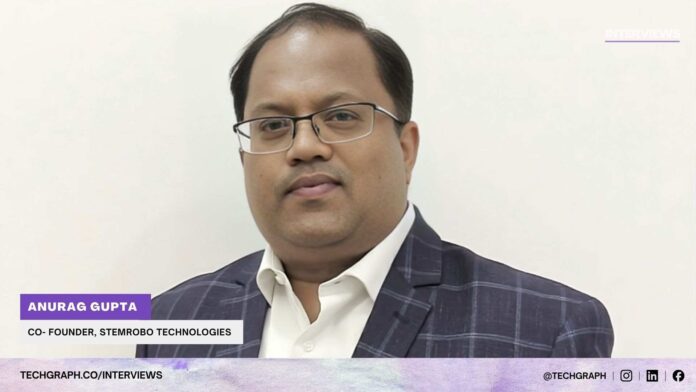
Structured STEM Learning: STEMROBO’s Anurag Gupta on Bringing Robotics and AI into India’s K-12 Education System

Date:

Trending

- Advertisement -

In an interaction with TechGraph, Anurag Gupta, CEO and Co-Founder of STEMROBO Technologies, outlined how robotics and AI are helping schools move beyond theory-heavy instruction toward hands-on learning that builds problem-solving, creativity, and logical reasoning from an early age, and how the company’s structured STEM programs bring real-world application into classrooms to prepare students for a technology-driven future.

He also spoke about STEMROBO’s focus on sustained adoption in schools, where ongoing support for teachers and engagement initiatives, as well as challenges and innovation showcases, ensure that students remain curious, motivated, and connected to learning well after their first exposure to new technologies.

Read the interview in detail:

TechGraph: How do you see the role of robotics and AI-based learning evolving in K-12 education, and what specific gaps do you think STEMROBO is addressing that traditional schooling systems often miss?

Anurag Gupta: From my perspective, Robotics and AI are no longer just an option; they are essential for transforming K-12 education from rote memorization to experiential, hands-on learning. These technologies help students build critical thinking, problem-solving, creativity, and logical reasoning right from an early age. Traditional schooling often emphasizes theory and standardized testing, leaving little room for applied learning or real-world skills.

At STEMROBO, we address this gap by providing structured yet practical STEM programs, including coding, robotics, and AI projects, where students can experiment, learn from mistakes safely, and innovate. Our goal is to combine theory with practical application so children don’t just understand concepts, they can actually apply them creatively, preparing them for a fast-changing technological world.

- Advertisement -

TechGraph: Many schools are still hesitant to fully integrate edtech due to infrastructure and teacher training challenges. How do you approach this resistance and ensure real adoption rather than surface-level implementation?

Anurag Gupta: In my experience, resistance in schools usually comes from infrastructure limitations and insufficient teacher training. At STEMROBO, we tackle this by offering complete, turn-key solutions: pre-configured STEM labs, online learning platforms, and thorough teacher training programs.

We focus on hands-on, outcome-driven implementation rather than simply installing technology. Continuous support, monitoring, and feedback ensure that adoption is measurable and sustainable. By showcasing real student achievements and classroom impact, we help school leadership understand the tangible value, encouraging long-term integration instead of superficial adoption.

TechGraph: With global conversations shifting towards future-ready skills, how do you balance the push for coding, AI, and robotics with the concern that not every student will pursue a STEM career?

Anurag Gupta: Not every student will pursue a STEM career, and that’s perfectly fine. However, coding, robotics, and AI cultivate transferable skills like problem-solving, logical reasoning, and creativity that benefit all learners.

At STEMROBO, we emphasize skill-building over career tracking, ensuring that even students outside STEM gain critical thinking, collaboration, and innovation skills. Our programs are interdisciplinary and inclusive, integrating with arts, humanities, and social sciences, making computational thinking and AI learning relevant and accessible for every student.

- Advertisement -

TechGraph: Edtech has experienced significant growth post-pandemic, but sustaining engagement remains a challenge. What strategies or innovations have helped STEMROBO maintain impact beyond the initial excitement?

Anurag Gupta: Sustaining engagement goes beyond novelty; it requires challenge, creativity, and relevance. At STEMROBO, we maintain long-term impact by combining hands-on robotics, coding challenges, AI projects, and gamified learning experiences. Regular competitions, hackathons, and innovation showcases encourage students to apply their skills beyond the classroom. Personalized learning paths and progress tracking allow students to see growth, while teacher mentoring keeps learning meaningful. By turning students into active creators rather than passive learners, we keep curiosity alive and engagement consistent.

TechGraph: Partnerships with schools often face the challenge of aligning with national curricula and boards. How do you ensure your solutions remain flexible yet structured enough to fit diverse educational ecosystems?

Anurag Gupta: Our approach at STEMROBO is to complement, not replace, existing curricula. Programs are flexible yet structured, mapped to STEM learning outcomes and competency frameworks, and modular enough to fit any school timetable or board requirement. We work closely with educators to ensure content aligns with local goals, and adaptive learning paths allow teachers to adjust pacing and difficulty. This ensures students gain practical, future-ready skills while schools remain fully compliant with curriculum standards.

TechGraph: As data-driven learning is gaining traction in education. How do you leverage technology to personalize learning while keeping the human side of teaching and mentoring intact?

Anurag Gupta: Technology helps us track student performance, identify gaps, and create personalized learning paths. But human guidance is equally crucial. Teachers and mentors interpret data, encourage students, and foster creativity, ensuring emotional and social growth alongside academic progress. At STEMROBO, we combine data insights with hands-on mentorship, giving students the guidance they need while keeping them motivated, confident, and inspired.

TechGraph: Looking ahead, where do you see the next major shift in K-12 edtech, and how is STEMROBO positioning itself to lead rather than follow that change?

Anurag Gupta: The next big shift in education will be AI-driven adaptive learning, immersive AR/VR experiences, and interdisciplinary skill integration. Schools will focus on creativity, problem-solving, and experiential learning over rote knowledge. At STEMROBO, we are preparing for this future by investing in AI-powered learning platforms, robotics innovation labs, and teacher training programs. Our mission is to help schools not just adopt technology but create future-ready learners capable of innovating, adapting, and thriving in a rapidly evolving world.

THE SNAPSHOTS

Sign up to get quick snaps of everyday happening, directly in your inbox.

We don’t spam! Read our privacy policy for more info.

- Advertisement -
Krishna Mali
Krishna Mali
Founder & Group Editor of TechGraph.

More Latest Stories

More Articles

India’s Air Crisis Needs a Deeptech Answer, Not a Consumer Gadget

Twenty years ago, an air conditioner in an Indian home was a luxury. Today it is infrastructure. Indoor air quality is on the same...

India’s Cloud Cost Crisis: Why Startups Are Rethinking Their Tech Stack

Over the last ten years, startups in India have experienced an incredible boom driven by the adoption of cloud services. It has enabled new companies to grow rapidly without having to invest large sums of money. For many startups, the cloud became the default...

Top No-KYC Crypto Casino Sites in 2026

Most online casinos demand a lot of personal information from you before you can...

Redrob AI Launches Professional AI Platform for India’s Workforce

In a bid to help students and professionals navigate an increasingly fragmented digital work...

Why Resume-Based Hiring Is Failing India’s Workforce

India needs a shift from credential-first hiring to skill-first validation

Why BFSI Is Moving from AI Experiments to AI Systems

For the past few years, Artificial Intelligence in banking, financial services, and insurance has...

From Intuition to Analysis: How AI Is Becoming Every CEO’s Second Brain

Most CEOs are making important decisions with partial information. The challenge is not just...

Rethinking Executive Search: Venator Search Partners’ Deepraditya Datta on Leadership Hiring in a Changing Talent Market

In an interview with TechGraph, Deepraditya Datta, Founder and Managing Director of Venator Search...

Simple Habits That Keep Your Car Running Longer

Keeping your car running longer doesn’t require expert-level knowledge—it comes down to building smart habits and staying consistent with maintenance. Many costly repairs and...

Beyond the MVP: Gacsym Ventures CTO Nandagopal P on Helping Startups Through Venture Studios

In a conversation with TechGraph, Nandagopal P, Chief Technology Officer at Gacsym Ventures, shared...

How Air Can Become Urban India’s New Water Source

India's cities are running dry. Chennai nearly ran out of groundwater in 2019. Bengaluru's...

Why Ontarex.com Is Gaining Canadian Investor Attention

In recent months, Ontarex has started to attract noticeable attention from Canadian investors. As...

How AI is Rewriting the Economics of India’s $300 Bn IT Services Sector

When Microsoft CEO Satya Nadella recently disclosed that artificial intelligence now generates nearly 30...

Why India Must Own Its Education Intelligence Stack

India has rapidly digitised large parts of its education ecosystem over the last decade. But digitisation alone does not improve learning outcomes. The next...

AI and Fake Content: Can Technology Win the Battle Against Misinformation?

Artificial Intelligence has transformed how content is created, manipulated, and distributed at scale. News, video, photos, and opinions are now shared across different platforms within seconds. This increased speed and the accessibility of communication thanks to Artificial Intelligence has created an unprecedented challenge for...

Why Micro Learning at 3 Minutes Works Better Than Lectures at 3 Hours

In the fast-moving world of digital education, there is one myth that continues to...

More Than Just a Scratch: The Importance of Windshield Care

Maintaining your vehicle’s windshield often appears as a seemingly minor task that can easily...

The Rise of Integrated Solar Tech Ecosystems in India

India’s clean energy is all about building an ecosystem that is interconnected with various...

Beyond Nvidia: The Hidden Winners of the AI Stock Rally

Nvidia stock (NASDAQ:NVDA) has returned roughly 1,200% since ChatGPT launched in late 2022. Most...

What PM Modi’s Appeal to Avoid Gold Buying Could Mean for India’s Jewellery Economy

When Prime Minister Narendra Modi recently urged citizens to avoid purchasing gold for a...

As Crypto Markets Mature the OpenSea Insider Trading Case Still Shapes Governance Debates

When federal prosecutors charged former OpenSea employee Nathaniel Chastain in June 2022, the case...

How Agentic AI Is Personalising the End to End Salon Experience

Walk into a salon today, and more often than not, the experience still depends...

From Black Box to Trusted AI: Why Defence Needs Constitutional AI Models

For decades, the defence and intelligence agencies have followed one non-negotiable rule: trust nothing...

Hermès vs MetaBirkin: The NFT Case That Redefined Ownership on Ethereum

The NFT boom of 2021 and early 2022 pushed digital assets into the mainstream,...

Why Ontarex.com Is Gaining Canadian Investor Attention

In recent months, Ontarex has started to attract noticeable attention from Canadian investors. As...

“Budget should focus on reducing taxes on capital gains,” Says Abhishek Gupta of Hex N Bit

Speaking in the upcoming Union Budget 2021, Abhishek Gupta, Founder, and CEO, Hex N...

“China is a Global thief” Rep. Tom Rice on Uyghur Forced Labor Prevention Act

Speaking at the House on Uyghur Forced Labor Prevention Act, Rep. Tom Rice (R-SC)...

Why Cyber Resilience Is Replacing Cybersecurity as a Boardroom Priority

Traditionally, cybersecurity was hard-wired to be a technology concern that was only taken care...

Infrastructure 4.0: How AI & Predictive Analytics Are Transforming Real Estate

The new era of technology and innovation has changed operations in many industries. The...

How AI is Rewriting the Economics of India’s $300 Bn IT Services Sector

When Microsoft CEO Satya Nadella recently disclosed that artificial intelligence now generates nearly 30...

Alphabet Discloses $2.14 Billion in Public Equity Holdings as of June 30

Alphabet Inc. disclosed $2.14 billion in equity securities held across 39 positions as of...

The Role of Edtech in Addressing Equity Gaps in Higher Education

In the fast-paced world of EdTech today, the opportunity to bridge educational gaps and...

India to generate $100 bn from telephonic investments

India expects to attract $100 billion in investments in the telecom sector, a union...