


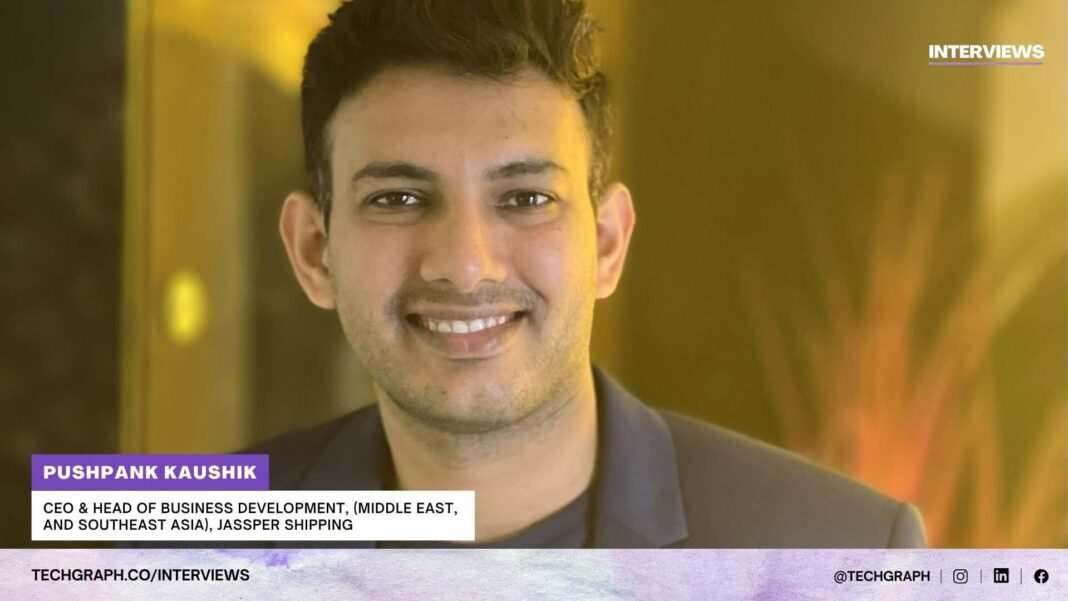
Speaking with TechGraph, Pushpank Kaushik, CEO and Head of Business Development (Subcontinent, Middle East, and Southeast Asia) at Jassper Shipping, discussed how Jassper Fuels represents the company’s new business model focused on aligning the maritime industry’s decarbonization goals with operational realities by promoting transitional fuels such as LNG that fit existing infrastructure while supporting the long-term shift toward hydrogen and ammonia.
He further explained how this model combines fuel supply expertise with collaboration across ports, regulators, and technology providers to build a cleaner and commercially viable marine fuel ecosystem that enables the industry to meet emission targets while maintaining operational and financial efficiency.

Read the interview in detail:
TechGraph: The shipping industry is under growing pressure to decarbonize, yet fuel remains both its largest cost and its biggest environmental challenge. How do you see Jassper Fuels positioning itself in this transition, where cost competitiveness and sustainability are equally at stake?
Pushpank Kaushik: Fuel remains shipping’s largest cost and its biggest environmental challenge but Jassper Fuels is turning this challenge into an opportunity. With decades of global shipping experience,we are aiming to help shipping operators manage costs while providing cleaner, greener fuel alternatives.
With initiatives like the National Green Hydrogen Mission, the Green Tug Transition Programme, the Harit Sagar Green Port Guidelines, and a ₹25,000 crore marine Development Fund that supports alternative fuels and green infrastructure, India is leading the way in a marine revolution.
Jassper Fuels enables shipping firms to cut emissions, streamline operations, and promote a cleaner, smarter maritime future by balancing cost effectiveness with sustainability.
TechGraph: Alternative fuels such as LNG, methanol and ammonia are being tested globally, but infrastructure gaps and scalability remain major hurdles. From your perspective in Asia and the Middle East, which of these fuels do you believe are most commercially viable in the near term?
Pushpank Kaushik: Shipping carries about 80% of the world’s goods but also produces 2–3% of global greenhouse gas emissions, over a billion tonnes a year as per The World Economic Forum. Traditional ship fuels are very polluting, with sulfur levels thousands of times higher than diesel. To reduce emissions, the industry needs alternative fuels.
Right now, the most practical option for shipping in Asia and the Middle East is LNG. LNG can cut CO₂ emissions by about 20 to 25 percent, and the great thing is it works with the infrastructure we already have. But looking further ahead, zero-emission fuels like green hydrogen and e-ammonia are really going to be important too, they just need a lot of investment and new infrastructure. So for now, LNG acts as a lower-emission bridge while the industry moves toward fully sustainable fuels.
TechGraph: Many ship owners remain hesitant to commit to new fuel technologies because of the risk of stranded assets. How is Jassper supporting clients in navigating these investment decisions with greater confidence?
Pushpank Kaushik: Jassper supports ship owners in making smarter, safer investment decisions. We guarantee our clients cost certainty even in uncertain markets by offering Fixed Price Agreements (FPA) and actionable data on fuel technology. As a result, they may cut emissions, streamline processes, and welcome the future of transportation without taking on needless operational or financial risk.
TechGraph: Regulatory frameworks are tightening, from IMO’s decarbonization targets to regional carbon taxes. How is Jassper Fuels aligning its strategy with these timelines, and do you see regulation as a catalyst for innovation or more of a constraint on the industry?
Pushpank Kaushik: Regulations are pushing the shipping industry to change faster than ever, and at Jassper Fuels, we see this as an opportunity. We combine financial strength, risk management, and operational expertise to help clients navigate uncertainty.
From providing bunker and lube oil at over 3,000 locations worldwide to offering Fixed Price Agreements that protect against price swings, we help clients focus on their business with confidence. For us, regulations aren’t a limit—they drive smarter fuel choices, better planning, and a faster move toward cleaner, more efficient shipping.
TechGraph: Building a reliable alternative fuel ecosystem requires more than supply alone. What kinds of partnerships or collaborations do you believe will be most critical in making that ecosystem commercially viable?
Pushpank Kaushik: Building a strong alternative fuel system is more than just supplying fuel. It needs the right equipment, technology, and trust. At Jassper, we work closely with port authorities, tech companies, and shipping operators. By partnering with governments, regulators, fuel producers, and storage experts, we ensure clean fuels are safe, reliable, and cost-effective for shipping.
TechGraph: Energy transition in shipping depends not only on technology but also on trust in execution. How is Jassper leveraging its established network of over 500 owners and operators to instill confidence in new fuel solutions among clients?
Pushpank Kaushik: Energy transition in shipping isn’t just about adopting new fuels—it’s about delivering them reliably and consistently. At Jassper, our network of over 500 owners and operators allows us to do exactly that. We combine operational reach with financial strength and risk management tools to provide clients with safe, dependable fuel supply, even in volatile markets.
From ensuring bunker oil and lube oil delivery at the right time and place, to offering Fixed Price Agreements that give cost certainty, we make it easy for clients to trust and adopt new fuel solutions. Our scale, experience, and commitment turn innovation into confidence.
TechGraph: Looking ahead to 2030, what role do you envision Jassper Fuels playing in shaping Asia’s shipping fuel market, and what would success in this transition mean for you personally?
Pushpank Kaushik: We at Jassper Fuels aim to be the go-to provider for alternative and sustainable fuels across Asia. Our role will be to ensure reliability, efficiency, and cost-effectiveness for shipping operators adopting new technologies. Success means leading the market in decarbonization while helping clients grow their businesses sustainably.