

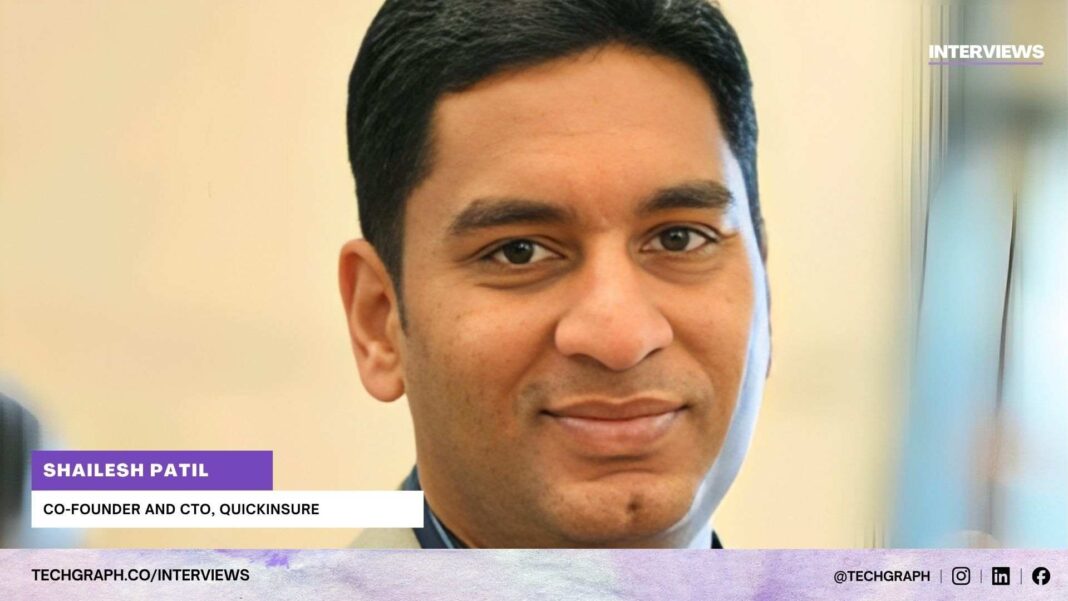
Speaking with TechGraph, Shailesh Patil, Co-founder and CTO of Quickinsure, discussed how the company’s advisor-first model is strengthening insurance distribution across India’s Tier 2, Tier 3, and rural markets by enabling transparent and compliant policy servicing that builds customer trust while simplifying every stage of the insurance journey.
He also spoke about Quickinsure’s focus on operational efficiency and portfolio diversification across SME, commercial, and niche insurance segments by leveraging centralized systems and automated workflows that drive scalability while preserving service quality and customer confidence.

Read the interview in detail:
TechGraph: Quickinsure operates as a tech-enabled platform for advisors, combining digital tools with an on-ground distribution network. Since customers don’t interact with the platform directly, how does your model ensure advisors can deliver transparent, compliant, and trust-driven insurance solutions?
Shailesh Patil: In India, 90% of insurance is still sold through intermediaries, so we deliberately built an advisor-first model. Customers don’t log in to our system; advisors use it to access products, generate quotes, and issue policies—removing overlap or confusion at the customer end.
Transparency is built into the journey: advisors can review premiums, Insured Declared value (IDV), and add-ons across insurers in one place, and the complete proposal form is shared with the customer for review and to ensure proposal acceptance before payment. IRDAI’s mandate on OTP-based KYC, along with our internal checks, enforces consent and reduces fraud risk.
The combination—advisor relationship on the front end and compliance-grade workflows in the back end—keeps the experience both clear and accountable.
TechGraph: Aggregators are often accused of reducing insurance to a price comparison, even though adequacy of cover and claims history matter more in the long run. How do you make sure customers on Quickinsure aren’t simply guided to the cheapest premium?
Shailesh Patil: We don’t promote a “lowest-price wins” approach. Quotes are sortable by premium for convenience, but advisors can (and routinely do) tune Insured Declared value (IDV), add-ons, deductibles, and other parameters to fit the risk. We don’t display or rank insurers by claim-settlement ratios on the platform, nor do we push any “recommended” insurer—there are no nudges that bias the sale.
However, the low awareness and maturity among customers often lead them to demand the lowest-priced policy, and in many cases, that is how sales happen. Only a smaller segment, around 20–30 percent, comes with a specific insurer in mind.
Our advisors focus on customer requirements and guide them to make an informed choice. When the lowest quote is chosen, it is typically because the advisor has validated that the customer requirement meets the coverage need, not because price was the only factor. Advisors also check practical considerations, such as nearby cashless garages or hospitals, before advising a choice.
TechGraph: Insurance penetration in India remains well below global levels despite two decades of liberalisation. From your position in distribution, what is the single biggest obstacle preventing Indian households from buying enough cover, and how is Quickinsure addressing that gap?
Shailesh Patil: Awareness remains the core challenge. Motor sells because it’s mandatory; health and life still require explanation and confidence-building, especially outside metros. We address this on three fronts:
- Local advisors at scale — a 45,000+ insurance advisor network concentrated in Tier-2/3 and rural markets, able to explain products in regional languages and handhold customers through purchase and renewal.
- Tech enablement — digital tools that cut paperwork and turnaround time so advisors spend more time advising and less time processing.
- Expert advisory support — a specialist team customers or advisors can consult for complex categories (notably health and life), ensuring queries are resolved accurately and quickly.
TechGraph: Your platform sits on rich data about customer search and buying behaviour. What trends are emerging from that data that insurers themselves may be missing, and how does Quickinsure plan to use those insights without straying into conflict with data privacy expectations?
Shailesh Patil: Our platform allows us to observe what is being quoted and sold, which add-ons are chosen, and where demand is rising. Three clear trends that we have observed:
- Rising price sensitivity in motor renewals — customers compare renewal notices with fresh quotes; discounts have intensified year-over-year, and typical private-car premiums many customers saw around ₹15,000 last year are frequently in the ₹9,000–10,000 band this year as insurers compete more aggressively. Discounts have risen from 65–70% earlier to as high as 90–95% today, showing the extent of competitive pressure.
- Category dependence on advisory — health and life purchases still rely heavily on guided conversations (benefits, network, exclusions, riders). In Tier 2 and Tier 3 markets, this is especially visible in health insurance, where affordability remains the main barrier. High annual premiums deter households, but if these were converted into EMI-style payments similar to SIPs, adoption would be far stronger.
Sharper customer priorities — Buyers today are clear about what they want: a trusted company, lower premiums, higher sum insured, comprehensive coverage, quick and reliable claims, flexible payment options, and, most importantly, the direct recommendation of their advisor.
We share aggregated, statistical views with insurers: regional traction for a product, visibility of their quotes versus peers, or anomaly signals (e.g., clusters of claims from a particular RTO). When needed, we also apply guardrails on our side — for example, temporarily suppressing quotations where suspicious or fraudulent patterns are detected — always with the intent of protecting insurers’ loss ratios, and without ever sharing customer-level data. Customer specifics are neither collected for marketing nor shared; our approach is privacy-first and compliance-led.
TechGraph: The claim settlement process is still the weakest link in India’s insurance chain. Since Quickinsure is often the first point of contact for a policyholder, do you see the platform’s responsibility extending into claims support, and if so, in what way?
Shailesh Patil: Claims settlement rests with insurers, but we actively step in to support customers wherever it is applicable or possible. Advisors help customers with documentation, connect them to cashless networks, and escalate if delays occur. We intervene in disputes (e.g., health cashless questions between hospitals and insurers) to keep the case moving.
We also invest in practical tech that shortens assessment cycles—for instance, in cattle insurance, we’ve deployed image-based checks (such as muzzle-based identification/age estimation) to speed verification and reduce time to decision; our advisors step in to push cases forward on behalf of the customer.
TechGraph: Insurers are scaling up their own digital platforms, while banks and fintechs are embedding insurance into everyday transactions. Where does this leave a standalone aggregator like Quickinsure, and how do you plan to defend relevance in that evolving landscape?
Shailesh Patil: Direct and embedded channels typically limit choice to a single brand or a bundled SKU. Our relevance comes from breadth and independence: multiple insurers, multiple categories like motor, health, life, and specialized/commercial lines, and even coverage for specific products that are not yet digitally exposed by some insurers, we serve those through controlled ofline rails, so advisors don’t lose the opportunity. The advisor’s local trust plus a unified workspace across carriers means faster comparative advising and fewer dead ends for the customer.
TechGraph: Beyond metros, insurers continue to struggle with awareness and distribution in Tier 2 and 3 towns. What have you learned from your offline force in these markets that digital-first players often miss?
Shailesh Patil: The real difficulty in insurance distribution has always been in Tier 2 and Tier 3 regions, where awareness and access are limited. Quickinsure was established with the clear intent of addressing this gap. A majority i.e, 90% of our advisor base is located in Tier 2/3 and rural regions, which means customers are guided by local people they already trust. Advisors explain policies in familiar terms, guide households in their decisions, and provide support in regional languages where required.
We strengthen this local presence with technology. Our platform ensures that advisors no longer need to visit insurer offices for processes such as policy issuance, endorsements, or cancellations. Everything is handled digitally, which makes their work faster and more efficient. To further support them, we also provide digital marketing material and vernacular back-end assistance, so advisors can build awareness and maintain customer relationships more effectively.
The results speak for themselves. Nearly 70 percent of our business conversions come from Tier 2 and Tier 3 markets. In fact, this was the starting point of our model — we identified the absence of insurers and technology in these regions and deliberately built to fill that gap. This shows that by combining local trust with strong technology enablement, Quickinsure has been able to bridge the awareness and distribution gap in areas where insurers traditionally lacked presence.
TechGraph: Globally, several insurtechs that started with aggregation have faced margin pressures once insurers built direct channels. What gives you confidence that Quickinsure’s model can avoid that squeeze in India over the long term?
Shailesh Patil: Pure aggregators in other markets have faced difficulties once insurers developed their own direct channels. Quickinsure is positioned differently. Three levers give resilience:
- Operating leverage from one centralized office — standardized workflows, automated reconciliation, and platform-level controls keep opex lean while serving a large advisor base nationally.
- Portfolio mix — we’re expanding in non-motor lines (SME/commercial, etc.) and niche sachet products (mobile, cyber, pet) where economics aren’t as commoditized, and volumes can scale.
- Advisor enablement vs. pure aggregation — we’re not just listing prices; we’re equipping advisors to configure cover, manage servicing, and retain customers—creating value that’s harder to disintermediate.
By combining lean operations with a diversified portfolio and stronger margins in non-motor categories, we ensure the model remains sustainable in the long term.