


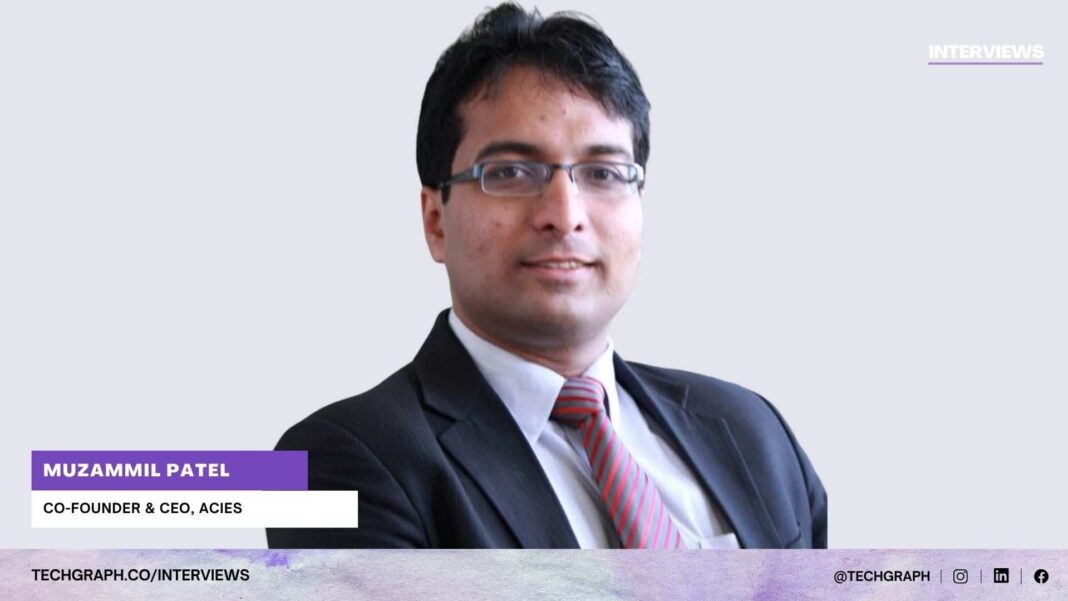
Speaking with TechGraph, Muzammil Patel, Co-founder and CEO of Acies, spoke about the company’s no-code platform Revolutio, which is redefining enterprise technology by enabling mission-critical applications in risk, regulatory, and treasury domains, and how its containerised, cloud-agnostic architecture supports seamless deployment without compromising on security or compliance.
He further outlined how Acies is evolving Revolutio to combine human-led design with AI-driven automation, using generative and agentic AI to simplify app creation, automate workflows, and expand access to developers and entrepreneurs alike, positioning the platform to bridge the gap between regulated enterprise needs and the growing creator economy for no-code innovation.

Read the interview in detail:
TechGraph: Acies has positioned Revolutio as the backbone for solutions in risk, regulatory and treasury spaces. How challenging is it to bring no-code into such high-stakes environments where compliance and accuracy are critical?
Muzammil Patel: Bringing no-code platforms to mission critical environments and applications is quite challenging to begin with because the focus beyond functionality is on stability, speed, scalability, and information security. Building a no-code platform that is enterprise-grade, cloud agnostic, and can also work seamlessly on-premises requires a rewriting of traditional technology architectures. It requires that multiple technologies be onboarded on the platform, pre-architected, and deeply integrated into the developer tools.
Information security is critical, and continuous technical upgrades to the core platform, rigorous testing, and the latest in encryption technologies are incorporated at the fundamental level. Positioning Revolutio in a high-stakes and regulatory-intensive environment was particularly challenging to begin with, but it has borne significant rewards since the platform was built with an enterprise-grade production capability in mind and is now able to adapt to almost any use case across industries.
TechGraph: Many no-code platforms work well for small-scale solutions but struggle with enterprise-grade deployments. How has Revolutio been built differently to support mission-critical operations for banks and financial institutions?
Muzammil Patel: There are multiple aspects in which Revolutio is built differently. To start with, Revolutio is containerized, wherein resource management across different services is optimized and can be further balanced using fabrics like Kubernetes. Revolutio is database agnostic and can operate serverless for compute operations.
This allows easier integration into legacy IT environments. All services required for enterprise-grade operations like queuing, distributed compute, distributed data management, data encryption, resource management, multi-tenancy, and application management, are built onboard the platform, and the platform does not rely on external on-premises or cloud services.
In essence, Revolutio can be deployed to virtually any infrastructure and can operate as a scalable platform running hundreds of applications, as all the services required for enterprise grade deployments are onboard the platform itself.
TechGraph: Large financial organizations often operate on legacy technology and face regulatory hurdles. What strategies has the platform adopted to integrate seamlessly without creating new layers of complexity?
Muzammil Patel: Revolutio is a containerized platform that can be deployed with or without fabrics and multi-cloud infrastructure layers like Kubernetes and OpenShift. It allows for small single-server deployments as well as large, distributed deployments across data centres. The platform has been built keeping two things in mind: (i) deployments can be done simply by moving a container to a virtual machine or a virtual machine cluster without the need for any additional software or services, and (ii) the platform can be deployed on any on-premises environment or cloud, but is not dependent on any cloud service.
This helps reduce architectural complexity and/ or dependence on any cloud provider. For integrating with existing systems, Revolutio has onboard API management as well as data replication technologies that are database agnostic. This allows for easy integration and exchange of data with legacy systems.
TechGraph: Security, transparency, and audit trails are central to financial systems. What kind of in-built controls does Revolutio provide to address these concerns and build confidence among regulators?
Muzammil Patel: Revolutio has an audit trail system and mechanism at par with security operations centres. Every screen action, every database action, and every user activity is logged to ensure indelible audit trails. More importantly, organizations can configure for each of their tenants their own password policy, IP tracking, session management, multi-factor identification, row level security for data, data encryption settings, and hierarchy controls. and screen-level permissible actions.
For regulators, policy makers, and governance functions, the most important aspects are control over data, indelible audit trails, analysis of user patterns, and optimal resource management. and predictive insights on potential information security risks. Revolutio provides all these on-screen without any technical know-how.
TechGraph: With AI reshaping the no-code landscape, how do you see Revolutio evolving to combine human-led design with AI-driven automation?
Muzammil Patel: Generative AI and agentic AI are both significant forces of evolution for no-code platforms. We have been focussing and investing heavily on user experience and making the platform simpler for creators and developers. Generative AI helps cut down this investment dramatically, as UI driven engagement can now be conversational. Agentic AI would also help users automate workflows significantly after building the apps.
We are continuing to make significant investments in this space with the primary purpose of replacing screen base UI interaction with conversational interaction to build apps. The other element of investment is focused on post app build automation with agentic AI to handle work-flow management and let humans focus on decision making.
TechGraph: While Revolutio already powers institutions, there’s also a vision to extend it to entrepreneurs and creators. What needs to change in the ecosystem for no-code to truly democratize technology beyond enterprise use?
Muzammil Patel: The core vision of Revolutio is to democratize technology. While building for the enterprise helps create a robust and time-tested platform that has operated well in high-stakes and high-pressure environments, the ultimate goal is to make this technology available to everyone. The goal is to make it available in an affordable manner and usher in a creator economy for apps, similar to a creator economy for content.
Truly democratizing no-code technology beyond enterprise use is about simplicity and affordability. We believer that AI does help bring about simplicity a lot quicker and will help adoption and use a lot faster over the next 2 years. For affordability, we continue to work on optimizing resource management within the platform. More importantly, we have started building smaller bite bite-sized no-code services that can serve the purpose of specific creators and developers. This is an important aspect of bringing affordability to app development.
TechGraph: Looking ahead, how do you see Revolutio redefining the way technology-led transformation is approached across industries, not just in financial services?
Muzammil Patel: Our next focus with Revolutio is the digital ERP space. We have recently launched a new suite of applications under the Streamlign brand. The idea is to enable automation across industries by focusing on two aspects (i) filling white-space left by legacy ERPs and the high cost of moving from accounting software to full-fledged ERPs for small and medium enterprises for standard processes and operations, and (ii) enable enterprises to build their custom analytics, apps and workflows to bring their own unique business model to life in a fully digital world.