


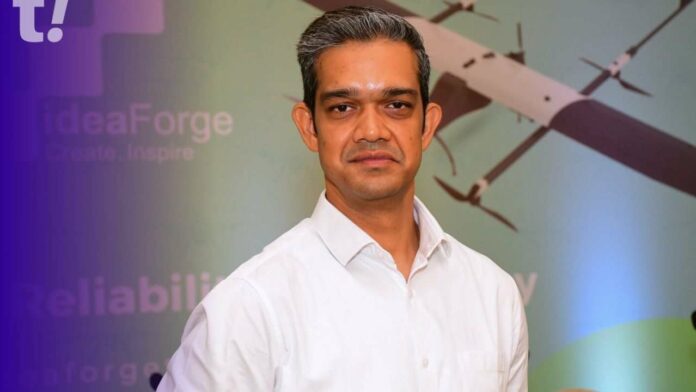

During the interview with TechGraph, Rahul Singh, Vice President (VP) for Engineering and Whole Time Director of ideaForge Technology Ltd outlines the company’s plans for utilizing the proceeds from its recently launched IPO, and how it is expanding its product portfolio to tactical UAVs and last mile logistic drones opportunities to cater to the unique demands and regulations of emerging markets like Bangladesh, Vietnam, and Nepal.
Read the complete interview:
TechGraph: With the ideaForge IPO opening this month, can you elaborate on how you plan to utilize the proceeds from the fresh issuance? Could you provide more details about the allocation of funds towards debt repayment, working capital funding, product development, and general corporate purposes?
Rahul Singh: We intend to utilize the proceeds towards repayment/prepayment of certain indebtedness availed by our company, funding the working capital gap, investment in product development, and general corporate purposes.
The proceeds from its fresh issuance to the tune of Rs 50 crore will be utilized for repayment of certain indebtedness availed by the company; Rs 135 crore towards funding working capital requirements; Rs 40 crore for investment in product development and the remaining for general corporate purposes.
TechGraph: The recent pre-IPO placement saw significant institutional investment. Could you share some insights into the decision-making process behind choosing these particular investors and how their involvement will benefit ideaForge in the long run?
Rahul Singh: The Offer was made in terms of Rule 19(2)(b) of the SCRR, through the Book Building Process by Regulation 6(2) of the SEBI ICDR Regulations. Through this offer not less than 75% of the Net Offer was allocated proportionally to QIBs, provided that our Company, Indusage, and Celesta Capital in consultation with the BRLMs, allocated up to 60% of the QIB Portion to Anchor Investors.
The basis of such allocation was made discretionarily by our Company, Indusage, and Celesta Capital in consultation with the BRLMs by the SEBI ICDR Regulations. Nomura Funds Ireland Public Ltd, Pinebridge Global Funds, Goldman Sachs Funds, Tata AIG General Insurance Company, Tata AIA Life Insurance Company, and Max Life Insurance Co Ltd are among the many anchor investors.
The insight that these prominent investors will bring to the table will aid us in growing our company, achieving our objectives more quickly, and better meeting customer demands.
TechGraph: The company has shown remarkable growth in revenue from operations in the past two fiscal years. What are the key factors driving this growth, and how does ideaForge plan to sustain this positive trajectory in the coming years?
Rahul Singh: IdeaForge’s success is ascribed to its vertically integrated operation capabilities, which include an in-house product development center that allows us to design, develop, engineer, and build indigenous unmanned aerial vehicles (UAVs).
IdeaForge’s research and development efforts have helped indigenously develop the Quadcopter Unmanned Aerial Vehicle (UAV) and Fixed-wing VTOL UAV. A plethora of novel technology fields are also being investigated and executed for enhanced product specifications and designs. We consistently focus on creating compact and cost-optimized systems that encapsulate cutting-edge technical standards.
Our UAVs are equipped with industry-leading specifications and capabilities, comparable to those of other established global players in the UAV industry. Our in-house design, development, engineering, and manufacturing capabilities have enabled us to develop better products in response to changing customer demands, thereby improving the customer experience with our products.
ideaForge is one of the few original equipment manufacturers (OEMs) with its own proprietary autopilot subsystem and ground control software in the world. We have over 25 patents due to our ongoing product development and innovation efforts. ideaForge Technology doesn’t depend on any other company in India or outside India.
Another key factor is that we are vertically integrated into the technology, which means that the raw materials we buy for the same technology are purchased at the component level rather than the sub-system level. Then, by adding our technological layer on top, we can build a differentiated service while experiencing growth.
The plan for maintaining this positive trajectory is to continue product development, grow into local and foreign markets, and supply clients with a strong product range that helps them minimize their total cost of ownership. We have established a subsidiary in the United States to conduct product demos and other activities to expand in the worldwide market, giving us an early mover advantage.
TechGraph: ideaForge is currently focused on Middle Mile drones. Could you shed some light on the company’s strategy to expand its product portfolio to include tactical UAVs and Last Mile Logistic drones? What opportunities do you see in these segments, and how does ideaForge plan to capitalize on them?
Rahul Singh: ideaForge currently focuses on and provides solutions for applications related to security, surveillance, mapping, and surveying rather than middle-mile drones. However, there is a significant possibility to deploy drones for middle-mile (hub-to-hub) logistics in India, with the potential to expand globally. Hence, we also intend to develop UAVs with sufficient payload capacity to cater to the middle-mile logistics industry.
According to the 1Lattice Report, the drone logistics market is currently valued at US$ 0.3 billion in 2022. It is projected to reach US$ 33 billion by 2030. Further, our UAVs can carry small payloads which can be extended to support last-mile delivery applications. Our focus shall also be on developing tactical UAVs which are larger platforms and offer longer flight times and larger payload carrying capabilities.
To take advantage of the enormous untapped potential in these markets, ideaForge will keep investing in product innovation, engineering, and design. The drone industry is at a nascent stage and requirements are evolving.
Since product and technology innovation is at the core of our growth, we emphasize continuous innovation and enhancement of our product and technology stacks. We will continue to innovate in technology, business models, and evolving offerings. Through our extensive experience, established product portfolio, and proven track record, we are strongly positioned for providing products and solutions to these segments.
TechGraph: As ideaForge plans to expand its operations to Bangladesh, Vietnam, and Nepal, what challenges and opportunities do you foresee in entering these new markets? How does the company plan to adapt to each country’s unique demands and regulations?
Rahul Singh: Permissions, exports, visas, geography, and other issues posed difficulties. However, as government officials announced various programs and policies, the industry benefitted. We have begun to see more opportunities. The DGFT’s recent liberalization and simplification of export policy will also help us meet ideaForge’s and the industry’s objectives.
Continued product development is the plan we look at to sustain our product portfolio and its advantage in the hands of the customer, which gives us sustained growth and helps us retain our margins in the markets in which we will engage. We will continue building technology, intellectual property, and products that are superior in terms of performance, ability to survive in the real world, heavy-duty cycle endurance, and ultimately making the operator’s life as simple as possible.
ideaForge is setting up a system that requires as little skill as feasible, so that the customer bears the lowest possible cost of operation, and as a result, our focus as a business is on the customer’s total cost of ownership (TCO). It will be possible to sustain our expansion in a specific country if the TCO for the customer is low. We are also less reliant on foreign technology and growing our product line, region, and application area.