


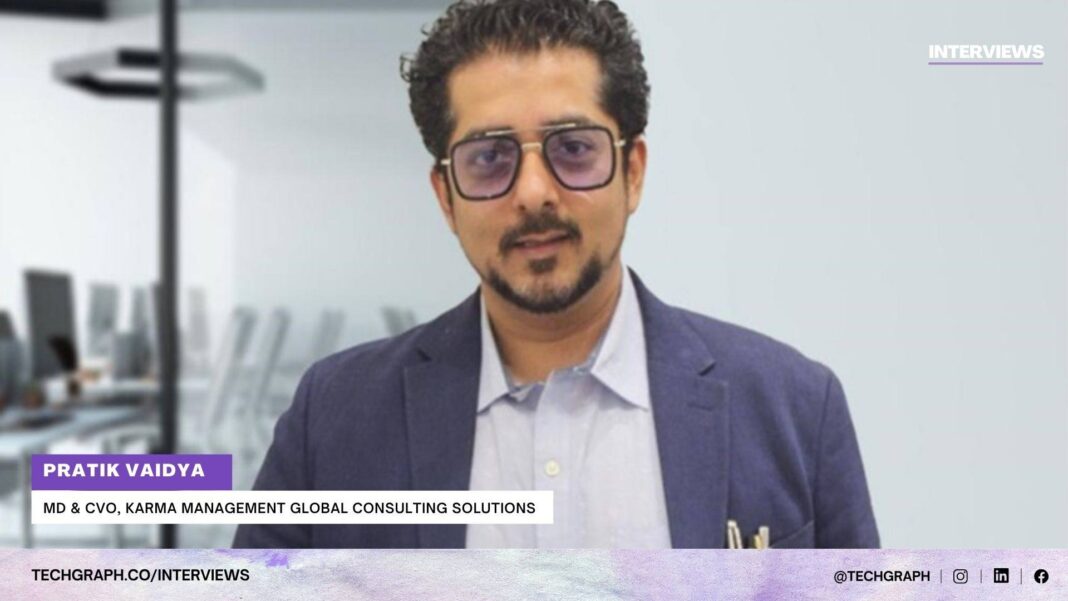
Speaking to TechGraph, Pratik Vaidya, Managing Director and Chief Vision Officer of Karma Management Global Consulting Solutions Pvt. Ltd., discussed how the rise of gig work and remote employment has created new compliance challenges around data privacy, worker classification, and social security, and how India’s regulators are adopting AI-led digital audits to drive greater transparency and accountability across industries.
He also spoke about how the company is using open APIs, continuous reporting, and collaborative data-sharing frameworks to help organizations engage with regulators more constructively and use technology as a bridge of trust, while preparing for a borderless compliance future where labour laws, taxation, and data protection align across jurisdictions.

Read the interview in detail:
TechGraph: Companies are rushing to adopt AI in compliance, but many do so without a clear strategy. From your experience, what mistakes do organizations make when they treat AI as a quick fix rather than a long-term compliance partner?
Pratik Vaidya: In India, the temptation to bolt artificial intelligence onto existing compliance processes is high. Yet our reality is more complex. A recent report on regulatory compliance for manufacturing MSMEs notes that a typical single-unit enterprise is subject to over 1,450 compliance obligations, dealing with 59 different inspectors and maintaining 48 registers, with 486 imprisonment clauses—many linked to labour laws .
With such deep-rooted complexity, AI cannot be a band-aid. Treating it as a quick fix often leads to fragmented deployments, poor data hygiene, and a false sense of security. The true value of AI emerges when it becomes a partner—learning from regulatory updates (there were 9,331 updates in FY 202425 ) and predicting risks. At Karma, we embed AI into workflows, allowing teams to move from compliance checklists to predictive insights. The technology matures with your organisation, but it demands strong governance, quality data, and human oversight. Without these, AI is just another dashboard.
TechGraph: Workforce compliance is no longer limited to payroll accuracy or contract management. With gig platforms, remote staff, and global teams, what do you see as the most pressing compliance blind spots businesses are overlooking today?
Pratik Vaidya: The gig economy and remote work have exploded, but lawmaking is catching up. A NITI Aayog estimate cited in the Karnataka Gig Worker Bill noted 77 lakh (7.7 million) gig workers in 202021 (1.5% of India’s workforce), expected to rise to 2.35 crore (23.5 million) by 202930 (4.1%). Yet misclassification, dataprivacy gaps, and socialsecurity coverage remain blind spots. The draft Karnataka law requires aggregators to register gig workers, disclose algorithmic impacts on work and contribute 15% of payouts to a welfare fund —but most platforms lack transparency.
Remote employees pose similar challenges: salary payments across jurisdictions, tax withholding, and data protection. Meanwhile, MSMEs struggle with a dizzying 42 regulatory updates per day. Businesses that treat payroll and contract management as the whole of compliance risk are missing the growing expectations around social security, fairness, and ESG disclosures.
TechGraph: Predictive analytics promises to identify risks before they turn into violations, but acting on forecasts requires courage. How does Karma convince leaders to trust data-driven foresight instead of waiting for problems to surface?
Pratik Vaidya: Convincing leaders to act on early warnings requires proof. In Indian financial services, manual audits consume 40–60% of compliance teams’ time, yet AI has cut audit preparation times by 50–70% and reduced violations by 75 %. At Karma, we use models that flag emerging issues—missing registrations, expiring licences or regulatory updates—that could balloon into penalties.
We cite evidence from our own implementations and from industry reports showing that organisations recover their AI investment within 12–18 months, saving ₹2–5 crore annually. When leadership sees that data-driven foresight prevents fines, accelerates approvals, and builds trust with regulators, they shift from reactive firefighting to proactive risk management. Courage comes from empirical success and transparent models, not blind faith.
TechGraph: Regulators are becoming more tech-savvy, using AI and digital audits to detect non-compliance. Do you believe this shift will push companies toward greater transparency, or will it widen the trust gap between businesses and regulators?
Pratik Vaidya: Regulators in India are embracing technology. The Securities and Exchange Board of India’s (SEBI) June 2025 consultation paper proposes governance and testing requirements for AI/ML models used by market participants: senior management must oversee algorithms, firms must disclose features and risks to clients, conduct segregated testing, ensure fairness and bias detection, and comply with data privacy laws.
SEBI also proposes a tiered framework where internal uses (e.g., surveillance and cybersecurity) have lighter obligations . Such digital audits will push companies toward transparency if they embrace dialogue. Treating regulators as adversaries widens the trust gap. At Karma, we advocate for open APIs and continuous reporting. When companies voluntarily share data and regulators provide clear frameworks, technology becomes a bridge rather than a barrier.
TechGraph: Many firms still see compliance as a burden or a cost center. What would it take for compliance, powered by AI and automation, to be reframed as a strategic driver of growth and resilience?
Pratik Vaidya: Compliance is often seen as a cost, but research shows the opposite. EY’s India-focused outlook notes that businesses are increasing their technology budgets to automate compliance tasks; AI/ML tools help proactively identify risks and streamline processes, reducing the burden and enhancing effectiveness.
India’s ESG landscape is also tightening: SEBI’s Business Responsibility and Sustainability Reporting (BRSR) requires the top 1,000 listed companies to disclose ESG metrics, and the top 250 must report and obtain assurance on Scope 3 GHG emissions from FY 202425 .
Companies that treat these as strategic opportunities gain investor confidence, access green finance, and improve supply chain resilience. Automating compliance reduces manual effort, freeing teams to innovate. At Karma, we position compliance as a “business health check”—enabling faster product launches and smoother audits. Growth isn’t just topline; it’s growth without legal fragility.
TechGraph: Smaller enterprises often lack the resources to keep pace with shifting labor laws and global standards. How does Karma ensure technology narrows this gap instead of widening the divide between large corporations and smaller firms?
Pratik Vaidya: The compliance burden weighs heaviest on small enterprises. Recent reports highlight that MSMEs face over 1,450 compliance obligations, deal with 59 types of inspectors, and maintain 48 registers, with annual costs of ₹13–17 lakh. They also face about 42 regulatory updates per day, with more than 9,300 updates in FY 202425. Without technology, keeping up is impossible.
At Karma, our ComplyMgmt.ai platform is designed to democratise compliance: automated reminders for licence renewals, single dashboards for labour and ESG filings, and plain-language alerts. We offer modular pricing so that even a small workshop can afford digital compliance. By partnering with local accounting bodies and chambers of commerce, we provide training and support. When technology is accessible and contextual, it narrows—not widens—the gap between large corporations and SMEs.
TechGraph: If you had to name one workforce compliance challenge that will define the next decade, something businesses are not preparing for today, what would it be?
Pratik Vaidya: The defining challenge will be regulating a borderless workforce in an era of AI. India’s gig workforce is projected to reach 2.35 crore by 2030 , and remote work will only expand. Reconciling multijurisdictional labour laws, tax rules, and social security obligations while protecting worker data will test organisations. Add to this SEBI’s forthcoming AI/ML guidelines and mandatory ESG disclosures for top listed companies .
Businesses need systems that automate laws, validate documents in real time, and integrate with regulators globally. Preparing today means investing in AI-enabled compliance platforms, adopting strong data governance frameworks, and fostering a culture of continuous learning. Those who view compliance as a global connective tissue—not just a domestic checkbox—will navigate this complex future with resilience.