


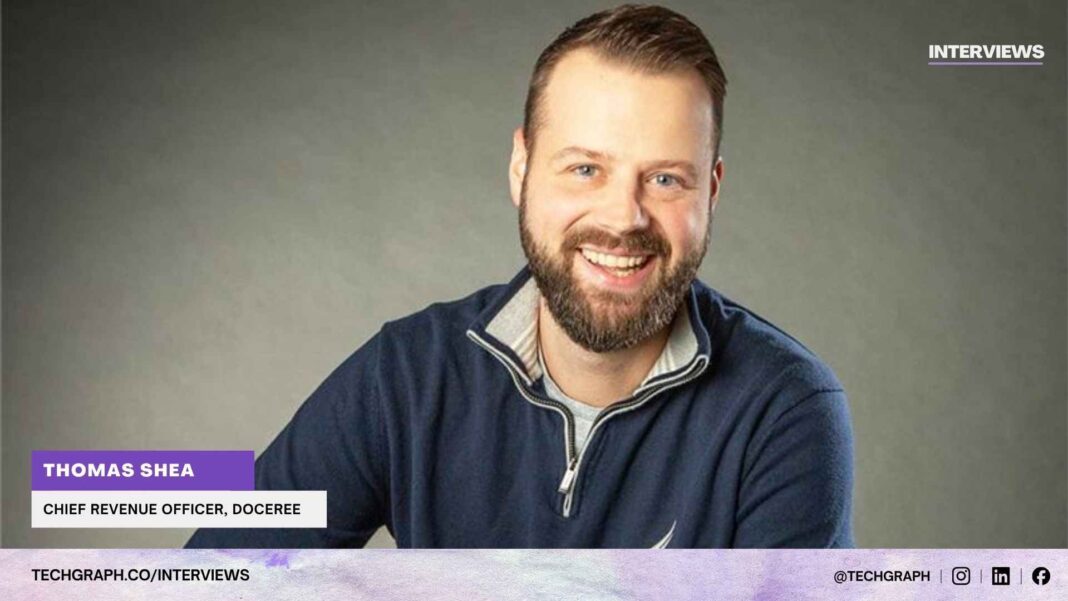
Speaking with TechGraph, Thomas Shea, Chief Revenue Officer (CRO) at Doceree, discussed how artificial intelligence is reshaping healthcare marketing by shifting focus from campaign volume to precision-driven engagement, and how Doceree’s AI-led frameworks are connecting digital interactions with real-world prescribing and adherence outcomes to deliver measurable clinical and business impact that aligns with physicians’ needs across global markets.
Shea also spoke about how Doceree embeds privacy and ethics at the core of its technology, filtering every communication through compliance guardrails aligned with international standards such as HIPAA and GDPR to ensure personalization that enhances relevance without compromising trust or regulatory integrity.

Read the full interview in detail:
TechGraph: Healthcare marketing has long struggled with relevance and resonance in physician engagement. From your vantage point, how is Doceree leveraging AI not just to automate campaigns but to enhance the quality of conversations between brands and healthcare professionals in ways traditional models cannot?
Thomas Shea: From my perspective, the biggest opportunity with AI in healthcare marketing isn’t just automation or optimization; it’s elevating the quality of engagement with physicians. Too often, traditional approaches were about volume: more campaigns, more impressions, and more touchpoints. But physicians don’t need more noise; they need communication that respects their time and aligns with their clinical reality and needs.
What excites me about AI is its ability to interpret context, identifying when a message is most relevant, what format works best, and how to make it feel like part of a physician’s natural workflow. That transforms interactions from being perceived as interruptions to being seen as useful resources. We’re not just delivering information; we’re enabling smarter, more supportive conversations that can actually strengthen trust.
Ultimately, AI helps us strike the right balance: reaching scale without losing precision, and creating engagements that feel personal, timely, and valuable in ways traditional models simply couldn’t achieve.
TechGraph: Regulations in healthcare communications vary widely across markets, making scalability a major challenge for global pharma brands. How does technology, particularly contextual AI, help companies navigate this complexity while still delivering tailored messaging that feels personal and compliant?
Thomas Shea: Regulation in healthcare marketing isn’t a barrier; it’s a guiding framework that safeguards patients, promotes ethical engagement, and reinforces trust across the ecosystem. The difficulty for global brands is that every market has its own set of rules, making scalability tricky. What contextual AI allows us to do is build flexibility into the system. Instead of taking a standardized approach, AI can interpret local regulatory frameworks, filter messaging through compliance guardrails, and adapt content accordingly.
At the same time, it ensures that communication still feels personal to the physician, not watered down by regulatory limitations. By aligning tailored messaging with built-in compliance checks, brands can scale responsibly across diverse markets without compromising integrity. That balance between precision targeting and regulatory rigor is what makes technology so critical. It gives companies the confidence to engage globally, while physicians experience messaging that is both relevant and trustworthy.
TechGraph: One of the most pressing pain points for marketers is proving tangible business outcomes. Beyond vanity metrics like impressions and engagement, how is Doceree building frameworks to link marketing efforts directly with prescribing behaviors or patient-level impact, and what are the limitations you see in this measurement journey?
Thomas Shea: Measurement has always been a sticking point in healthcare marketing. Impressions and clicks might look good on a dashboard, but they don’t tell us whether physicians are making different choices or if patients are staying on therapy longer. What we’re doing with AI and data is creating frameworks that connect marketing exposure to meaningful outcomes like shifts in prescribing behavior or improved adherence patterns. By linking de-identified real-world data with campaign activity, we can show cause-and-effect more clearly.
That said, there are limitations. Data access varies by market, privacy must always be safeguarded, and not every patient decision can be tied neatly back to a marketing moment. But the trajectory is clear: we’re moving away from surface-level reporting toward evidence that marketing contributes to measurable health and business impact. For me, that’s the most important evolution: proving value where it truly matters.
TechGraph: With data privacy regulations tightening worldwide and concerns growing around the ethical use of AI, how do you balance innovation with responsibility? In practical terms, what safeguards or design principles does Doceree follow to ensure trust is not compromised while delivering personalization?
Thomas Shea: Innovation in healthcare marketing only matters if it’s grounded in responsibility. For me, the first principle is that trust is non-negotiable. Physicians and patients need to know their data is secure, and brands need assurance that every interaction is compliant. That’s why we embed privacy and compliance into the very design of our technology, not as an afterthought, but as a foundation.
Contextual AI helps here because it allows for personalization without overstepping boundaries. Instead of relying on sensitive identifiers, it interprets context, ensuring relevance while respecting privacy. Every output is run through compliance guardrails, aligning with HIPAA, GDPR, and other global frameworks.
The safeguard is twofold: transparency in how data is used, and strict adherence to regulatory standards. By combining these principles with AI’s ability to deliver meaningful engagement, we can innovate at scale while ensuring trust remains intact. That’s the balance that defines sustainable progress.
TechGraph: There is often criticism that healthcare marketing overwhelms physicians with repetitive or fragmented content. Where do you see AI playing the most meaningful role in cutting through the noise, and how do you make sure interactions add real educational value rather than just more digital clutter?
Thomas Shea: I completely agree that physicians are inundated with content, most of which feels repetitive or irrelevant. That’s where AI can play its most meaningful role: cutting through the noise by ensuring communication is contextual and purposeful. Instead of pushing out the same message to every physician, AI can tailor engagement based on specialty, practice setting, and even the moment of care.
The goal isn’t just frequency; it’s relevance. When interactions are aligned with a physician’s clinical reality, they shift from being interrupted to being helpful resources. For me, the benchmark is educational value: does the content support better decision-making or improve patient outcomes? If the answer is no, it’s just clutter.
By leveraging AI thoughtfully, we can reduce duplication, streamline messaging, and prioritize substance over volume. That’s how we move from “more marketing” to “meaningful engagement” in healthcare.
TechGraph: Pharma companies are investing heavily in omnichannel strategies, yet execution often falls short because of siloed systems and inconsistent data. From your perspective, what are the critical gaps that still hold brands back, and how is Doceree working to bridge those gaps to make omnichannel truly seamless?
Thomas Shea: Omnichannel has become a buzzword in pharma, but the execution gap is real. The biggest challenge I see is data living in silos, media teams, brand teams, and commercial teams all working off different systems that don’t talk to each other. That creates fragmented experiences for physicians and inconsistent insights for marketers. Another gap is the lack of real-time adaptability; campaigns are often planned in isolation and can’t adjust quickly enough to changing physician needs.
What excites me is how technology is starting to bridge these divides. By connecting disparate datasets and layering AI on top, we can orchestrate messaging across channels in a way that feels unified and context-aware. For physicians, it means fewer disjointed touchpoints and more cohesive support. For brands, it means clarity on impact and efficiency. To me, that’s the true promise of omnichannel, seamless, personalized engagement that works across the ecosystem.
TechGraph: Looking ahead, if AI in healthcare marketing truly delivers on its promise, what fundamental shifts should we expect in how the industry measures success? Will it remain campaign KPIs, or do you see it moving closer to patient outcomes?
Thomas Shea: If AI fulfills its potential, I believe the definition of success in healthcare marketing will expand well beyond traditional KPIs. Campaign metrics like reach, clicks, or impressions won’t disappear, but they’ll no longer be the end goal; they’ll simply be signals along the way. The real measure of success will be tied to outcomes that matter: are physicians making more informed prescribing decisions, are patients staying adherent to therapies, and ultimately, are health outcomes improving?
AI allows us to move in that direction by linking marketing exposure with de-identified real-world data and surfacing patterns that connect engagement to patient impact. It won’t be perfect; outcomes are influenced by many variables, but the shift will be undeniable. For me, the future isn’t about marketing proving activity, it’s about marketing proving value. That’s a fundamental change, and it’s where I see the industry heading with AI at the core.