


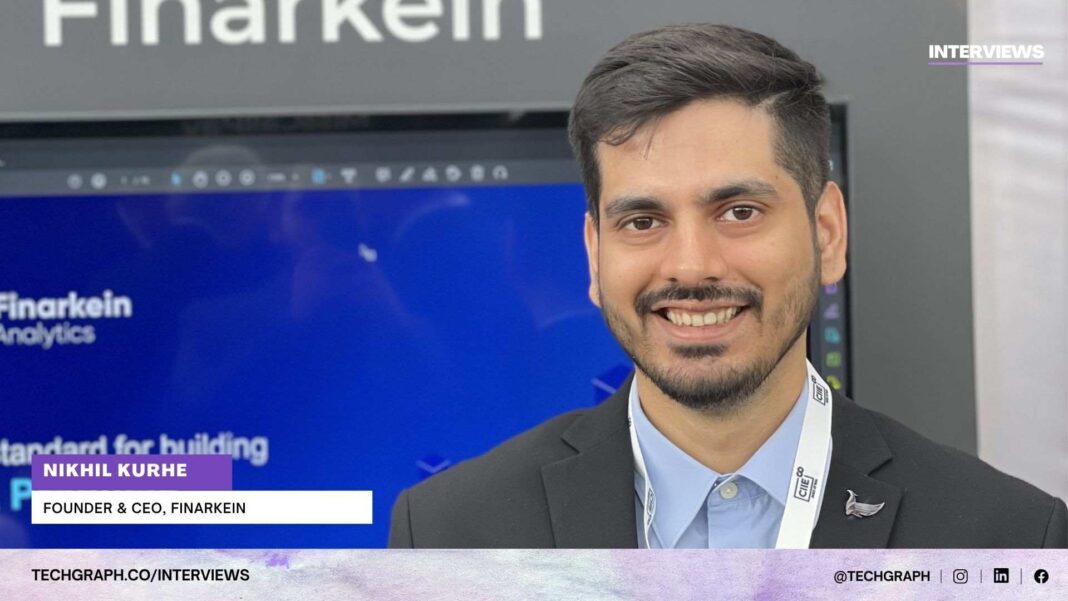
Speaking with TechGraph, Nikhil Kurhe, Co-founder and CEO of Finarkein Analytics, discussed how India’s digital public infrastructure, anchored by Account Aggregators, ONDC, and OCEN, is creating new pathways for inclusion by linking data, credit, and commerce, and how Finarkein is helping financial institutions adapt to this shift through its plug-and-play platform that simplifies AA adoption, enables secure data processing, and accelerates integration with open networks.
Further highlighting open finance’s role in driving broader financial inclusion, Kurhe outlined the company’s approach as one that goes beyond connectivity to deliver measurable outcomes such as enabling small businesses to access working capital through consented financial data and allowing lenders to offer faster and fairer credit to micro-merchants and gig workers.

Read the interview in detail:
TechGraph: The Account Aggregator ecosystem has been described as a backbone of open finance, yet adoption across banks and NBFCs has been slower than anticipated. What do you see as the biggest bottlenecks, and how is Finarkein working to overcome them?
Nikhil Kurhe: The promise of Account Aggregators (henceforth, “AA”) is clear: real-time, consented data-sharing that can fundamentally reshape credit, insurance, and wealth management. However, adoption has been slower because this isn’t just a tech integration; it requires fundamental changes in risk models, processes, and even culture within banks and NBFCs. Legacy systems were never designed to consume data in this way, and compliance teams, understandably, move cautiously.
At Finarkein, our role has been to make this transition less daunting. We’ve built a plug-and-play platform that abstracts away the complexity of the AA framework so institutions can integrate faster, without compromising on compliance. Beyond just pipes, we focus on data processing logic and insights that can flow into credit decisioning, fraud detection, and customer journeys. The goal is to demonstrate immediate business value; once institutions see that, adoption naturally accelerates.
TechGraph: As ONDC and OCEN gain momentum, there is a lot of excitement but also uncertainty about how they will integrate with existing BFSI systems. How do you see these open networks reshaping distribution and the overall customer journey?
Nikhil Kurhe: ONDC and OCEN are transformative because they break traditional silos, whether in commerce or credit, and create level playing fields for participation. But plugging into these networks isn’t as simple as flipping a switch. Banks and NBFCs need to reimagine their customer acquisition and distribution models for an open-network world.
Finarkein is enabling exactly this. Our platform allows BFSI players not just to connect, but to participate intelligently in open networks. For example, by combining AA data with OCEN workflows, lenders can extend credit to micro-merchants in a matter of minutes, not weeks. What excites me is that the customer journey becomes seamless while remaining secure – data, commerce, and finance all stitched together in ways that were unthinkable before.
TechGraph: AI and ML are often described as transformative for financial services, but legacy infrastructure and fragmented data make implementation challenging. What does it take to move beyond the hype and deliver tangible outcomes for BFSI companies?
Nikhil Kurhe: AI is only as good as the data that feeds it, and in financial services, data is often siloed, outdated, or incomplete. The real unlock is high-quality, real-time, consented data, and that’s what frameworks like AA enable.
At Finarkein, we see ourselves as the bridge between raw financial data and usable AI/ML outcomes. We provide the secure data access layer, but also the processing tools that help institutions feed their models with the right signals. That’s how you move beyond hype to tangible outcomes like reducing NPAs, preventing fraud, or personalizing credit.
TechGraph: Trust and privacy are critical in financial services, especially with the kind of sensitive data that Account Aggregators handle. How do you strike a balance between compliance and innovation while building confidence among both institutions and customers?
Nikhil Kurhe: Trust isn’t a feature you add later; it must be the default setting, especially in the financial sector. From day one, Finarkein has taken a data-lite approach: we process only what’s necessary for the stated purpose, nothing more. That’s a deliberate design choice, and it resonates with both regulators and BFSI clients.
Compliance and innovation don’t have to be in tension. In fact, innovation that is grounded in strong compliance frameworks scales faster because it reduces risk for adopters. Our job is to make sure that when a customer consents to share their data, the institution gets exactly what’s needed, and the customer’s confidence is reinforced, not eroded.
TechGraph: Digital public infrastructure is often seen as a catalyst for inclusion. In practical terms, how can platforms like Finarkein expand access to credit and financial services for small businesses and underserved communities?
Nikhil Kurhe: Inclusion is where the real impact of DPI will be felt. Even today, millions of small businesses and individuals are “thin-file” customers, and they lack the formal financial history needed for traditional credit underwriting. AAs can flip that.
Finarkein’s work is about operationalising that promise. For example, a kirana store sharing its bank transaction history through AA can now access working capital loans at better rates, something that was unthinkable a few years ago. Similarly, gig workers or small merchants on ONDC can be assessed and onboarded in real time. Financial inclusion doesn’t stop at access; it’s about making financial services usable, affordable, and trustworthy. That’s the gap we’re working to bridge.
TechGraph: The space is crowded with technology providers positioning themselves as trusted partners. What do you believe sets Finarkein apart in terms of creating real, long-term value for BFSI institutions?
Nikhil Kurhe: What sets us apart is twofold: depth and design. Depth, because we’re not just building pipes, we’re deeply invested in solving the second-order problems of data processing, compliance, and analytics. And design, because we’re relentlessly focused on keeping our platform data-lite, interoperable, and simple to adopt.
Many providers stop at integration. We go further, helping institutions extract business value from open data while staying compliant with the agile tech regulatory landscape of the country. Additionally, our focus on privacy and confidential computing has set us apart, positioning us as the only player who is compliant with RBI guidelines in letter and spirit vis-à-vis the competition. That’s why we’re trusted not just by BFSI players, but also by regulators, associations, and ecosystem builders who see us as long-term partners.
TechGraph: As India deepens its push towards open finance and open networks, what should the industry realistically prepare for in terms of opportunities, disruptions, and challenges over the next three to five years?
Nikhil Kurhe: The next five years will be defined by three things: scale, convergence, and governance. Scale, because adoption of AAs, ONDC, and other DPIs will move from pilots to mainstream. Convergence, because finance, commerce, and health data will increasingly intersect to create new customer journeys. And governance, because the frameworks we set today for pricing, privacy, and interoperability will determine how sustainable this ecosystem really is.
For BFSI players, the opportunity is immense: new markets, new customer segments, and new revenue models. But the challenge is cultural, moving from a closed, proprietary mindset to an open, collaborative one. At Finarkein, we see ourselves as enablers of that shift, helping institutions not just plug into open networks, but thrive in them.