


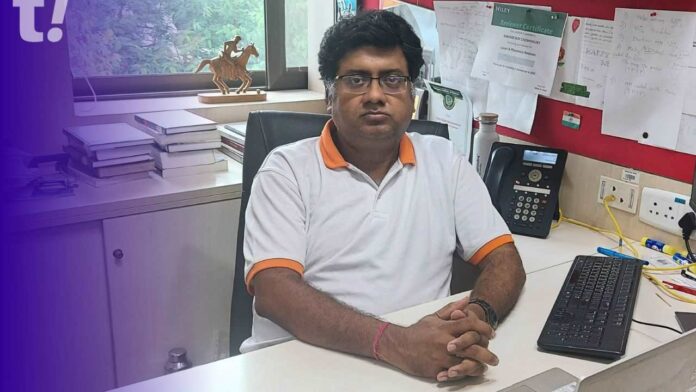

During the interview with TechGraph, Dr. Dibakar Roy Chowdhury, Professor & HOD of Physics spoke about how Mahindra University (MU) promotes a culture of innovation and entrepreneurship by providing students with the resources to transform their ideas into impactful ventures.
Read the complete interview:
TechGraph: Can you give us an overview of Mahindra University’s educational programs?
Dr. Dibakar Roy Chowdhury: Mahindra University offers a wide range of undergraduate, postgraduate, and doctoral programs across various disciplines, including engineering, management, law, media, liberal arts, and basic sciences.
The curriculum of our programs is designed to impart both theoretical knowledge and practical skills, preparing students for real-world challenges. We also focus on developing critical thinking, creativity, design thinking, and communication skills in our students, which are essential for their personal and professional growth.
TechGraph: What role does research play in Mahindra University’s educational offerings, and how do you ensure students are exposed to the latest advancements in their fields?
Dr. Dibakar Roy Chowdhury: Research is an integral part of our educational programs at Mahindra University. Our faculties and students engage in state-of-the-art research activities, collaborate with industry and other academic institutions, and publish their findings in reputed journals and conferences.
We also organize seminars, workshops, and conferences regularly where experts from academia and industry share their latest research and advancements with our students. At the same time, research outputs originating from Mahindra University labs are also showcased to world-renowned experts, not only in MU but in other external forums too.
Moreover, we believe teaching and research should be in perfect harmony where they complement each other. Here, we ensure that aspect is preserved ensuring modern-day holistic education in a true sense.
TechGraph: What kind of support do you provide to students to succeed academically and professionally? How does the university prepare them for the workforce?
Dr. Dibakar Roy Chowdhury: At Mahindra University, we provide a supportive learning environment for our students, which includes access to state-of-the-art infrastructures, experienced faculty, and career guidance services. Our curriculum is designed to provide our students with the knowledge and skills required to succeed in their chosen careers.
We also offer various training programs and internships, enabling our students to gain hands-on experience and network with industry professionals. We have a dedicated placement cell that works closely with companies to facilitate job opportunities for our students. We have several faculties across disciplines with enormous industry experiences who recognize the current trends in industrial sectors. As required, they train our students to make them industry ready.
TechGraph: How do you incorporate technology and innovation into Mahindra University’s educational offerings, and what impact do you think this has on the quality of education students receive?
Dr. Dibakar Roy Chowdhury: In modern days, technology and innovation are critical components of education. Therefore, at Mahindra University, we leverage technology to enhance the learning experience of our students, be it through online resources, digital libraries, or virtual labs.
We also encourage innovation and entrepreneurship among our students through various programs, hackathons, and other competitions. Our students are trained in state-of-the-art research facilities available in-house providing them with direct exposure to the latest technologies as well as the importance of innovation. In this way, technology and innovation are integrated into our educational offerings, and we ensure that our students are prepared for the rapidly emerging world.
TechGraph: How does Mahindra University ensure that its educational programs align with industry needs and trends?
Dr. Dibakar Roy Chowdhury: We work closely with industry partners to ensure that our educational programs are aligned with their needs and trends. We have an industry advisory board comprising of experts from various industries who provide us with feedback and guidance on our programs’ content and structure.
At the faculty level, we ensure a good number of faculty representatives with industry backgrounds. We also organize guest lectures, industrial visits, and internships, which expose our students to the industry’s latest practices and trends. All these efforts ensure our educational offerings are in sync with industry demands.
TechGraph: Can you speak about the role of experiential learning in Mahindra University’s educational approach?
Dr. Dibakar Roy Chowdhury: At Mahindra University, we put special emphasis on hands-on experiential learning which forms the key component of our educational approach.
We believe that students learn best by doing, and hence, we provide them with ample opportunities to apply their theoretical knowledge to real-world practical problems.
We have various experiential learning programs, such as project-based learning, internships, research projects, summer projects, and industry collaborations that help our students gain practical skills and experience. Also, students are encouraged to take up projects with our international partners.
TechGraph: How does Mahindra University’s curriculum integrate interdisciplinary learning?
Dr. Dibakar Roy Chowdhury: At Mahindra University, we recognize the importance of interdisciplinary learning in today’s world. Our curriculum is designed to encourage interdisciplinary thinking, where students can choose courses from different disciplines and explore the connections between them.
We offer elective courses across the schools and disciplines, that’s another way of enhancing the scope of interdisciplinary learning. We also offer various interdisciplinary programs, such as Data Science, Artificial Intelligence, Nanotechnology, Sustainable infrastructures, Cybersecurity, and many more that prepare our students for the multidisciplinary nature of the modern workforce.
TechGraph: Can you share any recent or ongoing initiatives Mahindra University has undertaken to enhance its educational programs?
Dr. Dibakar Roy Chowdhury: Mahindra University is committed to delivering world-class education to its students and continuously undertakes initiatives to enhance its educational programs. One of the recent initiatives is the introduction of industry-relevant, interdisciplinary programs that provide students with the skills and knowledge required to succeed in today’s dynamic job market.
We have also established partnerships with leading universities (Ecole Centrale France, Cornell University, University of Florida, Virginia Tech, etc.) around the world to offer exchange programs, joint research projects, and collaborations that enrich the learning experience of our students. Additionally, we have invested in modern infrastructure, world-class research laboratories, and technologies to provide a state-of-the-art learning environment to our students.
TechGraph: How does Mahindra University foster a culture of innovation and entrepreneurship among its students?
Dr. Dibakar Roy Chowdhury: At Mahindra University, we believe that innovation and entrepreneurship are critical drivers of economic growth and development. To foster a culture of innovation and entrepreneurship among our students, we have established several initiatives, including innovation and entrepreneurship centers, startup incubators, and accelerator programs.
We have recently received Atal Incubation Centre (AIC) from govt of India. These programs provide students with the necessary resources and guidance to develop and launch their innovative ideas into viable businesses.
We also encourage our students to participate in national and international innovation and entrepreneurship competitions to showcase their talents and gain exposure to industry leaders. In this regard, Favo Construction started by our students was incubated in the Mahindra University entrepreneurship cell for several years before becoming a full-grown company.
TechGraph: Can you speak about the role of research in Mahindra University’s educational offerings?
Dr. Dibakar Roy Chowdhury: Research and development are one of the driving forces at Mahindra University which is mandatory to be recognized globally. Undoubtedly, research is essential for driving innovation and addressing complex societal challenges to advance mankind. In Mahindra University research is strongly encouraged through PhD programs and involving undergrad students.
To this end, we have established several research centers of excellence in various fields, including energy, nanotechnology and nanoscience, Terahertz photonics, ultrafast and 6G communications, artificial intelligence, high-performance computing (HPC), robotics, etc. These centers undertake cutting-edge research projects in collaboration with industry partners and leading academic institutions worldwide.
We also encourage our faculty and students to undertake research projects and provide them with the necessary resources and support to pursue their research interests. As a result, Mahindra University pursues internationally competitive research as can be affirmed by the patents and publications in top-notch journals.
TechGraph: How does Mahindra University ensure that its graduates are prepared to enter the workforce and make a meaningful contribution to society?
Dr. Dibakar Roy Chowdhury: At Mahindra University, we believe that our graduates should be well-prepared to enter the workforce and make a meaningful contribution to society.
To achieve this, we have developed a rigorous and industry-relevant curriculum that equips our students with the necessary skills and knowledge required for today’s job market. We also provide our students with hands-on learning opportunities, including internships and industry collaborations, to gain practical experience in their chosen fields.
Additionally, we have established a robust career services center that offers career counseling, job placement assistance, and networking opportunities to our graduates. We also encourage our students to engage in community service and social responsibility initiatives to develop a sense of civic responsibility and contribute positively to society.
TechGraph: How do you see Mahindra University in the Indian research landscape and worldwide in the coming years?
Dr. Dibakar Roy Chowdhury: Over the past several years, we have seen a tremendous surge in research and development of indigenous technologies which calls for a paradigm shift that would assess the current technological challenges, emphasize framing proper research methodology, and develop the infrastructure to meet the scalability requirements. Mahindra University, in this regard, finds itself at the forefront.
Considering its strong inclinations in research and development, MU has already emerged as a strong player through significant contributions in several fields of study, using state-of-the-art research activities. The remarkable works in the domains of developing next-generation 6G communications technology as well as stress on AR, VR, artificial intelligence, and quantum technology have validated the research prowess and acumen.
MU takes pride in showcasing its active collaborations with several renowned institutes within India and abroad. At the fundamental level, this has become possible because of the presence of a young, dynamic, highly enthusiastic group of faculties with an appropriate research bent of mind.
As morning shows the day, Mahindra University carries all the credentials to make a strong impact in terms of research and development and showcase its national as well as global footprint in the research fraternity.