



PARIS, Nov. 17, 2023 /PRNewswire/ — Starting today, Vestiaire Collective, the leading global second-hand luxury fashion platform, announces it is banning a second wave of fast fashion brands from its platform. This marks the second year in a three-year rollout to ban all fast fashion from Vestiaire Collective’s website. Following last year’s initial announcement, Vestiaire Collective saw 70% of members impacted by the ban come back to the platform to shop for better quality items and invest in second-hand. Furthering their commitment to create a more circular economy, Vestiaire Collective worked with a committee of nine fashion and sustainability experts to create a clear definition of fast fashion and leverage this framework to ban industry giants from its website.
BANNED BRANDS AND DEFINING FAST FASHION
Banning more fast fashion from Vestiaire Collective’s website will spark debate, however, with the climate crisis accelerating and ninety-two million tons of textile waste thrown away every year1, it is a necessary step to reduce fashion’s environmental and social impact. As part of the company’s mission to change the way people consume, Vestiaire Collective will utilize the platform to bring awareness to issues of textile waste and fashion overconsumption, as well as encourage other key fashion players to join the mission to change the industry. After a year of research and planning, starting today, Vestiaire Collective proudly bans a list of 30 brands including: Abercrombie & Fitch, Gap, H&M, Mango, Uniqlo, Urban Outfitters, and Zara among others.
Vestiaire Collective gathered key industry experts to help build a framework defining fast fashion based on the five criteria fueling overproduction and overconsumption:
Low price point: estimated average price point, also considering the repairability componentIntense renewal rate: the estimated number of collections or number of new items drops per yearWide product range size: the number of items available at a given momentSpeed to market: the production cycle time, from designing phase to finished goods in storeStrong promotion intensity: the frequency and intensity of sale promotionsVestiaire Collective’s nine industry and sustainability committee members were selected based on their expertise and strong understanding of fast fashion’s negative environmental and social impact. The experts gave their in-depth opinion and analysis of the fast fashion market. The members include:
1 (Source: Ellen MacArthur Foundation)
Orsola de Castro, Co-founder of Fashion Revolution and authorRachel Cernansky, Senior Sustainability Editor at Vogue BusinessChristina Dean, Founder and Board Chair of NGO Redress and Founder and Chief Operating Officer of The R CollectiveEva Kruse, Chief Global Engagement Officer Pangaia, Founder of the Global Fashion AgendaLiz Ricketts, Co-founder and Director of The Or FoundationLauren Singer, Managing Partner, Overview CapitalFrançois Souchet, Global Head of Sustainability and Impact Consulting at BPCM, Former lead “Make Fashion Circular” at Ellen MacArthur FoundationLucianne Tonti, Fashion journalist and authorMatteo Ward, Co-founder of Wrad living, activist, UN/CEFACT advisor”The decision to ban fast fashion was made to support Vestiaire Collective’s long time work to promote alternatives to the dominant model of fashion. Fast fashion brands contribute to excessive production and consumption, resulting in devastating social and environmental consequences in the Global South. It is our duty to act and lead the way for other industry players to join us in this movement, and together we can have an impact.” noted Dounia Wone, Chief Impact Officer, Vestiaire Collective.
EDUCATION AND AMPLIFICATION
Vestiaire Collective knows that banning fast fashion only works if consumers shop more consciously, and the company encourages buyers to think critically about their purchasing habits and the true impact of their choices. Vestiaire Collective created an educational journey for buyers and sellers who will see informational messages at every step of their shopping or listing experience. They will also receive practical alternatives for their existing fast fashion items via an online guide with resources for donation strategies and sustainability insights. Vestiaire Collective also commits to educating companies on the benefits of sustainable operations as well as evaluating existing relationships with partners and influencers based on their current practices.
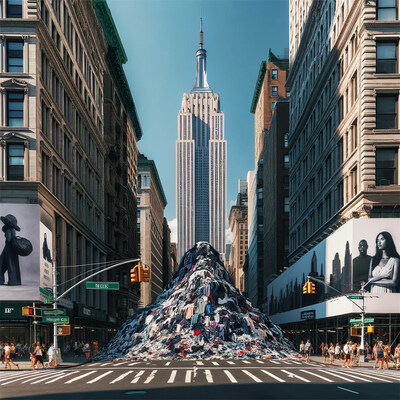
To create awareness, Vestiaire Collective is launching a global campaign “Think First, Buy Second” across its digital channels. The campaign leveraging AI technology, will include a video and visuals of piles of clothes located in some of the most recognizable locations of the Global North, such as Times Square, or The Eiffel Tour to replicate what textile waste and landfills would look like in consumers’ own countries. The campaign will encourage social media users to take the pledge in an effort to turn Black Friday into a Better Friday. Participants can choose between pledging to only buy second-hand this Better Friday, until the end of the year, in 2024 or to stick to second-hand forever.
ADVOCACY AND LOBBYING
As part of the creation of an Extended Producer Responsibility (EPR) framework for textiles currently under discussion at the European Parliament, Vestiaire Collective has drawn up a position paper advocating greater transparency in the regulation of end-of-life and textile waste exports. The Company has called on the European Parliament and all industry stakeholders to address the urgency of textile waste.
Today, France is the only European country to benefit from an Extended Producer Responsibility (EPR) system that the European Commission proposes to expand to all European countries. Vestiaire Collective and Paris Good Fashion have conducted research and examined the shortcomings of the French system, which still relies heavily on the mass export of textiles, in order to propose a responsible and circular management of used garments, on a sound and solid basis, within the European Union and worldwide.
About Vestiaire Collective
Vestiaire Collective is the leading global platform for pre-loved luxury fashion. The company’s mission is to transform the fashion industry for a more sustainable future, promoting the circular fashion movement as an alternative to overproduction, overconsumption and the wasteful practices of the industry. Driven by the philosophy “Long Live Fashion,” Vestiaire Collective offers a trusted space for its community to prolong the life of its most-loved fashion pieces. The platform’s innovative features simplify the selling and buying process and give its members access to one-of-a-kind wardrobes around the world. The company boasts a curated catalog of five million rare and highly desirable items. Founded in Paris in 2009, Vestiaire Collective is a Certified B Corporation® and is active in 80 countries worldwide. To learn more, download the app, visit vestiairecollective.com and follow @vestiaireco o n Instagram.
Video – https://mma.prnewswire.com/media/2280287/Vestiaire_Collective.mp4Photo – https://techgraph.co/wp-content/uploads/2023/11/Visual_Vestiaire_Collective.jpgLogo – https://techgraph.co/wp-content/uploads/2023/11/Vestiaire_Collective_Logo.jpg
View original content:https://www.prnewswire.co.uk/news-releases/vestiaire-collective-bans-industry-giants-from-platform-in-a-second-wave-of-the-fight-against-fast-fashion-301992222.html