



India’s Union Budget for 2026, presented on Feb 1 by Nirmala Sitharaman, further integrated technology into the centre of economic policy, as artificial intelligence, cloud infrastructure, and research funding received stronger institutional backing. Higher allocations for national technology missions, combined with extended tax incentives aimed at attracting long-term cloud investments, reflected a broader effort to align digital growth with the country’s infrastructure-led expansion.
The measures attracted wide response from technology leaders, who said the Budget recognised the growing role of AI, data platforms, and digital systems in supporting economic scale across sectors, including agriculture, enterprise services, and cloud computing.

Read the budget reactions from tech industry leaders and experts in detail:
Dr. Kanishk Agrawal, Chief Technology Officer at Judge Group India
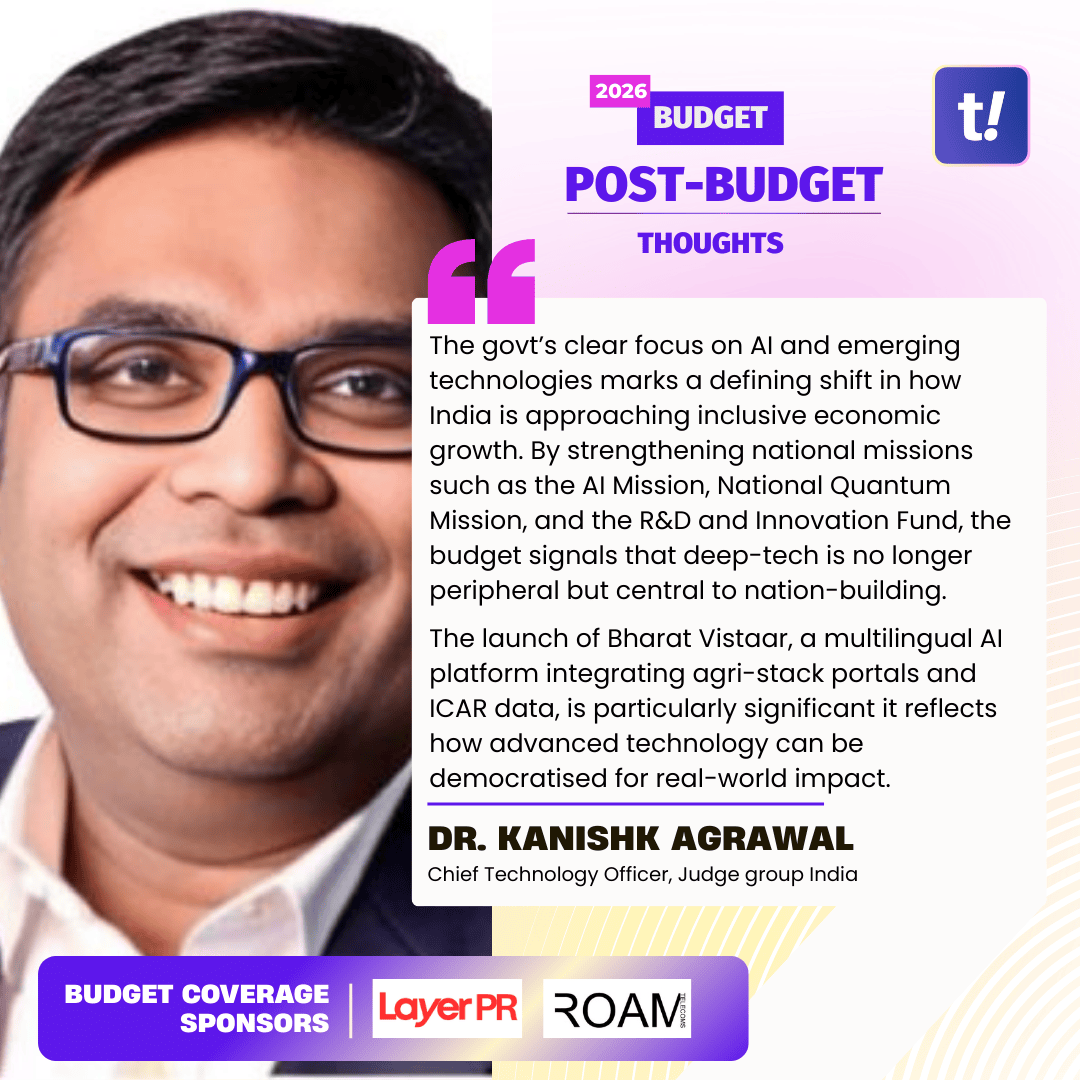
The government’s clear focus on AI and emerging technologies marks a defining shift in how India is approaching inclusive economic growth. By strengthening national missions such as the AI Mission, National Quantum Mission, and the R&D and Innovation Fund, the budget signals that deep-tech is no longer peripheral but central to nation-building. The launch of Bharat Vistaar, a multilingual AI platform integrating agri-stack portals and ICAR data, is particularly significant, as it reflects how advanced technology can be democratised for real-world impact. AI-led advisory tools have the potential to transform agriculture by improving productivity, enabling data-driven decisions, and reducing risks for farmers, especially in underserved regions. What stands out is the intent to align innovation with accessibility, ensuring that technology-driven growth benefits not just enterprises and institutions, but also grassroots stakeholders who form the backbone of India’s economy.
Niranjan Chintam, Chairman, Kellton

Beyond tax incentives, the real impact of this move is ecosystem-building. If global cloud providers begin serving the world from India, it will fundamentally deepen the country’s capabilities in cloud architecture, cybersecurity, FinOps, and managed services, creating a generation of higher-value digital jobs and positioning India as a true hub for the global cloud economy.
Major Vineet Kumar, Founder and Global President, CyberPeace

Union Budget 2026–27 makes it clear that India’s growth ambitions are now inseparable from its digital and security foundations. With public capex rising to INR 12.2 lakh crore and a long-horizon tax holiday till 2047 for global cloud service providers operating data centres in India, the Budget sends a strong signal that India wants to build at scale across AI, cloud, deep-tech, and future-ready infrastructure. This is not just about steel and cement; it is a mandate for software, data platforms, cybersecurity, and intelligence layers. As India sustains 7% growth while expanding digital public services to millions, cybersecurity emerges not as a technical afterthought, but as a core economic and national capability that must grow alongside scale and innovation.
ANURAG JAIN, CEO & FOUNDER, ORISERVE
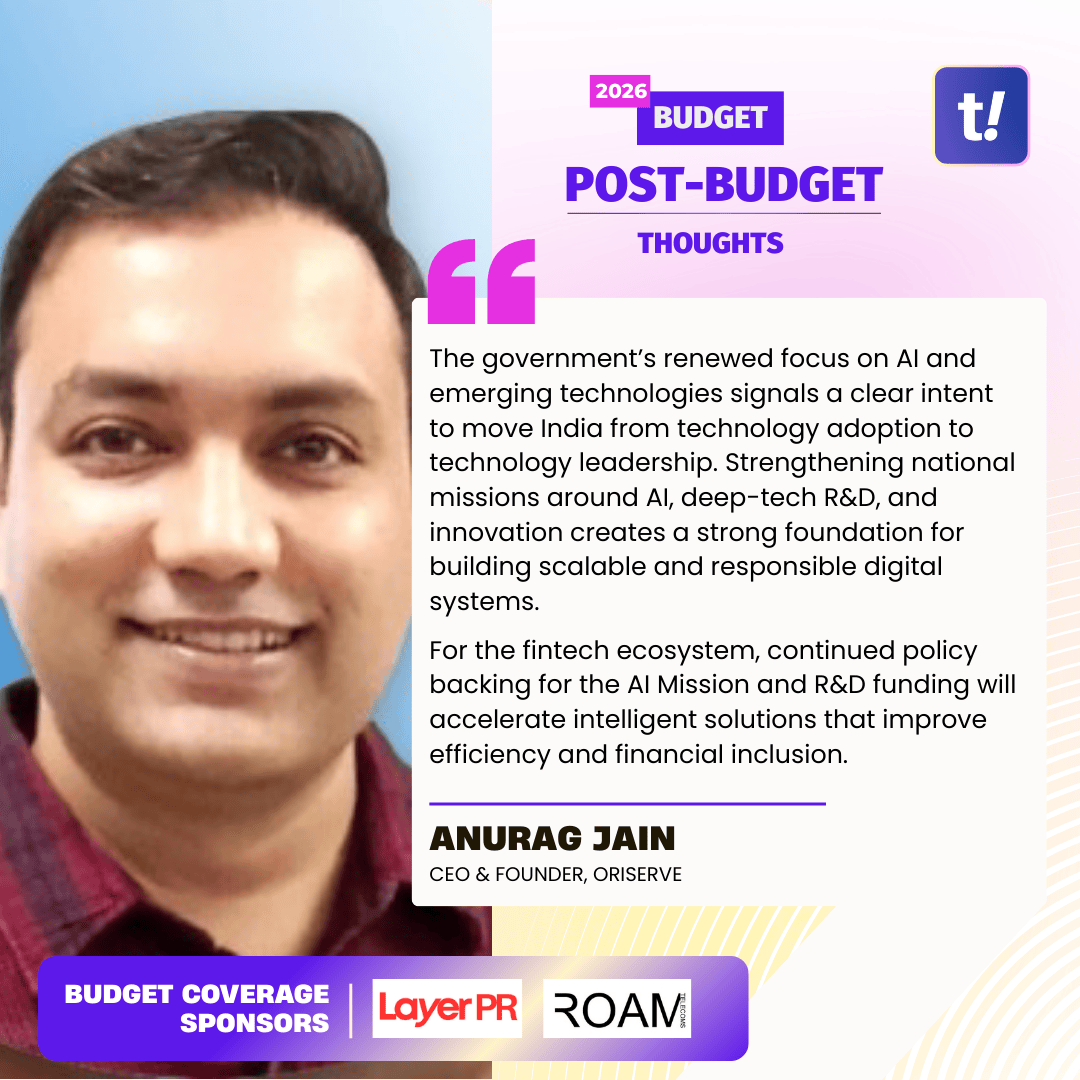
The government’s renewed focus on AI and emerging technologies signals a clear intent to move India from technology adoption to technology leadership. Strengthening national missions around AI, deep-tech R&D, and innovation creates a strong foundation for building scalable and responsible digital systems. For the fintech ecosystem, continued policy backing for the AI Mission and R&D funding will accelerate intelligent solutions that improve efficiency and financial inclusion. Initiatives like Bharat Vistaar emphasize the importance of multilingual, AI-led platforms in widening access. This approach is especially relevant for financial services, where trust, personalization, and reach are critical.
Prashanth Naik, Co-founder and Head of Technology/Creative, IndieVisual

The Union Budget outlines a broad push towards strengthening India’s innovation and creative ecosystem. Within this, the emphasis on AI adoption and innovation funding is encouraging, with the real opportunity lying in how effectively these initiatives translate into action through AI missions and research. Platforms like TReDS can also play a meaningful role in enabling MSMEs and startups by improving access to timely working capital. India’s young talent base continues to drive innovation across technology and creative sectors, and with AVGC alone expected to require nearly two million professionals by 2030, sustained policy support and execution can help strengthen India’s position in applied, AI-driven creative solutions globally.
Vikram Labhe, Founder & CEO, Melooha
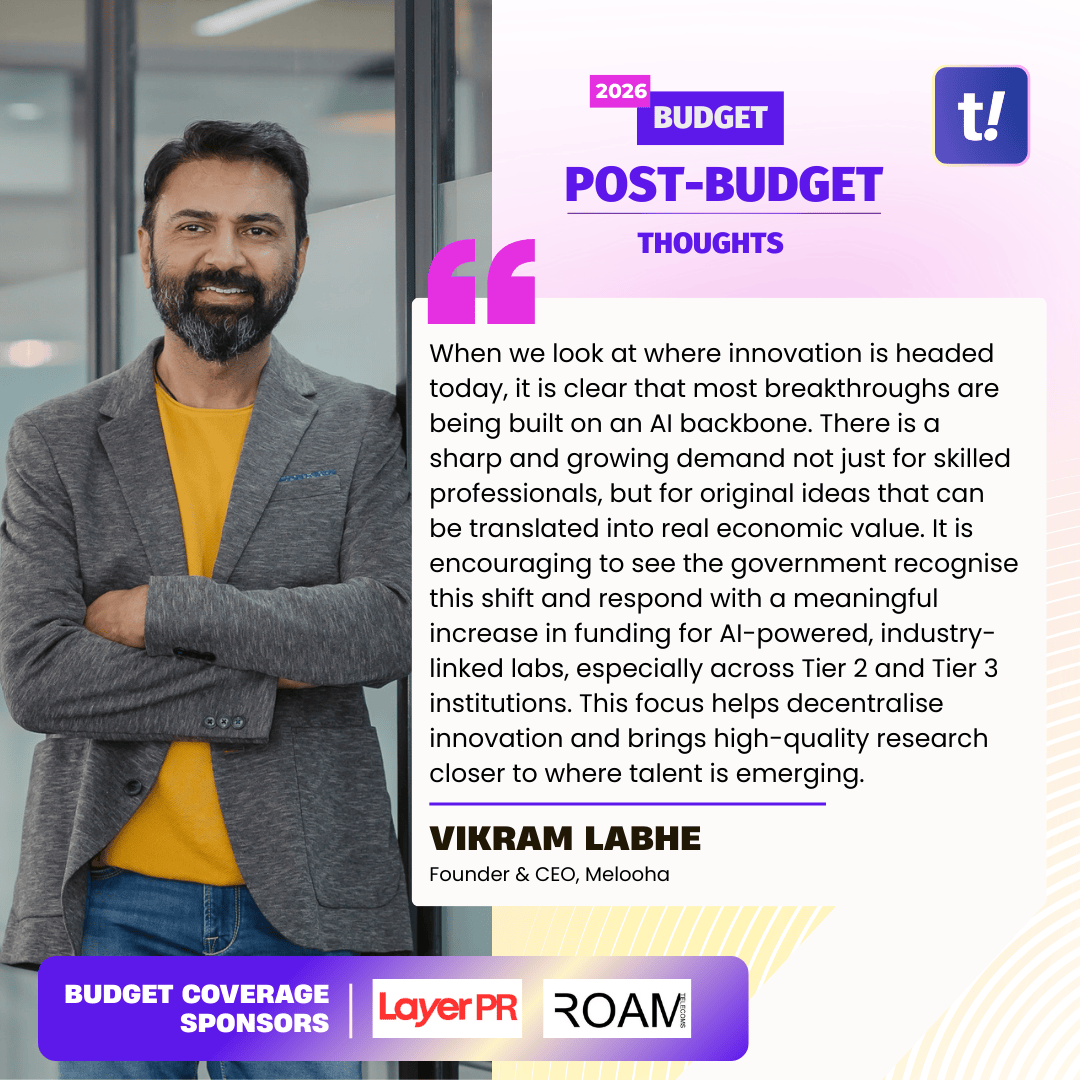
When we look at where innovation is headed today, it is clear that most breakthroughs are being built on an AI backbone. There is a sharp and growing demand not just for skilled professionals, but for original ideas that can be translated into real economic value. It is encouraging to see the government recognise this shift and respond with a meaningful increase in funding for AI-powered, industry-linked labs, especially across Tier 2 and Tier 3 institutions. This focus helps decentralise innovation and brings high-quality research closer to where talent is emerging. For companies like Melooha, this creates a stronger pipeline of ideas, skills, and applied intelligence. With sustained support for AI and targeted backing for MSMEs, we can expect a new wave of solutions across sectors that are locally rooted, globally relevant, and capable of shaping the next phase of India’s digital economy.
Akshat Saxena, Co-founder and CEO, Vibrium.AI

Union Budget 2026–27 highlights how artificial intelligence will enable industries, agriculture, logistics, governance, and social development. Initiatives mentioned in the budget, like Bharat-VISTAAR, AI-led job matching, and technology-driven customs and welfare systems, reflect a desire from the government to build a resilient digital backbone for the economy. Budget’s emphasis on AI-driven productivity, security, and inclusion will go a long way in strengthening service delivery, enhancing competitiveness, and preparing India’s workforce for the future. As stakeholders in the agentic AI space, this momentum will encourage innovation, responsible deployment, and large-scale impact, enabling India to lead the next wave of intelligent, autonomous technologies.
Harishanker Kannan, CEO & Co-founder, Scalefusion

With a strong focus on IT services, expansion of data centre infrastructure, cloud adoption, and enabling cross-border digital operations, India’s Union Budget clearly reinforces the country’s ambition to emerge as a leading global digital and technology powerhouse. The policies encouraging cloud innovation, strategic data infrastructure, and seamless global connectivity will lay the foundation for faster adoption of secure and scalable digital solutions by enterprises around the world. For organisations managing distributed teams and devices, this evolving landscape creates an ideal environment to implement resilient, compliant, and future-ready IT systems at scale, an opportunity we at Scalefusion are proud to help enable.
Ankush Sabharwal, Founder and CEO, CoRover

The Union Budget marks a clear shift from intent to execution for India’s technology and AI ecosystem. Much before the Budget, there was optimism that this would be an adoption-led framework, and the announcements have lived up to that expectation. The strong emphasis on risk capital, R&D-led innovation, and large-scale adoption reflects a mature understanding of how deep technologies move from labs to real-world impact. What stands out is that this is not just a visionary Budget, but one that clearly outlines the methods to achieve that vision through stronger education-to-employment linkages, enterprise-focused skilling across IT, ITES, and KPO sectors, and meaningful inclusion of Divyangjan via technology-enabled solutions supported by institutions such as ALIMCO.
The ₹20,000 crore R&D Innovation Fund, alongside the larger ₹1 lakh crore support through the Department of Science and Technology, creates a solid foundation for long-term innovation. Initiatives like Bharat Vistar’s multilingual, AI-led agriculture framework linked with ICAR further reinforce inclusive growth. With data center incentives and a global outlook, India has a real opportunity to emerge as a global AI hub, driving ease of living, ease of business, and sustainable prosperity.