



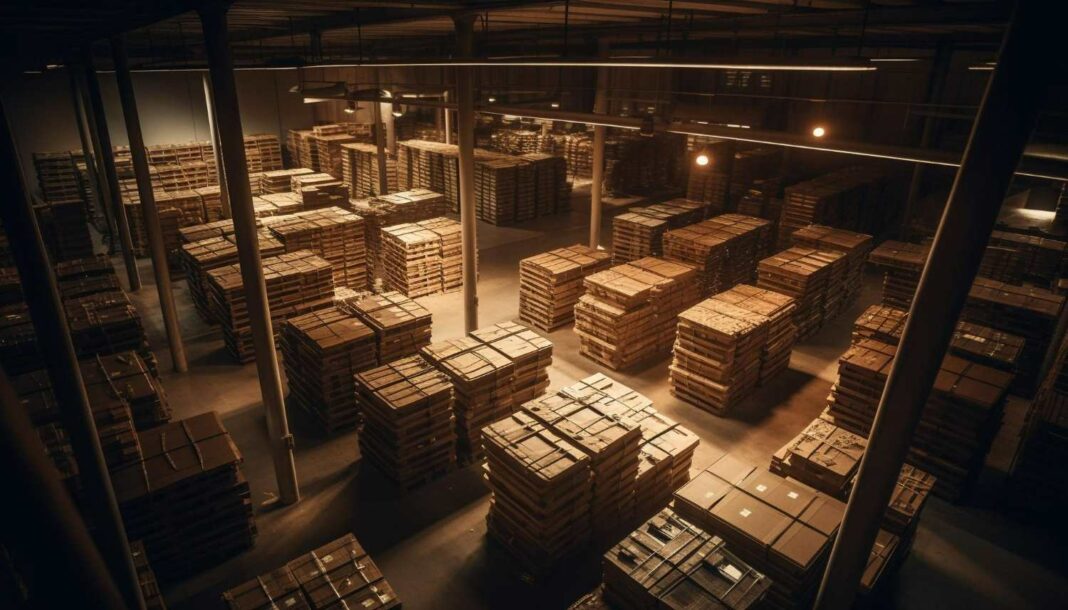
There was a time when warehouses were the forgotten middle step in a product’s journey. Customers didn’t think about them, and most businesses saw them as static storage units. That’s changing, and fast. Today, they are turning into the smart hubs of India’s fast-moving economy. They’re no longer just about stacking boxes but about syncing data, predicting demand, and powering next-day and same-day deliveries.
With every scan, sensor, and software update, India’s warehousing sector is rewriting the rules of logistics. This shift is an urgent response to the rising demands of e-commerce, global trade, and 24/7 consumer expectations. Behind the scenes, technological advancements are steadily enhancing the speed, intelligence, and connectivity of modern warehouse operations.

A Market Poised for Transformation
India’s warehousing sector is undergoing a significant transformation. Valued at INR 1,206.03 billion in 2021, the market is projected to reach INR 2,872.10 billion by 2027, growing at a compound annual growth rate (CAGR) of approximately 15.64% during the 2022–2027 period. Key contributors to this growth include fast-paced urbanisation, higher consumption levels, and the widening reach of e-commerce and third-party logistics.
Major metropolitan areas such as Mumbai, Delhi NCR, Bengaluru, and Pune already account for a significant share—nearly 60%—of India’s modern warehousing stock. However, the industry’s progress is no longer measured by capacity alone. Businesses are increasingly focused on capability, seeking smarter, tech-enabled warehouses that offer better control, faster turnaround, and greater accuracy. As a result, the adoption of automation, AI, and data analytics is accelerating across the warehousing landscape.
Why Technology Is Becoming Essential
Two factors, speed and precision, are at the heart of the sector’s technological transformation. With rising demand for same-day and next-day delivery, third-party logistics (3PL) providers are shifting away from manual, paper-driven operations to adopt smart, automated workflows.
Automation is now standard in many warehouses operated by 3PL providers. Tasks such as item picking, barcode scanning, and inventory updates are increasingly handled by machines, allowing staff to focus on more complex functions like quality checks or managing returns. What once took hours can now be done in minutes, with real-time data giving managers clear visibility into stock levels and overall performance.
In this context, modern 3PL-operated facilities are also becoming multi-functional. Beyond basic storage and dispatch, many now offer services like product bundling, labelling, repairs, and even customisation, often integrated within a single digital platform that ensures accuracy and consistency.
Technology-Enabled Visibility and Planning
Technological solutions like Warehouse Management Systems (WMS) and Transport Management Systems (TMS) have become central to streamlining operations. These platforms offer real-time visibility across the entire supply chain from the point of production to the end consumer, enabling better planning, reducing delays, and improving transparency for customers.
Advanced forecasting tools powered by AI further enhance operational planning. These tools analyse historical sales data, seasonal patterns, and even consumer sentiment to anticipate demand more accurately. This allows companies to position inventory more strategically, reduce excess stock, and minimise missed sales opportunities.
Many 3PL companies are supporting brands by providing real-time logistics data and operational insights that enhance demand planning. While brands take the lead on forecasting and strategy, 3PLs play a critical backend role, ensuring faster response times, streamlined inventory management, and seamless coordination across supply nodes.
Challenges on the Road to Digitisation
Of course, transitioning to a digital-first approach presents its own complexities
The cost of implementation, especially for robotics or advanced AI, is a big concern, particularly for small and mid-sized companies. Then there’s the human side of the story: training teams to move away from legacy systems and embrace new tools takes time and consistent effort.
System integration is another pain point. Getting warehouse, transport, order, and finance platforms to work together smoothly isn’t easy; it requires expert planning and the right technology partners.
A phased approach often works best. Start with easy-to-adopt tools that bring visible benefits. Build confidence among teams. And choose platforms that can scale as your operations grow.
Looking Ahead: Predictive, Personalised, and Automated
The future of warehousing is focused on personalised operations, predictive capabilities, and improved automation. AI and machine learning will allow systems to forecast not just demand but potential disruptions such as machinery downtime or shipment delays, enabling proactive interventions.
3PL providers are evolving into highly customer-centric partners, leveraging data to optimise every touchpoint. Based on order history, location, or urgency, intelligent systems will automatically prioritise workflows, select faster delivery routes, and customise packaging for greater efficiency.
Early adopters are already using AI for forecasting and robotic process automation (RPA) to streamline routine tasks. Tools like conveyor-based movement, video monitoring, and intelligent dashboards are helping reduce manual effort and increase operational accuracy.
Conclusion
Warehousing in India is no longer defined by storage space; it is defined by strategic intelligence. Technology is reshaping how 3PL providers operate, transforming warehouse functions from traditional back-end support into core enablers of business growth. For organisations navigating the new landscape of digital commerce, investing in smart warehousing solutions is not optional; it is critical. The modern warehouse is no longer an isolated link in the supply chain. It is a digitally integrated, efficiency-driven command centre powering speed, reliability, and customer satisfaction in a highly competitive market.
