



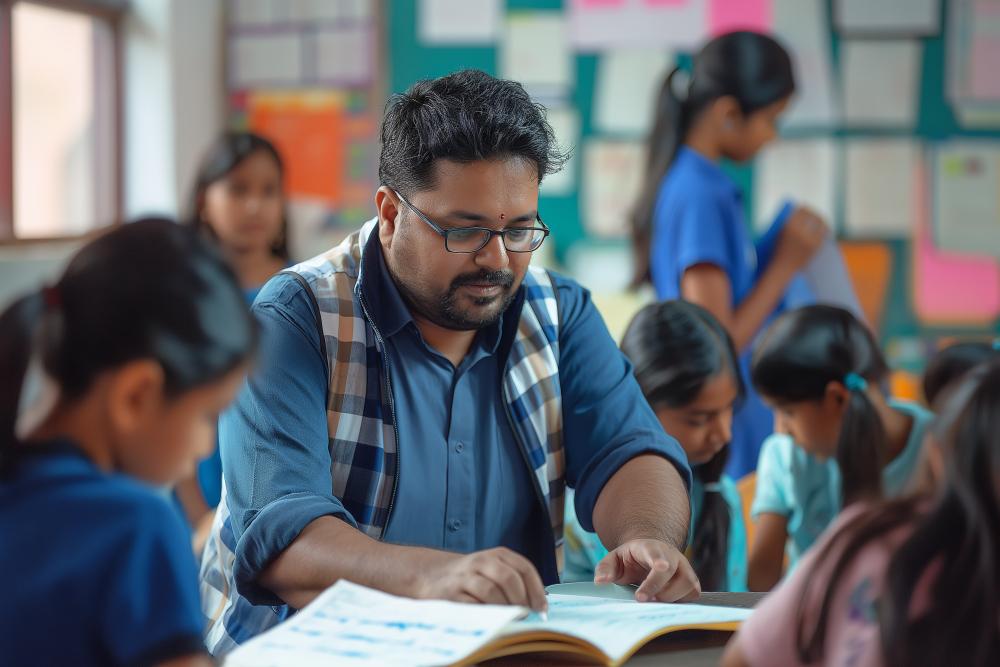
If you step into an Anganwadi on any given morning, what you’ll see is more than a “pre-school.” You’ll see children curious, expressive, sometimes shy, sometimes loud, finding their first rhythm with numbers, stories, and with each other. That humble space is shaping the foundations of their entire learning journey.
Across India, nearly 7.5 crore children under five are enrolled in Anganwadi centres, according to government data, a number that reflects both the scale and the responsibility of this network. These centres are not just hubs for nutrition and health check-ups, but for early growth, play, and learning. Yet, for many families, Anganwadis remain the first doorway into the world of education.

The first six years of a child’s life are critical. Scientific evidence shows that as much as 90% of brain development happens before age six, and meaningful early experiences during this period dramatically influence later learning, social skills, and emotional growth.
This matters because early learning is not only about literacy and numeracy skills. It’s about how children feel about learning whether they approach challenges with curiosity or with fear.
In many Anganwadi centres across different states, what stands out most is the dedication of Anganwadi workers women who juggle nutrition distribution, health records, home visits, and community outreach, all while nurturing young minds. What often goes unnoticed is how little formal training many of them receive in early childhood pedagogy, especially approaches that engage young children meaningfully. That’s where play-based learning becomes especially powerful.
Play is not a “break” from learning. Play is learning.
Consider a simple shift from rote counting drills to games using stones, leaves, or bottle caps collected by children themselves. Instead of sitting quietly and reciting numbers, children sort, compare, share, and discuss. A child who rarely speaks may suddenly explain why one pile has more stones than another. In that moment, reasoning replaces repetition. Confidence replaces hesitation.
These small, practical activities build foundational skills problem-solving, communication, collaboration without requiring expensive materials. What they require is thoughtful design and an understanding of how young children learn best.
Recent field reports show that preschool enrolment in Anganwadis has risen significantly, with more than three-quarters of three-year-olds enrolled in early childhood education programmes in rural areas. This increase in participation is a hopeful sign that parents are beginning to see Anganwadis not just as places for meals and supervision, but as meaningful learning spaces.
However, enrolment alone does not guarantee impact. To truly fulfil their potential, centres need stronger training support, practical teaching resources, and ongoing guidance in early childhood methods. Structured, play-based models can help transform everyday classroom routines into richer learning experiences. Importantly, such approaches do not demand high-cost infrastructure only clarity of purpose and support for frontline educators.
When Anganwadi workers feel equipped and confident in their teaching methods, classrooms become more dynamic. Children walk in curious and leave feeling capable. The ripple effects extend far beyond the classroom into primary school readiness, retention rates, and long-term academic outcomes.
If India truly wants to strengthen its education foundation, it must start here at the very beginning of a child’s learning journey. Anganwadis already serve millions; with structured play-based learning, they can serve millions of confident learners.
And that is how India’s education foundation will be transformed one child, one idea, one playful moment at a time.
