


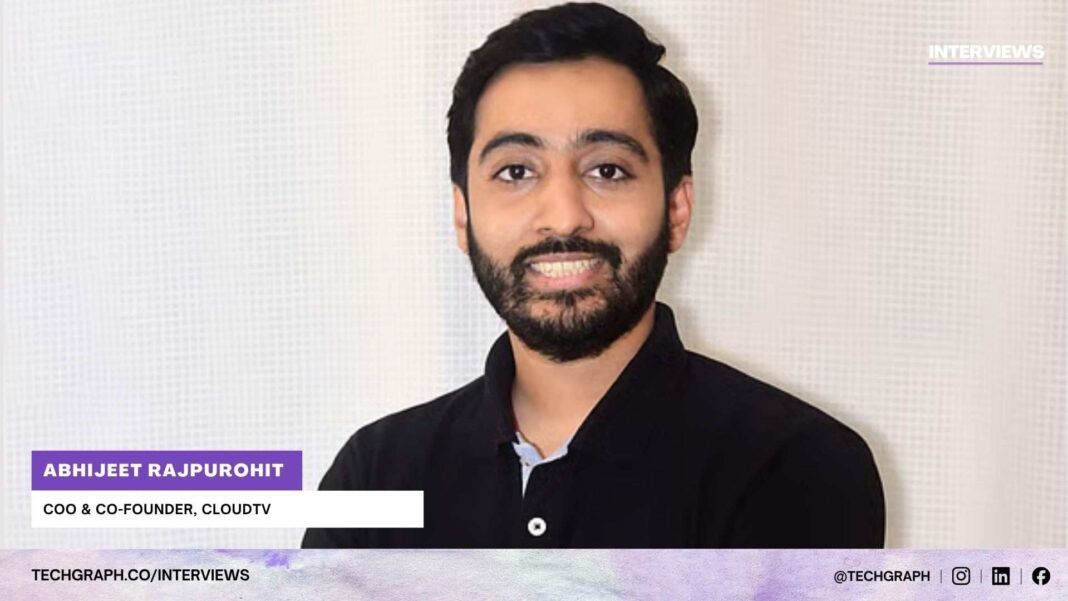
Speaking with TechGraph, Abhijeet Rajpurohit, COO and Co-founder of CloudTV, discussed how the company is enabling advertisers to tap into India’s fast-growing connected TV base as it partners with leading OEMs in the affordable segment to make smart TVs accessible to new households across Tier 2 and Tier 3 cities and is creating an ecosystem that brings both scale and inclusivity to the country’s digital television landscape.
He also spoke about how CloudTV leverages audience data and contextual insights to help advertisers plan more relevant campaigns while ensuring that each interaction feels meaningful and maintains transparency and user trust across the connected TV ecosystem.

Read the interview in detail:
TechGraph: CloudTV Ads presents itself as more than just an ad delivery platform, promising both precision and storytelling at scale. How do you balance the technical rigor of targeting with the creative need to make ads feel authentic and not intrusive?
Abhijeet Rajpurohit: CloudTV sits at a unique moment in the user journey—the homepage, where viewers are already in discovery mode, actively browsing for their next watch. This intent-driven context is our foundation. When ads align with what users are already looking for, they don’t feel like interruptions; they feel like recommendations.
We combine demographic intelligence with creative flexibility. The precision comes from our data; the authenticity comes from working closely with brands to ensure their creative adapts naturally to the connected TV (CTV) environment.
TechGraph: Connected TV is now one of the fastest-growing advertising channels, but also one of the most crowded. How has CloudTV carved a space for itself in a market dominated by both global tech majors and traditional broadcasters trying to reinvent themselves?
Abhijeet Rajpurohit: We’ve deliberately focused on a segment others have underserved: the affordable tier. CloudTV has become the preferred operating system for OEMs targeting price-conscious consumers—a massive and growing segment in India. Our advantage isn’t just reach; it’s speed and adaptability. In fact, we’re part of the growing story of the new CTV audience in the industry. We understand the nuances of the Indian CTV OEM market better than global players, and we move faster than legacy broadcasters trying to retrofit digital strategies.
This focus has given us scale where it matters most: millions of new CTV households entering the market for the first time. We’re their gateway and have been proudly and effectively enabling this growth for the industry.
TechGraph: Advertisers increasingly demand transparency in metrics. Real-time analytics is one of your selling points, yet many platforms still struggle with reconciling measurement across devices. How do you address this gap and build trust with brands that have been burned before?
Abhijeet Rajpurohit: We use measurement technologies that are industry-standard and globally recognized—which means systems that most leading digital advertising companies use to track and report ad performance. We provide detailed, granular reports and work closely with brands to ensure they understand what they’re seeing. Beyond that, we encourage collaboration: we offer advertisers the option to share their own tracking systems (trackers) for independent verification.
The challenge, frankly, isn’t always technical—it’s educational. Many advertisers are still learning how CTV measurement differs from traditional TV. The media supply chain is complex, and information often gets lost between buying desks and brand teams. We see our role as not just delivering transparency but helping brands interpret it. Brands have been burned by platforms that hide behind complexity—we’re doing the opposite and bringing transparency to the CTV ads industry.
TechGraph: Your mission talks about reaching every household. That is an ambitious promise in markets where access, affordability, and content diversity are uneven. What does this really mean in practice, and how do you measure progress against it?
Abhijeet Rajpurohit: Every Smart TV powered by CloudTV starts with our homepage—it’s the central navigation hub. Whether a viewer is launching an OTT app, searching for content, or switching to an HDMI input, they pass through our interface. That universality is what “every household” means: regardless of what content they consume or where they fall on the economic spectrum, we’re present at the moment of intent.
We measure progress through footprint: the number of OEM partnerships, devices shipped, daily active users, and geographic penetration across urban and non-urban markets. Our reach isn’t constrained by content libraries or subscription tiers—it’s infrastructural.
TechGraph: Traditional broadcasters are also pivoting to digital and trying to hold on to their long-standing relationships with advertisers. How then do you convince a legacy brand that a CloudTV campaign delivers more value than an extension of their conventional TV buy?
Abhijeet Rajpurohit: Traditional TV requires brands to negotiate with multiple broadcasters, each with their own pricing, minimum spends, and reporting standards. You’re often paying for audience overlap without realizing it, and reconciling reach across channels can be exhausting. Campaign execution is expensive and opaque.
CloudTV simplifies all of that. We offer a single entry point to reach households regardless of what they’re watching. Our targeting is precise, our reporting is detailed, and our economics are more favorable because we operate at scale without the fragmentation. Even legacy brands need differentiation. The market is cluttered, and audiences are fragmenting. Staying exclusively with traditional broadcasters is a defensive play. Experimenting with CTV is growth. For precision, efficiency, and reaching the next generation of viewers, CTV is essential.
TechGraph: With privacy laws tightening and third-party data becoming harder to rely on, what future do you see for precise targeting in connected TV, and how are you preparing CloudTV for that shift?
Abhijeet Rajpurohit: We already comply with all data regulation laws and do not depend on any third-party data for our targeting. We use first-party data to recommend to users better content and advertisements that can add value to their viewing experience without being intrusive.
TechGraph: You have built CloudTV in an industry that keeps reinventing itself every few years. Looking ahead, what do you believe will define the next major leap in connected TV advertising, and how is CloudTV positioning itself to not just keep pace but set the pace?
Abhijeet Rajpurohit: Two things will define the next era: cross-platform measurement and TV commerce.
Technologies like ACR (Automatic Content Recognition, which identifies content being viewed on a TV) will unlock advanced analytics—not just what ads people saw, but what content they watched across apps and broadcasters. This will finally give advertisers true reach and frequency insights at the household level.
At the same time, the TV is becoming shoppable. As audiences spend more time on the largest screen in their home, commerce experiences will migrate there. The TV won’t just be a discovery medium—it’ll be a transaction medium.
We also understand that CTV ads are not just about tech; it is also about understanding the shifting behaviour and usage patterns of the viewer and cracking what they like or interact with. Creative storytelling on CTVs can also be something to look forward to.