


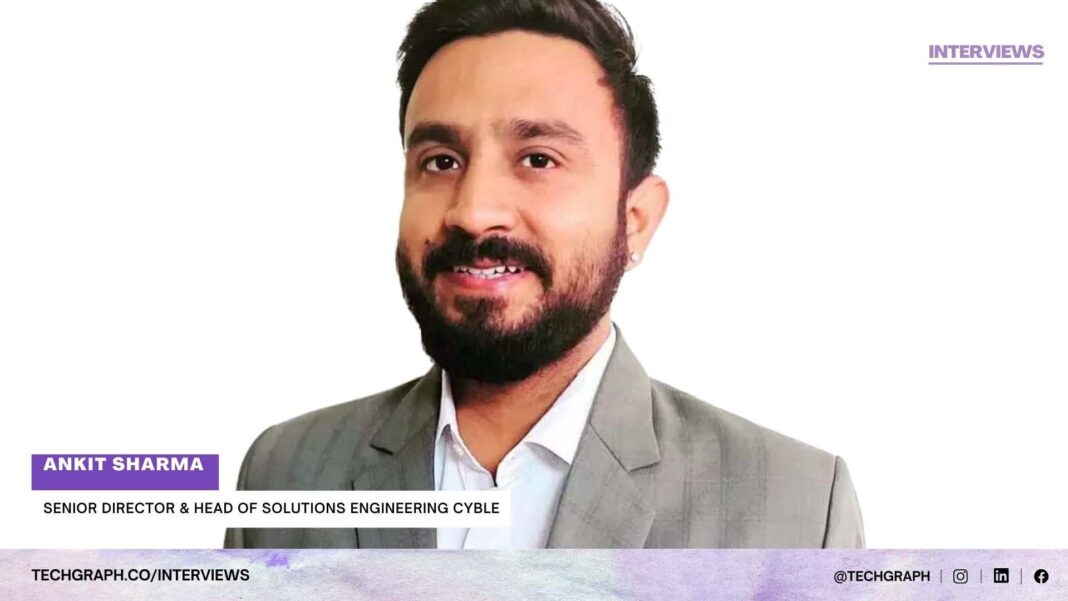
Speaking with TechGraph, Ankit Sharma, Senior Director and Head of Solutions Engineering at Cyble, discussed how security teams today face an overwhelming volume of alerts with limited visibility, and how Cyble Blaze AI addresses this by turning fragmented signals into actionable intelligence through real-time collaboration between autonomous AI agents.
He further outlined how the company’s use of predictive modeling and adversarial simulations helps anticipate attacker behavior and neutralize threats automatically, enabling security teams to move beyond signature updates and manual patching toward continuous, real-time protection across hybrid environments.

Read the interview in detail:
TechGraph: Cyble Blaze AI is described as an AI-native and multi-agent cybersecurity platform that not only detects threats but also claims to eliminate them before they escalate. What makes this platform’s architecture fundamentally different from traditional threat detection systems that rely heavily on post-event analysis?
Ankit Sharma: Cyble Blaze AI stands apart from traditional threat detection systems through its AI-native, multi-agent architecture that shifts cybersecurity from reactive detection to proactive defense. Unlike conventional tools that rely heavily on post-event analysis, rule-based alerts, and human intervention, Blaze employs Agentic AI, where autonomous agents not only detect anomalies but also collaborate, decide, and act in real time.
This multi-agent design eliminates silos by enabling specialized AI agents for threat hunting, correlation, and remediation to work together seamlessly, reducing dependency on manual SOC triage. Instead of flagging threats after damage indicators surface, Blaze leverages predictive modeling and adversarial simulations to neutralize risks at the reconnaissance or exploit stage, effectively stopping attacks before they escalate.
Its adaptive learning loop continuously evolves by integrating global threat intelligence and attempted intrusion data, ensuring it can outpace adversaries without waiting for signature or rule updates. In essence, Blaze transforms cybersecurity from a “see and report” model into an autonomous defense system capable of preemptive threat elimination.
TechGraph: Many AI-driven platforms promise speed and accuracy, yet in practice security teams still face alert fatigue and gaps in visibility. How does Blaze AI address these long-standing challenges without overwhelming security operations teams with noise?
Ankit Sharma: Blaze AI tackles the challenges of alert fatigue and visibility gaps by fundamentally rethinking how signals are processed and acted upon. Instead of generating endless low-value alerts, its multi-agent system autonomously correlates, validates, and prioritizes signals before surfacing them. Each agent is designed with a specialized role—such as detection, analysis, or remediation—and they collaborate to filter out false positives and consolidate related events into a single, actionable narrative. This ensures that security teams receive only high-fidelity insights rather than raw, noisy alerts.
Moreover, Blaze provides end-to-end visibility across attack surfaces by continuously monitoring digital assets, simulating adversarial behaviors, and mapping threat contexts in real time. By automating investigation and response at machine speed it removes much of the manual burden on SOC teams, empowering them to focus on strategic decision-making rather than drowning in repetitive triage. In doing so, Blaze replaces noise with clarity and transforms overwhelming alert volumes into precise, prioritized intelligence.
TechGraph: The concept of turning raw intelligence into measurable security outcomes suggests a direct line from detection to remediation. Can you walk us through how Blaze AI actually operationalises this in environments where legacy infrastructure, cloud workloads, and modern applications all coexist?
Ankit Sharma: Blaze AI operationalizes the transformation of raw intelligence into measurable outcomes by acting as a unifying, adaptive layer across heterogeneous environments that include legacy systems, cloud workloads, and modern applications. Instead of simply detecting anomalies, its multi-agent architecture contextualizes raw threat data, correlates it with global intelligence, and then autonomously decides the best course of action. For legacy infrastructure, Blaze agents can integrate through lightweight connectors and APIs to monitor logs, behaviors, and traffic without disrupting existing workflows, ensuring older systems are not blind spots.
In cloud and containerized environments, Blaze continuously scans for misconfigurations, privilege escalations, and lateral movement attempts, allowing agents to neutralize threats dynamically before they impact workloads. Modern applications benefit from real-time behavioral analysis, where Blaze predicts and intercepts malicious activity during runtime.
Across all layers, the platform goes beyond issuing alerts by automating key stages of the incident lifecycle—detection, validation, prioritization, and remediation—while maintaining transparency for SOC teams. This direct pipeline from intelligence to action means that regardless of the mix of infrastructure, Blaze consistently delivers measurable outcomes such as reduced dwell time, minimized attack surface exposure, and faster recovery, effectively harmonizing security operations across complex, hybrid IT ecosystems.
TechGraph: Threat actors are increasingly blending automation with human ingenuity, often making their campaigns more adaptive than the defenses set against them. How then does Blaze AI keep pace with such adversaries without falling into the same cycle of reactive patching that has plagued the industry?
Ankit Sharma: Blaze AI keeps pace with adaptive adversaries by shifting the paradigm from reactive patching to proactive, autonomous defense. Where traditional systems wait for indicators of compromise before updating rules or deploying fixes, Blaze AI’s multi-agent architecture continuously simulates adversarial behavior and stress-tests defenses in real time. Its agents operate collaboratively—some focused on hunting, others on analysis, and others on remediation—allowing the platform to anticipate attacker moves and respond before exploits gain traction.
By leveraging Agentic AI, Blaze adapts dynamically to evolving tactics, techniques, and procedures (TTPs) without waiting for human analysts to update playbooks. It integrates global threat intelligence with contextual, environment-specific insights to create a constantly evolving security posture that mirrors—and often outpaces—the adaptability of attackers.
In practice, this means Blaze doesn’t just close vulnerabilities after they are exploited; it continuously learns, predicts, and neutralizes emerging threats, ensuring organizations break free from the industry’s cycle of reactive patching.
TechGraph: For enterprises that already invest heavily in SIEMs, SOARs, and EDR tools, integration and interoperability often become stumbling blocks. How do you position Blaze AI in ecosystems that are already crowded with overlapping solutions, and what level of displacement or coexistence are you realistically seeing?
Ankit Sharma: Blaze AI is designed to complement, not conflict with, existing SIEM, SOAR, and EDR investments by acting as an intelligence and action layer that unifies these tools rather than replacing them outright. Its multi-agent architecture integrates seamlessly through APIs and connectors, enabling it to ingest signals from disparate systems, correlate them in real time, and reduce duplication by consolidating overlapping alerts into a single, prioritized storyline.
Unlike SIEMs, which aggregate logs, or SOARs, which orchestrate predefined workflows, Blaze adds autonomous decision-making and remediation—turning existing data feeds into actionable outcomes without requiring extensive reconfiguration. In many enterprises, this has meant coexistence rather than displacement, where Blaze enhances the ROI of current tools by reducing alert fatigue and accelerating response.
Over time, however, organizations do see a natural rationalization of redundant systems as Blaze demonstrates measurable reductions in mean time to detect (MTTD) and mean time to respond (MTTR). The positioning is clear: Blaze AI is not another point product but an orchestration and defense layer powered by Agentic AI, designed to maximize the value of current security investments while gradually modernizing the stack.
TechGraph: Regulators and boards now demand clear metrics to justify cybersecurity investments. Beyond technical performance, how does Blaze AI help leaders translate security posture into quantifiable business value that withstands scrutiny at the executive level?
Ankit Sharma: Blaze AI helps security leaders bridge the gap between technical defenses and business accountability by translating cybersecurity posture into quantifiable, board-ready outcomes. Instead of overwhelming executives with technical metrics like log counts or blocked alerts, Blaze AI tracks and reports on measures that directly impact enterprise resilience and financial risk. These include reductions in dwell time, faster mean time to detect (MTTD) and respond (MTTR), percentage decreases in attack surface exposure, and the volume of high-fidelity threats neutralized before escalation.
The platform also models risk in business terms, such as projected cost savings from prevented breaches, lowered regulatory exposure, and improved operational uptime. Because its multi-agent architecture automates and validates each step of the threat lifecycle, leaders gain verifiable evidence of how investments directly mitigate risk. This transparency not only supports compliance with regulatory mandates but also equips boards with a defensible ROI narrative—demonstrating that cybersecurity spend with Blaze translates into measurable business value, reduced liability, and stronger stakeholder confidence.
TechGraph: Finally, if we look three to five years ahead, where do you see AI-native multi-agent systems like Blaze AI shaping the broader cybersecurity landscape? Do you anticipate they will redefine how enterprises structure their defenses, or will they remain as augmentations to existing human-led models?
Ankit Sharma: Over the next three to five years, AI-native multi-agent systems like Blaze AI are poised to fundamentally reshape how enterprises structure their defenses. Today, most organizations still rely on human-led models, where analysts orchestrate SIEMs, SOARs, and EDRs to respond after an incident. That model simply cannot scale against adversaries blending automation, AI, and human ingenuity. Multi-agent systems introduce a new paradigm: autonomous defense ecosystems where specialized AI agents continuously collaborate to hunt, analyze, and remediate threats with minimal latency.
In the near term, these systems will act as powerful augmentations—reducing alert fatigue, accelerating response, and maximizing ROI on existing tools. But as enterprises grow more comfortable with autonomous decision-making and see tangible reductions in risk, we’ll likely see a shift in SOC structures, with human teams focusing less on manual triage and more on governance, oversight, and strategic risk management.
In effect, Blaze and platforms like it will evolve from “helpers” into the operational backbone of cyber defense, with humans guiding high-level priorities while AI-native systems handle the speed and scale of day-to-day security operations. Over time, this will redefine cybersecurity from a reactive, human-bound discipline into a proactive, AI-driven one.