


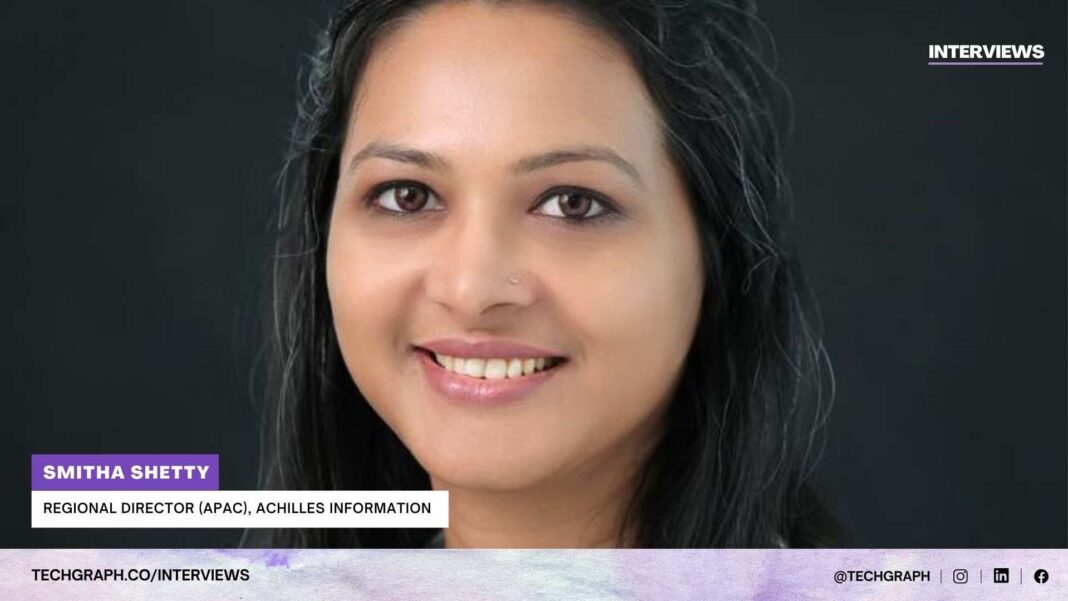
Speaking with TechGraph, Smitha Shetty, Regional Director, APAC at Achilles Information Limited, discussed how the company is helping organisations in Asia Pacific transform ESG from a reporting requirement into a strategic lever that drives efficiency, access to new markets, and stakeholder trust through verified supplier insights.
She also explained, how the company’s adaptive sustainability scoring and audit-backed verification process ensures that companies assess supplier ESG performance with accuracy and confidence, creating a foundation for measurable progress and credible sustainability outcomes.

Read the interview in detail:
TechGraph: How is Achilles enabling companies in APAC to move beyond ESG as a compliance exercise and towards ESG as a driver of long-term value in supply chains?
Smitha Shetty: At Achilles, we see ESG as an enabler of resilience and competitiveness rather than a checklist. By bringing transparency across entire value chains, we help organisations identify where ESG performance creates cost savings, operational efficiencies, and access to new markets.
For example, companies that can demonstrate responsible sourcing and lower carbon intensity are increasingly preferred by global buyers and investors. Our work in APAC focuses on translating ESG ambition into measurable supplier improvements, ensuring organisations capture long-term value while building trust with their stakeholders.
TechGraph: What methods does Achilles use to verify supplier ESG data so that buyers can trust it with confidence, especially when disclosures across this region are often inconsistent?
Smitha Shetty: At Achilles, data integrity is the foundation of our platform. Verification is not left to technology alone. We combine advanced tools with the expertise of ESG specialists who rigorously vet suppliers before they are published on our system. Each supplier undergoes a structured process that blends self-disclosures with independent checks such as desktop and onsite audits, document verification, and third-party data integration.
Suppliers are then benchmarked through the Achilles Sustainability Score, which provides a transparent and auditable measure of ESG performance across environmental, social, and governance pillars, including carbon, climate, health and safety, financial resilience, insurance, and cyber security. The scoring is adaptive, tailored to sector and geography, and updated continuously rather than on an annual cycle. This ensures organisations are working with current and reliable information in regions where reporting standards can vary widely.
With global experience in supply chain risk management, from onboarding to ongoing monitoring, we keep our criteria aligned with evolving regulations such as CSRD, BRSR, and the Modern Slavery Acts. Buyers gain a single, verified view of supplier risk, supported by live tracking of critical documents, industry-specific scoring models, and data that is both granular and comparable. This gives organisations the confidence to build resilience, protect their reputation, and meet compliance demands without blind spots.
TechGraph: Scope 3 emissions remain the biggest blind spot for most companies. Without supplier-level carbon accuracy, isn’t there a risk that ESG reports supported by Achilles overstate actual progress?
Smitha Shetty: Scope 3 emissions continue to be one of the most challenging areas for companies to measure. At Achilles, we try to address this by starting at the source, engaging suppliers directly, and collecting primary data wherever possible rather than relying only on estimates. This information is then checked and validated to strengthen its reliability.
Our long experience working with MSMEs across the region has also helped us build the right capacity to guide smaller suppliers on the type of data and documents needed. In practice, this means that the first year often serves as a benchmarking stage from which companies can begin to monitor, track, and plan meaningful carbon reduction targets.
The Achilles Carbon Management Module is designed to support this process by simplifying data collection, improving supplier engagement, and enabling reporting against recognised frameworks such as CSRD, SBTi, and CDP. It also assists companies in setting science-based targets and building stronger collaboration with suppliers to accelerate decarbonisation.
On the question of overstating progress, our aim is to reduce that risk by ensuring supplier data is validated and, where appropriate, independently assured. Carbon inventories are verified against internationally recognised standards such as ISO 14064-1, ISO 14067, PAS 2050, and Toitū. This gives organisations and their stakeholders greater confidence that reported improvements are measured, consistent, and backed by evidence.
In this way, ESG reports supported by Achilles reflect progress as it stands, helping companies to move forward on their decarbonisation journey with both clarity and credibility.
TechGraph: With growing scrutiny around greenwashing, how does Achilles help businesses demonstrate that their ESG claims are credible and not just marketing spin?
Smitha Shetty: Concerns about greenwashing have made it clear that organisations need to demonstrate substance behind their sustainability commitments. At Achilles, we believe credibility is built on evidence rather than statements alone. That is why our platform focuses on giving businesses access to supplier data that is independently validated, supported by documented audits, and traceable back to real supplier practices.
This approach helps companies show a clear connection between what they claim and what is actually happening across their supply chains. For example, when an organisation reports progress on emissions or labour standards, those claims can be supported with verified supplier data and audit findings rather than broad, unaudited declarations.
We also understand that expectations are evolving quickly, with regulators, investors, and civil society all paying closer attention to sustainability disclosures. By ensuring that information is both transparent and verifiable, we help reduce the risk of reputational harm and give stakeholders greater confidence in the accuracy of ESG reporting.
Our role is not only to provide assurance but also to enable organisations to engage more constructively with their suppliers, identify gaps, and improve performance over time. In this way, ESG reporting becomes less about meeting immediate scrutiny and more about building lasting trust, resilience, and accountability across the value chain.
TechGraph: Many small and medium suppliers in Asia face resource constraints. How is Achilles making sure that rising ESG requirements do not push them out of global supply chains?
Smitha Shetty: Small and medium-sized enterprises (SMEs) form the backbone of supply chains in Asia, yet they often have limited resources to meet increasing ESG expectations. At Achilles, our focus is on enabling inclusion rather than creating barriers. We work to make ESG requirements more accessible by offering scalable tools and practical guidance that help suppliers understand what data and documentation are needed to demonstrate their practices in a credible way.
Suppliers that are prequalified and published on our platform gain visibility with multiple buying organisations. This visibility creates opportunities to secure new business while also highlighting their competitiveness in the market. By standardising requirements and allowing suppliers to demonstrate performance once for recognition by many, Achilles helps SMEs remain active participants in global supply chains and strengthen their long-term growth prospects.
TechGraph: Looking ahead, what role do you see Achilles playing in shaping the benchmark for supply chain ESG practices in the Asia Pacific over the next five years?
Smitha Shetty: In the coming years, Achilles will continue to play a role in setting consistent and practical benchmarks for supply chain ESG across the Asia Pacific. The region is diverse, with markets at very different stages of regulatory maturity, so companies often need clarity and comparability in how ESG performance is assessed. Our platform provides that structure by combining supplier data, sustainability scoring, and independent validation, which helps organisations measure progress with confidence.
We also see our role extending beyond compliance. By fostering collaboration between buyers and suppliers, and by using technology to identify risks earlier, we help organisations not only meet requirements but also strengthen resilience and competitiveness. Over the next five years, our ambition is to shape supply chain ESG practices that are transparent, inclusive, and recognised as credible benchmarks across industries in the region.