


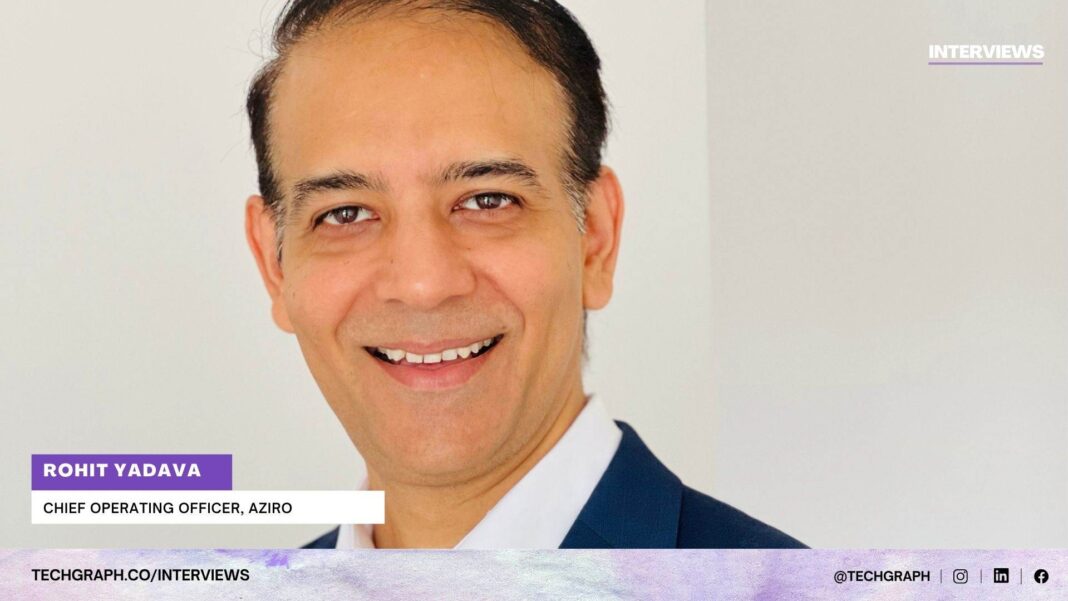
Speaking with TechGraph, Rohit Yadava, Chief Operating Officer at Aziro (Formerly MSys Technology), discussed the rise of AI-native architectures in financial services, where real-time personalization, fraud prevention, and resilient API ecosystems are opening new opportunities.
He also explained how Aziro weaves compliance and ethical AI practices directly into its engineering workflows, ensuring innovation scales responsibly across regulated industries.
Read the interview in detail:
TechGraph: Everyone wants to be seen as “AI-first,” but you use the term AI-native. From your decades in product engineering, what is the fundamental difference, and how is this shift changing the way enterprises evaluate their technology partners today?
Rohit Yadava: Good question! Most companies are today AI-first- they add AI on top of their existing processes, almost like a feature. AI-native is fundamentally different. It means AI isn’t layered on the top of existing services or products; it’s woven into the DNA of how products are conceptualized, built, deployed, and sustained.
For decades, Aziro (formerly MSys Technologies) has been recognized for our software product engineering expertise—trusted to deliver scalable, reliable, and complex systems. However, behind the scenes, we consistently strive to deliver technological excellence with the latest advancements in technology. We were building automation frameworks, cognitive infrastructure, cloud ecosystems, observability systems, and AI-native architectures, as well as vector databases and observability practices, as part of the foundation, not an afterthought.
Enterprises today aren’t just looking for vendors who can experiment with AI—they’re evaluating partners who can engineer products and platforms that think, adapt, and evolve as the business grows. And that requires a native approach, not a bolt-on one, and that’s where Aziro fits in.
TechGraph: With automation and platform rewiring central to Aziro’s work, what are the biggest hurdles you face when modernizing legacy systems for large clients, and how do you strike the balance between speed and stability in those transformations?
Rohit Yadava: The most significant challenge we face is the culture that has developed around these legacy systems. Many of these legacy platforms have been in place for decades, and clients are understandably cautious about changing what has always kept them operational.
On the technical side, we often encounter monolithic architectures, brittle integrations, and data silos that complicate modernization. So we take a dual approach. On the one hand, we introduce infrastructure automation and AI-driven accelerators and architecture to deliver quick wins, showing clients measurable outcomes early. On the other hand, we methodically re-architect the core to ensure long-term stability.
Operationally, we seek balance. If we chase speed without controls, we invite risk. If we over-index on stability, we lose momentum. Our philosophy is a two-speed model—stabilize what runs today, while simultaneously building the systems that will carry the client forward tomorrow. That’s how we transform legacy from a constraint into a launchpad for future growth.
TechGraph: Many firms now talk about embedding AI into their operations, yet the real challenge is scaling those systems across geographies and business units. What lessons has Aziro learned about sustainably scaling AI solutions?
Rohit Yadava: Before chasing scale, we believe every enterprise must earn the right to grow. That starts with clarity on the problem being solved. The company needs to find a repeatable use case that can be scaled. A repeatable use case isn’t just a proof of concept, it’s a pattern—a signal that a solution reliably delivers value across industries and stages. That’s what turns early adopters into referenceable customers, and customers into momentum. Too often, firms mistake noise for traction. Without repeatability, everything that follows—partnerships, funding, expansion—rests on shaky ground.
Technically, our approach is grounded in AI-native architecture that includes modular architectures, reusable automation frameworks, cognitive infrastructure engineering, AIOps solutions, vector databases, and observability principles. This provides business units with a shared foundation to build upon, rather than a blank slate. We also built an AI-native platform, CAWI, that helps companies scale efficiently, enabling organizations to build AI solutions on the platform for various use cases.
TechGraph: FinTech is among the sectors most disrupted by AI-driven engineering. Where do you see the most untapped opportunities for AI to reshape financial services in the near term, and which risks do you think remain underplayed in industry discussions?
Rohit Yadava: The best opportunities for AI in financial services are in creating real-time, hyper-personalized experiences at scale. From digital payments and robo-advisors to RegTech automation and fraud detection, AI is evolving financial services into intelligent, adaptive ecosystems. Where we see the most immediate impact is in building AI-native API platforms that deliver scalability, resilience, and low-latency performance, enabling enterprises to confidently launch new solutions, open new revenue streams, and expand globally.
Our recent acquisition of Gophers Lab strengthens this vision. Aziro’s expertise in FinTech, PayTech, and AI, combined with Gophers Lab’s specialization in Golang and Google Cloud, enables us to create next-generation AI-powered FinTech and API ecosystems. With Golang’s efficiency and concurrency, we can deliver secure, high-throughput systems capable of predictive fraud prevention, personalized financial recommendations, and seamless digital experiences.
However, the risks remain underplayed. Legacy systems often limit interoperability. Compliance and regulatory challenges demand not just AI adoption, but AI-driven governance. And cybersecurity must advance in lockstep, as APIs become the lifeblood of financial ecosystems. The lesson for us is clear: AI must be scaled responsibly—with repeatable use cases, strong guardrails, and a foundation of trust.”
TechGraph: Given the rising focus on responsible AI and regulatory scrutiny worldwide, how does Aziro integrate compliance and ethical considerations into the engineering process without slowing down innovation?
Rohit Yadava: At Aziro, we see responsible AI and compliance not as limitations, but as catalysts for creating trust. Companies today are seeking innovation at speed, but they also need assurance that AI systems are explainable, auditable, and compliant with global regulations. That’s why we integrate compliance directly in all our engineering processes, rather than treating them as afterthoughts.
Our AI-native frameworks are designed with governance layers—observability, model monitoring, and bias detection—built in. From data ingestion to model deployment, we use automated guardrails to track lineage, validate outputs, and flag drift. This ensures transparency without creating bottlenecks. On the regulatory side, we build configurable compliance modules into our platforms. Whether it’s the GDPR in Europe or emerging AI regulations elsewhere, our systems adapt to regional rules while maintaining a common engineering backbone. That flexibility allows us to scale responsibly across geographies.
Culturally, we drive a responsibility by design mindset with our teams—encouraging them to consider fairness, privacy, and sustainability alongside performance. The result is innovation that’s not slowed by compliance, but strengthened by it—because in highly regulated industries, trust is the ultimate accelerator.
TechGraph: DevOps has moved from enabling faster deployments to becoming an ecosystem that combines automation, observability, and AI-driven decision-making. What role do you see DevOps playing in shaping the next generation of intelligent platforms?
Rohit Yadava: DevOps is now shifting from speed to intelligence. The next generation of intelligent platforms will not be defined by how quickly code is moved to production, but by how well systems can sense, learn, and adapt in real-time. At Aziro, we’ve already reimagined DevOps as AI-powered pipelines with observability at the core.
Automation handles repetitive tasks, but observability analyzes systems and provides real-time feedback, and AI heals the process in real-time. Pipelines can self-optimize deployments, allocate resources dynamically, and even prevent failures before they occur. This approach doesn’t just deliver features faster—it provides them more reliably, securely, and at scale. They also create the foundation for compliance and resilience, because governance can be built into the same feedback loops.
TechGraph: The digital transformation space is crowded with players promising agility and scale. In such an environment, what sets apart companies that deliver long-term value from those chasing short-term momentum?
Rohit Yadava: Aziro is not a services company in the traditional sense—we’re an AI-native technology transformation company. Aziro is rooted in intelligence, autonomy, and the ability to adapt independently. We solve complex technology challenges and drive business success with AI-powered, future-ready technology solutions.
What sets us apart is our ability to drive technology transformations for global enterprises and high-growth ISVs by delivering AI-powered solutions and expert talent, enabling them to achieve market leadership. These abilities allow seamless AI integration across all facets of technology transformation.
We’re taking a three-part approach, utilizing AI to enhance customer products, refining tech processes like DevOps with AI, and helping businesses reevaluate their models through AI-based solutions and services. That gives us an edge when we design complete, AI-first, transformative solutions. We work closely with clients, not just to help them utilize AI—but to make it an integral part of how they grow, compete, and build long-term value.